

What are trading signals
Have you ever wondered if buy and sell signals in trading offer any real value for your strategy?
A trading signal is an algorithmic or AI-driven indicator that tells you exactly where the high-probability setups are on a chart. For traders whose strategy has been reliant on guesswork or left them drowning in data, signals allow trading with greater confidence in data-backed decisions.
Many traders start out expecting to will their way to success, but the marketplace is a treacherous space when armed with nothing but intuition. Signal trading tools can deliver an edge in a market where retail traders compete against high-powered market makers using sophisticated resources of their own. Here are trading signals explained for today's tech-driven trading landscape.
What is a trading algo?
An algo (algorithm) is a set of rules a computer follows to make a decision. Some algos are built to fully automate trading, from insight to execution. For algos that leave buying and selling in the hands of retail traders, a tool will surface entry signals on a live trading chart, highlighting high-probability trading setups.
The difference between signals and indicators
Think of a trading signal as a type of indicator that conveys a higher expression of intent.
If an indicator effectively distills data into a new visual distinction, like a line or a range on your trading chart,it's still entirely up to the user to interpret that data. Indicators give traders raw material to build from. That's valuable for traders who like to craft elaborate strategies, but rebuilding an underperforming strategy costs time that could be spent in the market.
This is where signals take data interpretation a step further, turning it into actionable insights. A signal is not necessarily telling a trader "you must trade right now," but it is surfacing the precise moment to make a decision based on verified data.
Algo vs AI trading: Which is better?
LLMs like ChatGPT and Claude are fundamentally algorithmic, making it difficult to distinguish between algo/AItrading. Both modes perform heavy data-lifting to simplify and speed up decision-making for traders.
The core differentiator is this: algorithms predefine exact thresholds for decision points, where as AI logic can be reinterpreted up until the moment of decision. There are advantages and drawbacks for each design.
Algo trading models process formulas instantly and interpret them using fixed rules, so systems know exactly which event will occur when certain metric thresholds are met.
- Algo upside: predictable parameters & repeatability
- Algo downside: less dynamic agility
AI trading models will actively review the logic at every stage, dynamically resetting parameters.
- AI upside: constant refresh of information
- AI downside: unverifiable, sometimes hallucinogenic logic
Signals make trading simpler
Trading has a reputation for complexity, but more screens and data matrices may not be the edge that tradersthink they are. 97% + of day traders aren't profitable, and it's likely that the elaborate strategies and modelstraders have sought to liberate them have actually made it harder to win.
In signal-centric strategies, computation happens under the hood. Each signal represents thousands of datapoints, indicating an entry opportunity. You don't have to comprehend the complexity. Instead, you get to acton the insights of the data.
The true challenge of simplicity
How do traders misuse trading signals? By overriding the data. Second-guessing confirmed entries while theseconds tick by. Chasing a signal after sitting down at your laptop three minutes too late. There are a hundredways to get it wrong. The good news is that the pattern is recognizable, and so is the way out.
Trading simplified is not trading made easy. Trading with signals is a great start to mitigate emotional trading, but universal truths still apply:
- Risk is inherent to trading: every profitable strategy comes by surviving losses and earning your way to consistency.
- Half the battle is in your mind: no algorithm can out-discipline an impatient trader who refuses to learn.
- Results are your responsibility: the market is uncaring, so make every loss a lesson, not a reason toblame.
For traders who are committed to self-discipline from day one, all that’s needed is a system on which to build a longstanding strategy.
How Jarvis helps traders
Jarvis is a sophisticated trading tool that automates the signal, not the execution. Here is what this looks like inpractice.
- Solving the complexity problem : When we were designing Jarvis, our daily question was "How can we make this even simpler?" LONG & SHORT signals are as simple as green light / red light, and by toggling timeframes, you can set these uniquely for the same symbol to fit day trading, swing trading, or investing.
- Knowing when not to trade : The most important rule in trading is this: Don’t lose money. This isn’t about finding great trades; it’s about avoiding bad ones. Every moment between Jarvis signals is a moment traders can sit out high-risk trades. Ifthere's no signal, there's no action required.
- Entry signals & exit indicators : Every signal indicates high-probability entry opportunities based on real data. These are not 100% guarantees of winning setups (no such service exists), but the logic behind them is built on a strong foundation of livemarket analysis and past price action, giving traders something real to believe in and build their strategy on.Similarly, the trailing Cloud indicator helps track exit opportunities for active positions so you can protect profitsand avoid overstaying.
Simplified trading is still trading
Signal trading is not a shortcut around the work. Algo signals change cognitive load, but they don't remove risk or responsibility. At the end of the day, all that matters is taking the right trade at the right moment, andknowing when to walk away.
Jarvis helps traders **keep emotion out of the equation** and make clearer, more decisive trades by trusting in a tool built on decades of trading experience. If you’re a trader who is committed to finding a strategy that willlast, start by putting some power behind it.
FAQ
What is a trading signal and how does it work?
A trading signal is a visual cue generated by an algorithm that highlights a high-probability entry point on a trading chart. When predefined market conditions are met, such as volume thresholds, price action, ormomentum data, the algo surfaces a LONG or SHORT tag. The trader then decides what action to take.
Are trading signals reliable?
No signal is 100% predictive, and any platform claiming otherwise should raise a flag. What reliable signals offeris data-based probability, a structured edge over emotionally-driven decisions. Signals are meant to improve consistency, not guarantee results.
What's the difference between a trading signal and an indicator?
An indicator provides data for interpretation. A signal interprets it for you, making it faster and less dependent on a trader's ability to read and respond to raw data in real time.
Can beginners use trading signals?
Yes, and in many ways, signals lower the barrier to entry. Rather than spending years developing the intuition to read charts and build day trading strategies from scratch, a beginner with a signal-based tool can learn torecognize and act on high-probability setups much faster.
Do professional traders use signals?
Many do, though the terminology varies. Institutional traders operate within highly structured rule sets,automated triggers, and defined entry criteria, which is functionally what a signal delivers. What separates professional from amateur trading is not the absence of tools, but the discipline to use them without overriding them.
More Stories
Why you can’t force success in trading (and willpower is only in your way)
Why you can’t force success in trading (and willpower is only in your way)
There is no hustle culture in trading. In fact, one of the main reasons new traders arrive overconfident and leave broke is that they won't believe this truth: You can find success in trading, but you can’t force it.
Not every session offers an edge, and treating sheer effort as a substitute for market conditions is a fast way to blow up an account. But the goal of every trading session and every tool in your setup should be the same:
Know when to trade…and when not to.
Trade expectations
“I shouldn’t have traded today.”
Every trader has experienced an afternoon like this. You’re staring at a chart full of chop, littered with executions from a morning that had nothing to offer.
The market owned you. And not just you, it owned your tools and your strategies too. Following rules didn’t matter. Neither did breaking them (as usual).
So why did this happen?
“In many people's careers, they’ve been able to create success by driving or executing an opportunity when others lacked the drive. In trading, you can’t create Jack. You must have the patience for the trade to come to you. For many, it’s the first time in their career that they could not create their own success. This is one of the most difficult lessons you must master to be a successful trader.”
- Jason Kramer, head trading trainer for Jarvis
For traders in their first year, survival begins with reshaping expectations.
Every trader starts out overestimating their own ability. Once you grasp how the market (the objective battleground) works alongside your mind (the subjective battleground), you’ll stop feeling guilty about walking away from dead trading days and start to see discernment as one of your greatest advantages.
The market owes you nothing
When trading, you participate in a market that cannot be bent to your will, doesn’t care about grit, and has no regard for your emotions, lifestyle, or family.
That statement should get your attention.
It should also dictate practical measures for approaching the market each day. When deploying a strategy like signal trading, you must stop looking for ways to make the market work for you and instead find patterns that give you an edge.
Market volatility is a prerequisite
Most strategies or tools require certain market conditions to succeed.
For retail models and signal services like Jarvis, volatility is the preeminent condition for opportunity. That means traders should be active about assessing conditions as they enter the trading day:
- What is the perceived volatility of my instrument?
- Is enough volume present in the market?
- What ATR is needed to reach the profit targets I’m aiming for?
Retail traders need price action to achieve profits. Observe these market conditions each morning, and remember, not every day will provide the volatility you need. And that’s ok.
Trading indicators are a compass, not an engine
Traders should use tools, but expecting them to do more than they’re built for may leave you frustrated with something that actually works—just not the way you hoped for.
You added the tool because you understand its power, but you also have to understand its limits. Imagine a sailor frustrated at his compass for not making a storm die down.
Tools help you navigate the market, not control it. And there will never be a tool put in the hands of retail traders that creates or controls market conditions.
Opportunity dependability vs predictability
The market doesn’t distribute opportunity in equal or predictable portions, and many traders miss their biggest opportunities simply by not being at their screens when the best action is available.
Think in day trading terms. If a month holds 20-22 trading sessions, institutional volume naturally concentrates around major economic catalysts and earnings windows. Volatility clustering suggests we should expect 15 days of modest or flat price action, punctuated by 4-6 breakout days. Retail traders don’t get to know when those will occur, but the frequency is reliable. This concept translates to other timeframes as well.
To succeed as a trader, you must be available more than you expect to be active. Since you can’t force profit when the market is flat, strategic patience is required to keep you available for the conditions you rely on.
3 surprisingly self-destructive trading traits
Now, what about the battleground inside our own mind?
Every trader has toxic traits that hinder balanced decision-making. Who hasn’t executed a trade and instantly thought “I know better than that…”
So what traits lead us to engage in markets that offer little to nothing?
Stubbornness
Stubbornness is poison for traders, and we’re tempted to name it something more noble, like grit. In reality, traders only do this to mask the fact that the problem with your trades is you.
Knowing when to walk away is a skill in trading. That skill is the difference between traders who are marks attracted to casino culture and those who prefer to play when the odds are in their favor.
Sometimes a chart is telling you “not today.”
Let it. And live to play another hand.
[How overtrading destroys accounts.]
Boredom
Boredom seems like a ridiculous reason to lose money. But it’s probably one of the more prevalent emotions involved in losses.
Many traders crave action and action without an edge can feel better than no action at all.
- Brett Steenbarger, Ph.D.
Anyone who can’t handle boredom doesn’t belong in trading. If an hour of watching bar-coding on your favorite ETF leaves you thinking “time to make something happen”, your account is on its way to zero.
Optimism
If your strategy is working, you will see it in your P&L, which is easy to track. You’ll also see it in your win/loss trade percentage, which requires deliberate tracking.
It’s easy to be an active, optimistic trader who doesn’t even realize you’re winning only 38% of your trades. But if you’re trading with capital, you can’t afford to lose your bearing like this.
Track your results, and you’ll see that there are simply days you shouldn’t be trading.
How expert traders handle flat days
Amateur traders look at a flat chart and see a puzzle they need to solve. Experts look at the same chart and recognize they have no statistical edge.
Sometimes the only winning move is stepping aside.
Here are a few ways to practice acceptance on the days when restraint means more than cunning:
Assess the weather
You have indicators of what the trading day will hold, so build your morning routine around assessing the horizon. Premarket range, ATR, and perceived volatility are all measurements at your disposal.
Your goal is to find trading days that set your strategy up for success. If you can see a storm coming, don’t leave the shore.
Reset your bearing
Treat sitting in cash as an active position. It’s a candlestick you can stare at for hours, knowing with certainty that you’re not losing capital.
In flat markets, your goal should shift from “finding the perfect entry” to “protecting your cash”. If that means walking away for the day, so be it.
Ready strategies for ready markets
Successful traders build their strategy on tools.
As we’ve expressed above, Jarvis is not a tool that will change the market for days that offer nothing to traders. But when the market starts to roll, you’ll be glad you were ready with more than a gut feeling.
Read more about how Jarvis signals work, and when you’re ready to check them out on your own chart, your first 30 days are on the house.
Conclusion
There’s a lot more pride involved in trading than we’d like to admit, but at the end of the day this isn’t an esteem game. We trade to make money, and ignoring the market and our own internal narrative only makes that harder.
Next time you’re staring at a chart with insufficient volatility and low volume, ask yourself this: Is the market actually offering an opportunity today? If the answer is no, you can either shut down your station or spend hours at it, giving your money away.
Protecting your capital is not admitting defeat. (The market-makers would love it if you believed that.) Know when not to trade. Take a day for yourself. And come back tomorrow, because it’ll be a whole new day.
Why you can’t force success in trading (and willpower is only in your way)
There is no hustle culture in trading. In fact, one of the main reasons new traders arrive overconfident and leave broke is that they won't believe this truth: You can find success in trading, but you can’t force it.
Not every session offers an edge, and treating sheer effort as a substitute for market conditions is a fast way to blow up an account. But the goal of every trading session and every tool in your setup should be the same:
Know when to trade…and when not to.
Trade expectations
“I shouldn’t have traded today.”
Every trader has experienced an afternoon like this. You’re staring at a chart full of chop, littered with executions from a morning that had nothing to offer.
The market owned you. And not just you, it owned your tools and your strategies too. Following rules didn’t matter. Neither did breaking them (as usual).
So why did this happen?
“In many people's careers, they’ve been able to create success by driving or executing an opportunity when others lacked the drive. In trading, you can’t create Jack. You must have the patience for the trade to come to you. For many, it’s the first time in their career that they could not create their own success. This is one of the most difficult lessons you must master to be a successful trader.”
- Jason Kramer, head trading trainer for Jarvis
For traders in their first year, survival begins with reshaping expectations.
Every trader starts out overestimating their own ability. Once you grasp how the market (the objective battleground) works alongside your mind (the subjective battleground), you’ll stop feeling guilty about walking away from dead trading days and start to see discernment as one of your greatest advantages.
The market owes you nothing
When trading, you participate in a market that cannot be bent to your will, doesn’t care about grit, and has no regard for your emotions, lifestyle, or family.
That statement should get your attention.
It should also dictate practical measures for approaching the market each day. When deploying a strategy like signal trading, you must stop looking for ways to make the market work for you and instead find patterns that give you an edge.
Market volatility is a prerequisite
Most strategies or tools require certain market conditions to succeed.
For retail models and signal services like Jarvis, volatility is the preeminent condition for opportunity. That means traders should be active about assessing conditions as they enter the trading day:
- What is the perceived volatility of my instrument?
- Is enough volume present in the market?
- What ATR is needed to reach the profit targets I’m aiming for?
Retail traders need price action to achieve profits. Observe these market conditions each morning, and remember, not every day will provide the volatility you need. And that’s ok.
Trading indicators are a compass, not an engine
Traders should use tools, but expecting them to do more than they’re built for may leave you frustrated with something that actually works—just not the way you hoped for.
You added the tool because you understand its power, but you also have to understand its limits. Imagine a sailor frustrated at his compass for not making a storm die down.
Tools help you navigate the market, not control it. And there will never be a tool put in the hands of retail traders that creates or controls market conditions.
Opportunity dependability vs predictability
The market doesn’t distribute opportunity in equal or predictable portions, and many traders miss their biggest opportunities simply by not being at their screens when the best action is available.
Think in day trading terms. If a month holds 20-22 trading sessions, institutional volume naturally concentrates around major economic catalysts and earnings windows. Volatility clustering suggests we should expect 15 days of modest or flat price action, punctuated by 4-6 breakout days. Retail traders don’t get to know when those will occur, but the frequency is reliable. This concept translates to other timeframes as well.
To succeed as a trader, you must be available more than you expect to be active. Since you can’t force profit when the market is flat, strategic patience is required to keep you available for the conditions you rely on.
3 surprisingly self-destructive trading traits
Now, what about the battleground inside our own mind?
Every trader has toxic traits that hinder balanced decision-making. Who hasn’t executed a trade and instantly thought “I know better than that…”
So what traits lead us to engage in markets that offer little to nothing?
Stubbornness
Stubbornness is poison for traders, and we’re tempted to name it something more noble, like grit. In reality, traders only do this to mask the fact that the problem with your trades is you.
Knowing when to walk away is a skill in trading. That skill is the difference between traders who are marks attracted to casino culture and those who prefer to play when the odds are in their favor.
Sometimes a chart is telling you “not today.”
Let it. And live to play another hand.
[How overtrading destroys accounts.]
Boredom
Boredom seems like a ridiculous reason to lose money. But it’s probably one of the more prevalent emotions involved in losses.
Many traders crave action and action without an edge can feel better than no action at all.
- Brett Steenbarger, Ph.D.
Anyone who can’t handle boredom doesn’t belong in trading. If an hour of watching bar-coding on your favorite ETF leaves you thinking “time to make something happen”, your account is on its way to zero.
Optimism
If your strategy is working, you will see it in your P&L, which is easy to track. You’ll also see it in your win/loss trade percentage, which requires deliberate tracking.
It’s easy to be an active, optimistic trader who doesn’t even realize you’re winning only 38% of your trades. But if you’re trading with capital, you can’t afford to lose your bearing like this.
Track your results, and you’ll see that there are simply days you shouldn’t be trading.
How expert traders handle flat days
Amateur traders look at a flat chart and see a puzzle they need to solve. Experts look at the same chart and recognize they have no statistical edge.
Sometimes the only winning move is stepping aside.
Here are a few ways to practice acceptance on the days when restraint means more than cunning:
Assess the weather
You have indicators of what the trading day will hold, so build your morning routine around assessing the horizon. Premarket range, ATR, and perceived volatility are all measurements at your disposal.
Your goal is to find trading days that set your strategy up for success. If you can see a storm coming, don’t leave the shore.
Reset your bearing
Treat sitting in cash as an active position. It’s a candlestick you can stare at for hours, knowing with certainty that you’re not losing capital.
In flat markets, your goal should shift from “finding the perfect entry” to “protecting your cash”. If that means walking away for the day, so be it.
Ready strategies for ready markets
Successful traders build their strategy on tools.
As we’ve expressed above, Jarvis is not a tool that will change the market for days that offer nothing to traders. But when the market starts to roll, you’ll be glad you were ready with more than a gut feeling.
Read more about how Jarvis signals work, and when you’re ready to check them out on your own chart, your first 30 days are on the house.
Conclusion
There’s a lot more pride involved in trading than we’d like to admit, but at the end of the day this isn’t an esteem game. We trade to make money, and ignoring the market and our own internal narrative only makes that harder.
Next time you’re staring at a chart with insufficient volatility and low volume, ask yourself this: Is the market actually offering an opportunity today? If the answer is no, you can either shut down your station or spend hours at it, giving your money away.
Protecting your capital is not admitting defeat. (The market-makers would love it if you believed that.) Know when not to trade. Take a day for yourself. And come back tomorrow, because it’ll be a whole new day.
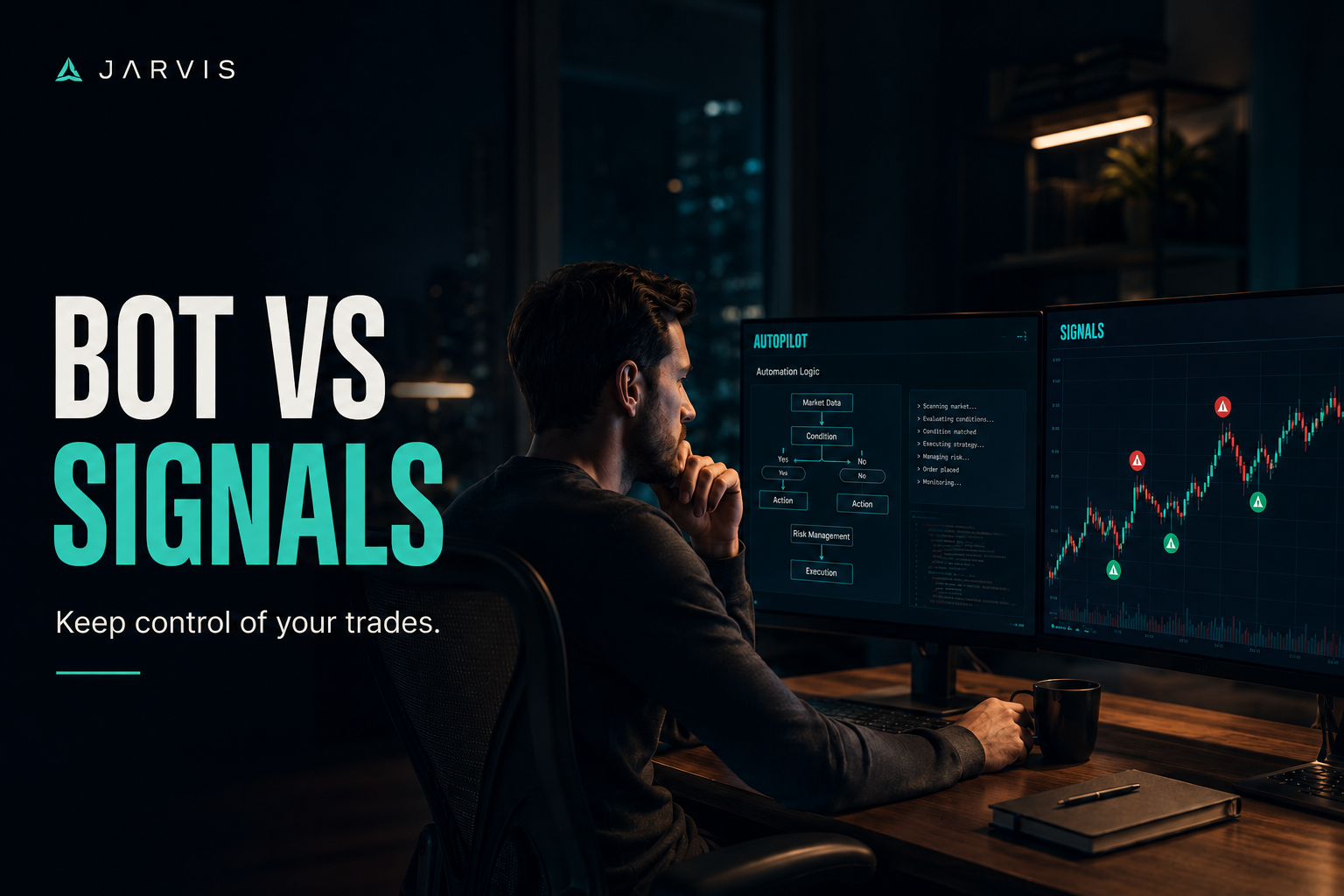
Trading bot vs signals: Should you give up control of your trades?
Trading bot vs signals: Should you give up control of your trades?
“Can I get a bot to trade for me?”
Before AI ever went mainstream, this question was already on every trader’s mind. Finding the right answer comes down to two things: whether fully automated trading bots are effective, and whether traders should hand over that kind of control in the first place.
Let’s examine the trade-offs between trading bots and real-time signals, examine where automation exposes traders the most, and show how traders can leverage algorithmic speed without giving up control of your trades.
How to tell a trading signal from a bot
Every trader uses tools to navigate the market, and the functions of trading tools fit into a few categorical buckets:
- Information: feeds and market data
- Education: trading guidance and disciplines
- Analysis: indicators and visual signals
- Execution: order placement and brokers
- Automation: trade execution by bots
Signals and bots are both built on algorithmic rule sets that determine their actions. The distinction between them comes down to who executes the trades.
Signal services analyze historic and live data giving traders real-time visual context for discretionary execution.
Trading bots take that analysis a step further, routing orders directly to a brokerage based on preset conditional logic.
Who are trading bots best for?
Experienced traders know that the greatest danger to your capital is often your own emotions. Fear, greed, and panic can disrupt strategies and derail a trader’s day before it even begins.
It’s easy to see the appeal, then, of an automated trading platform that is truly unemotional, both in analysis and execution.
In fact, all of this happens without the trader having to sit staring at a screen or managing active positions. The time-investment comes on the front end, fine-tuning your bot’s dials for backtesting and eventually live trading.
Because of this, trading bots are best suited for traders with a strong grasp of technical indicators like RSI and MACD, understand performance metrics like maximum drawdown, and want to apply their trading logic without spending all day on the screen.
All of this upside would be incredible for most traders if there weren’t risks attached to it. So what’s the catch?
Weighing automated trading risk
Automated trading features can feel more like hypothesis than reality once you’ve put real capital behind the bots you’ve built. It doesn’t take a human sitting at the station for errors to compromise a trading strategy, or for you to feel a knot of dread your stomach knowing that your capital is on the line.
Traders should weigh out a few things before putting a bot behind the wheel of their brokerage account:
API permission risks
Bots require full API execution access to your brokerage account. This means an automation has full permission to lose your capital, and all the liability rests on you.
Logic errors & parameter drift
Unemotional bots continuously execute orders that fulfill its instructions even when market regimes shift, or tuning mistakes trigger avoidable losses. A bot has no judgment to shut off the valve without human intervention.
Complexity & skill barrier
Setting effective parameters requires experienced knowledge of market microstructure. Bots can amplify financial risks to unimaginable proportions in the hands of the unprepared.
No promised results
There is no trading tool that can guarantee success. For the novices looking for a solution to trade profitably without experience or involvement, automation is not the answer. Market makers have more sophisticated tools than you can imagine. Yes, that includes your Claude vibe-trader.
None of this means that automated trading can’t work. Like any other form of trading, bots have their pros and cons. There is simply a reality of time investment, expertise, and risk that automated AI trading services can’t eliminate.
How to use signals without losing control of your trades
You don’t need to hand over control of your account to benefit from algorithmic speed.
Many traders appreciate the mathematical automation offered by AI trading bots, but want the final say in their trades. Trading signal suites like Jarvis are perfect for traders seeking this intersection of algo logic and human control.
Jarvis: for trader enhancement, not replacement
Instead of connecting to your brokerage and executing trades on your behalf, Jarvis focuses on distilling complex market data into the simplest format to help you make trading decisions in the moment.
Long & short signals can be fitted to any symbol or timeframe for day trading, investing, crypto, and more. Every signal you see is a real-time indicator surfacing entry opportunities for your selected asset and trading style.
Single screen trading reduces visual noise to prevent the information overload that leads to hesitation or overtrading. Jarvis works side-by side with your brokerage.
Manually execute trades only on the signals you feel totally confident about. The Jarvis algorithm is hard at work 24/7 to find the best entries. Acting on them is 100% your choice.
Is automated trading right for you?
For traders with a knack for experimentation, automated trading offers limitless options. New services emerge weekly, offering nearly infinite automation configurations. Just be careful not to be swept up in overpromised results, remembering that anything in trading that seems too good to be true, probably is.
And if you feel like you’re the only one who thinks maybe automated trading isn’t really the future of trading–at least not yet–know that you’re not alone. Human intuition will always play a role, because at the end of the trading day, no one has to answer for your results…except you.
FAQ
Q: Does Jarvis place trades for you automatically?
No. Jarvis is a visual trading tool that distills live information into simple signals that traders then use to execute trades within their own brokerage account.
Q: What’s the difference between a trading signal and a trading bot?
A trading signal is a single-moment indicator that highlights potential market setups for manual execution. A trading bot is an automated script that routes orders according to a predefined set of rules.
Q: Do I need experience to use Jarvis if it doesn’t trade for me?
Jarvis is quick to learn, and most users show strong comprehension after a week of participating in our live stream. It’s also important that you know your way around your brokerage platform, understanding exactly how to enter, exit, and size your trades for the correct instruments. That is where your capital is at stake and it’s important that you know how to use it.
Trading bot vs signals: Should you give up control of your trades?
“Can I get a bot to trade for me?”
Before AI ever went mainstream, this question was already on every trader’s mind. Finding the right answer comes down to two things: whether fully automated trading bots are effective, and whether traders should hand over that kind of control in the first place.
Let’s examine the trade-offs between trading bots and real-time signals, examine where automation exposes traders the most, and show how traders can leverage algorithmic speed without giving up control of your trades.
How to tell a trading signal from a bot
Every trader uses tools to navigate the market, and the functions of trading tools fit into a few categorical buckets:
- Information: feeds and market data
- Education: trading guidance and disciplines
- Analysis: indicators and visual signals
- Execution: order placement and brokers
- Automation: trade execution by bots
Signals and bots are both built on algorithmic rule sets that determine their actions. The distinction between them comes down to who executes the trades.
Signal services analyze historic and live data giving traders real-time visual context for discretionary execution.
Trading bots take that analysis a step further, routing orders directly to a brokerage based on preset conditional logic.
Who are trading bots best for?
Experienced traders know that the greatest danger to your capital is often your own emotions. Fear, greed, and panic can disrupt strategies and derail a trader’s day before it even begins.
It’s easy to see the appeal, then, of an automated trading platform that is truly unemotional, both in analysis and execution.
In fact, all of this happens without the trader having to sit staring at a screen or managing active positions. The time-investment comes on the front end, fine-tuning your bot’s dials for backtesting and eventually live trading.
Because of this, trading bots are best suited for traders with a strong grasp of technical indicators like RSI and MACD, understand performance metrics like maximum drawdown, and want to apply their trading logic without spending all day on the screen.
All of this upside would be incredible for most traders if there weren’t risks attached to it. So what’s the catch?
Weighing automated trading risk
Automated trading features can feel more like hypothesis than reality once you’ve put real capital behind the bots you’ve built. It doesn’t take a human sitting at the station for errors to compromise a trading strategy, or for you to feel a knot of dread your stomach knowing that your capital is on the line.
Traders should weigh out a few things before putting a bot behind the wheel of their brokerage account:
API permission risks
Bots require full API execution access to your brokerage account. This means an automation has full permission to lose your capital, and all the liability rests on you.
Logic errors & parameter drift
Unemotional bots continuously execute orders that fulfill its instructions even when market regimes shift, or tuning mistakes trigger avoidable losses. A bot has no judgment to shut off the valve without human intervention.
Complexity & skill barrier
Setting effective parameters requires experienced knowledge of market microstructure. Bots can amplify financial risks to unimaginable proportions in the hands of the unprepared.
No promised results
There is no trading tool that can guarantee success. For the novices looking for a solution to trade profitably without experience or involvement, automation is not the answer. Market makers have more sophisticated tools than you can imagine. Yes, that includes your Claude vibe-trader.
None of this means that automated trading can’t work. Like any other form of trading, bots have their pros and cons. There is simply a reality of time investment, expertise, and risk that automated AI trading services can’t eliminate.
How to use signals without losing control of your trades
You don’t need to hand over control of your account to benefit from algorithmic speed.
Many traders appreciate the mathematical automation offered by AI trading bots, but want the final say in their trades. Trading signal suites like Jarvis are perfect for traders seeking this intersection of algo logic and human control.
Jarvis: for trader enhancement, not replacement
Instead of connecting to your brokerage and executing trades on your behalf, Jarvis focuses on distilling complex market data into the simplest format to help you make trading decisions in the moment.
Long & short signals can be fitted to any symbol or timeframe for day trading, investing, crypto, and more. Every signal you see is a real-time indicator surfacing entry opportunities for your selected asset and trading style.
Single screen trading reduces visual noise to prevent the information overload that leads to hesitation or overtrading. Jarvis works side-by side with your brokerage.
Manually execute trades only on the signals you feel totally confident about. The Jarvis algorithm is hard at work 24/7 to find the best entries. Acting on them is 100% your choice.
Is automated trading right for you?
For traders with a knack for experimentation, automated trading offers limitless options. New services emerge weekly, offering nearly infinite automation configurations. Just be careful not to be swept up in overpromised results, remembering that anything in trading that seems too good to be true, probably is.
And if you feel like you’re the only one who thinks maybe automated trading isn’t really the future of trading–at least not yet–know that you’re not alone. Human intuition will always play a role, because at the end of the trading day, no one has to answer for your results…except you.
FAQ
Q: Does Jarvis place trades for you automatically?
No. Jarvis is a visual trading tool that distills live information into simple signals that traders then use to execute trades within their own brokerage account.
Q: What’s the difference between a trading signal and a trading bot?
A trading signal is a single-moment indicator that highlights potential market setups for manual execution. A trading bot is an automated script that routes orders according to a predefined set of rules.
Q: Do I need experience to use Jarvis if it doesn’t trade for me?
Jarvis is quick to learn, and most users show strong comprehension after a week of participating in our live stream. It’s also important that you know your way around your brokerage platform, understanding exactly how to enter, exit, and size your trades for the correct instruments. That is where your capital is at stake and it’s important that you know how to use it.