Know When
To Trade
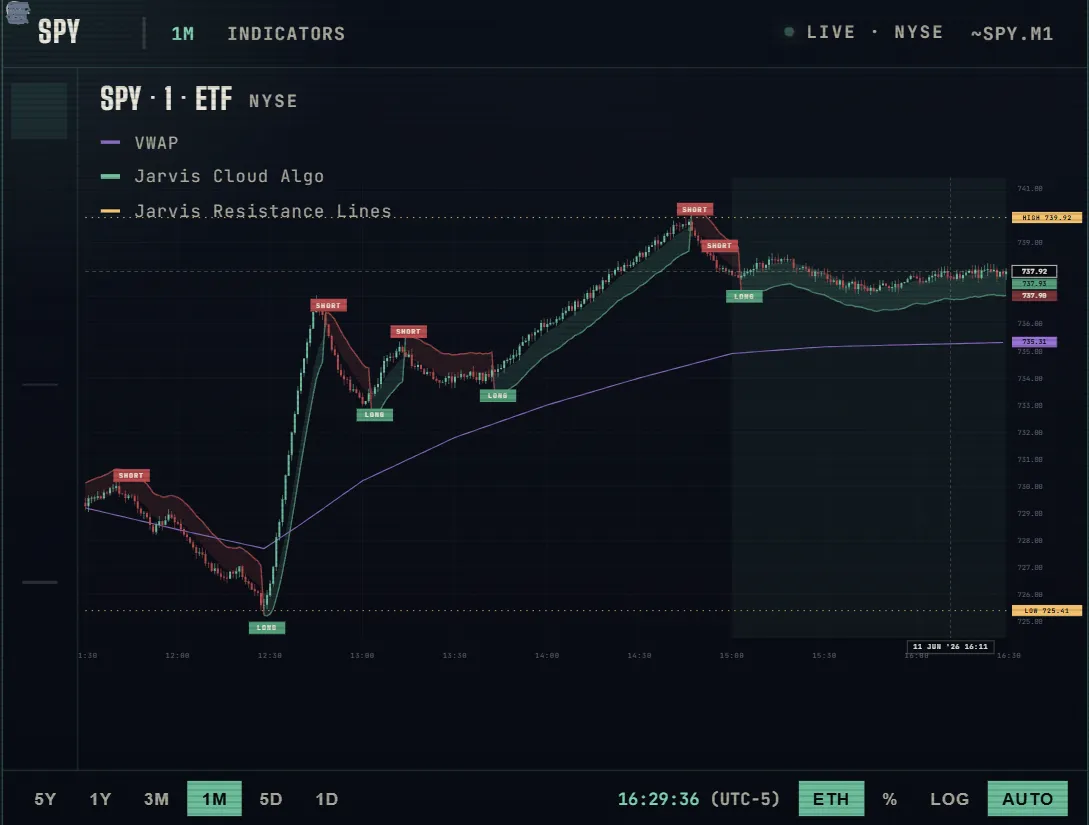
This Is What Trading Clarity Looks Like
Does it feel like your trading strategy is always this close to breaking through?
- Entering the right trades with the wrong timing
- Breaking your own rules with emotional trading
- Strategies that work for them, not for you
- Hours of multi-monitor anxiety
The answer isn’t more effort, it’s less complexity. Jarvis keeps trading simple.One screen. One tool. One signal.
Trading Doesn’t Have to Be Complicated
In 2026 you don’t need 30 years of trading experience to know when to trade. Pair Jarvis with your favorite brokerage and trade on signals you can trust.
- Options - Out-trade the experts with daily live-stream guidance.
- Stocks - Invest at the optimal moment for maximum returns.
- Futures - Master the art of day, swing, position, & hedge trading.
Jarvis is an algorithmic signal software that tells you exactly when to enter and exit a trade — in real time.
By analyzing volume, volatility, momentum, and probability simultaneously, Jarvis generates a single clear signal — Long or Short — so you spend less time guessing and more time executing. It doesn't touch your brokerage, it doesn't execute trades, and it doesn't replace your judgment. It just tells you when the setup is right.
Go long. Go short.
No worries.
#FearNoTrade
join the revolution
Our traders are everyday people who are taking back the market from trading elites and hedge funds. Together with Jarvis, traders are proving that overcomplicated strategies are no longer the path to profitability. Are you ready for a change?
RANDY F.
“Jarvis gives me exactly wanted I was looking for. A simple confirmation to enter and exit a trade for consistent profits.”
BRENAN k.
Pricing
Traders need tools that can prove their value. Try Jarvis FREE for 30 days and see the difference for yourself.
Your Trading Community Is Here
Our network of traders speak the same language and help each others master our mindset as we trade with the same powerful tools.
Learn more- Master Jarvis in just a few days
- Kick back with day trading mods on daily live stream
- Meet friends & mentors with a shared passion for trading

Knowledge Is Power
Smart traders make even smarter decisions using Jarvis. Here are some resources to guide you along your trading journey.

Crypto Just Landed on Jarvis. Here's Why That Changes Everything.
You've been trading crypto the hard way.
Watching five charts at once at 2 AM. Chasing the pump. Panic-selling the dip. Refreshing Twitter to see if some anonymous account with a laser-eye profile picture knows something you don't.
And every time you swear you'll be more disciplined next time — until the next candle moves and you're right back in the chaos.
Here's the thing: it's not your fault. Crypto has always been a market without guardrails. No closing bell. No circuit breakers. No structure. Just 24 hours of noise dressed up as opportunity, with your emotions invited to every single session.
That ends today.
Jarvis now supports crypto trading.
Why Crypto Traders Are the Most Emotionally Exposed Traders Alive
Options traders deal with time decay. Stock traders deal with earnings surprises. Crypto traders deal with all of it — plus a market that never closes, moves that happen while you're asleep, and a culture that rewards the loudest voice, not the most disciplined one.
The psychological warfare is non-stop.
You see Bitcoin climb 8% overnight and feel like you missed it. So you buy in at the top of the move. It retraces. You hold because you "believe in it." It drops another 12%. Now you're not trading anymore — you're coping.
Or you catch a real move. A clean 200% run on an altcoin. And instead of taking profit, you let greed whisper that this one's going to 500%. Then 1000%. Then it halves in four hours and you're back to flat.
Sound familiar?
This is the enemy inside every crypto trade. And it's the same enemy Jarvis was built to defeat.
What Jarvis Actually Does to a Crypto Chart
Jarvis doesn't add noise. It removes it.
Under the hood, Jarvis synthesizes the indicators that serious traders use — momentum signals, volume patterns, trend confirmation — and distills everything down to one thing on your screen: a signal telling you when to enter, and when to get out.
No Discord calls to verify. No influencer to follow. No gut feeling to second-guess.
You'll see a Long tag form. You enter. You'll see the signal break. You exit.
That's it. That's the whole game.
The traders who consistently profit aren't the ones with the most screens or the most conviction. They're the ones who follow a repeatable process and let it do its job — trade after trade, without interference.
Jarvis gives crypto traders that process for the first time.
The 24/7 Market Problem — Finally Solved
Here's what makes crypto uniquely brutal: the market never closes. Which means your temptation never closes either.
3 AM move? You're awake for it. Weekend pump? You're watching. Sunday night crash? You're in it.
Traditional traders get a break. They go home. The market closes. The psychological pressure resets. Crypto traders don't get that. And without a structured signal telling them when to actually act, they're always one sleepless trade away from a bad decision.
Jarvis changes the relationship you have with the clock. Instead of watching every candle waiting for something to happen, you wait for a signal. And when there's no signal, there's no trade. You close the screen. You live your life.
That is not a limitation. That is the strategy.
If You've Never Heard of Jarvis, Here's What You Need to Know
Jarvis was built by two traders who spent decades doing it the hard way — developing the intuition, logging the losses, building the process through years of trial and expensive error.
Then they asked a different question: What if you didn't have to?
What took them decades, Jarvis compresses into a single screen with clear signals. Options traders who found Jarvis reported understanding the system within a week of watching the live stream. Not months. Not years. A week.
The same system is now live for crypto.
If you've been trading crypto on instinct — or worse, on someone else's instinct — you now have something better. A proven signal framework built for the exact chaos that crypto throws at you.
The Market Doesn't Care About Your Conviction
This is the hardest truth in crypto, and almost nobody says it.
Your belief in a project doesn't protect your trade. Your research doesn't guarantee a return. The whitepaper you read, the community you trust, the influencer you follow — none of it moves the chart in your favor.
What moves the chart is price action. And what protects your account is the discipline to follow a signal instead of a story.
Crypto has always been a market that rewards storytelling. Jarvis is a tool built for traders, not believers. And for the first time, crypto traders can trade it that way.
Execute Clean. Take Profit. Be Content.
The same three-part equation that works in options works in crypto.
Execute Clean — Wait for the signal. Don't enter on a hunch, a feeling, or a fear of missing out. If there's no tag, there's no trade.
Take Profit — Exit when Jarvis tells you to exit. Not when you've calculated a bigger number in your head. Not after you've convinced yourself the move has more room. When the signal breaks, you step out.
Be Content — A 60% winner that you actually captured is worth more than a 400% winner you watched reverse in your account. The discipline to take what the market gives you — consistently, without interference — is what builds accounts over time.
Crypto traders have never had a system designed to protect them from themselves. Now they do.
This Is Your On-Ramp
If you've been grinding crypto charts without a signal framework, you already know what it costs. The missed exits. The emotional holds. The "I should have known" moments at 3 AM.
You don't have to know. You couldn't have known. But now you have something that does.
Jarvis is free for your first 30 days. Come watch the live stream, see the signals form in real time, and find out what it feels like to trade with structure in a market that has never offered any.
[Start your free 30-day trial →]
The crypto market is open right now. The question is: are you trading it, or is it trading you?
Trade examples are hypothetical and applied retroactively to demonstrate the Jarvis strategy. Trades were not executed in a live account. Results are based on exact signal execution and do not account for liquidity, slippage, or fees.
Frequently Asked Questions
Does Jarvis work for crypto the same way it works for stocks and options?
Yes. The same signal framework — Long/Short tags triggered by real-time indicator synthesis — now applies to crypto markets. You follow the tag, you exit when the signal breaks, and you stay out when there's no signal to follow.
Can I use Jarvis for crypto if I've never traded stocks or options?
Absolutely. Jarvis was built to eliminate the learning curve, not extend it. Crypto traders who come to Jarvis without any background in traditional trading can learn the system within a week of live-stream participation. You're not learning indicators — you're learning to follow a signal.
Crypto runs 24/7. How does Jarvis handle that?
Jarvis gives you structure inside the chaos. Instead of watching every candle and reacting to every move, you wait for a signal. No signal, no trade. This protects you from the biggest risk in 24/7 markets: the temptation to always be doing something.
What's the biggest mistake crypto traders make that Jarvis helps prevent?
Emotional overrides. Entering without a signal. Holding through a reversal because you "believe" in the move. These are the decisions that vaporize accounts. Jarvis takes the decision-making away from your emotions and gives it back to a system.
Is crypto on Jarvis available with the free trial?
Yes. Your first 30 days are free. That includes crypto signals, the live stream, and the full Jarvis interface — everything you need to see whether this changes the way you trade.
The information and trading signals provided on this site are for educational and informational purposes only and do not constitute financial, investment, or trading advice. Past performance is not indicative of future results. All trading involves substantial risk of loss.
You've been trading crypto the hard way.
Watching five charts at once at 2 AM. Chasing the pump. Panic-selling the dip. Refreshing Twitter to see if some anonymous account with a laser-eye profile picture knows something you don't.
And every time you swear you'll be more disciplined next time — until the next candle moves and you're right back in the chaos.
Here's the thing: it's not your fault. Crypto has always been a market without guardrails. No closing bell. No circuit breakers. No structure. Just 24 hours of noise dressed up as opportunity, with your emotions invited to every single session.
That ends today.
Jarvis now supports crypto trading.
Why Crypto Traders Are the Most Emotionally Exposed Traders Alive
Options traders deal with time decay. Stock traders deal with earnings surprises. Crypto traders deal with all of it — plus a market that never closes, moves that happen while you're asleep, and a culture that rewards the loudest voice, not the most disciplined one.
The psychological warfare is non-stop.
You see Bitcoin climb 8% overnight and feel like you missed it. So you buy in at the top of the move. It retraces. You hold because you "believe in it." It drops another 12%. Now you're not trading anymore — you're coping.
Or you catch a real move. A clean 200% run on an altcoin. And instead of taking profit, you let greed whisper that this one's going to 500%. Then 1000%. Then it halves in four hours and you're back to flat.
Sound familiar?
This is the enemy inside every crypto trade. And it's the same enemy Jarvis was built to defeat.
What Jarvis Actually Does to a Crypto Chart
Jarvis doesn't add noise. It removes it.
Under the hood, Jarvis synthesizes the indicators that serious traders use — momentum signals, volume patterns, trend confirmation — and distills everything down to one thing on your screen: a signal telling you when to enter, and when to get out.
No Discord calls to verify. No influencer to follow. No gut feeling to second-guess.
You'll see a Long tag form. You enter. You'll see the signal break. You exit.
That's it. That's the whole game.
The traders who consistently profit aren't the ones with the most screens or the most conviction. They're the ones who follow a repeatable process and let it do its job — trade after trade, without interference.
Jarvis gives crypto traders that process for the first time.
The 24/7 Market Problem — Finally Solved
Here's what makes crypto uniquely brutal: the market never closes. Which means your temptation never closes either.
3 AM move? You're awake for it. Weekend pump? You're watching. Sunday night crash? You're in it.
Traditional traders get a break. They go home. The market closes. The psychological pressure resets. Crypto traders don't get that. And without a structured signal telling them when to actually act, they're always one sleepless trade away from a bad decision.
Jarvis changes the relationship you have with the clock. Instead of watching every candle waiting for something to happen, you wait for a signal. And when there's no signal, there's no trade. You close the screen. You live your life.
That is not a limitation. That is the strategy.
If You've Never Heard of Jarvis, Here's What You Need to Know
Jarvis was built by two traders who spent decades doing it the hard way — developing the intuition, logging the losses, building the process through years of trial and expensive error.
Then they asked a different question: What if you didn't have to?
What took them decades, Jarvis compresses into a single screen with clear signals. Options traders who found Jarvis reported understanding the system within a week of watching the live stream. Not months. Not years. A week.
The same system is now live for crypto.
If you've been trading crypto on instinct — or worse, on someone else's instinct — you now have something better. A proven signal framework built for the exact chaos that crypto throws at you.
The Market Doesn't Care About Your Conviction
This is the hardest truth in crypto, and almost nobody says it.
Your belief in a project doesn't protect your trade. Your research doesn't guarantee a return. The whitepaper you read, the community you trust, the influencer you follow — none of it moves the chart in your favor.
What moves the chart is price action. And what protects your account is the discipline to follow a signal instead of a story.
Crypto has always been a market that rewards storytelling. Jarvis is a tool built for traders, not believers. And for the first time, crypto traders can trade it that way.
Execute Clean. Take Profit. Be Content.
The same three-part equation that works in options works in crypto.
Execute Clean — Wait for the signal. Don't enter on a hunch, a feeling, or a fear of missing out. If there's no tag, there's no trade.
Take Profit — Exit when Jarvis tells you to exit. Not when you've calculated a bigger number in your head. Not after you've convinced yourself the move has more room. When the signal breaks, you step out.
Be Content — A 60% winner that you actually captured is worth more than a 400% winner you watched reverse in your account. The discipline to take what the market gives you — consistently, without interference — is what builds accounts over time.
Crypto traders have never had a system designed to protect them from themselves. Now they do.
This Is Your On-Ramp
If you've been grinding crypto charts without a signal framework, you already know what it costs. The missed exits. The emotional holds. The "I should have known" moments at 3 AM.
You don't have to know. You couldn't have known. But now you have something that does.
Jarvis is free for your first 30 days. Come watch the live stream, see the signals form in real time, and find out what it feels like to trade with structure in a market that has never offered any.
[Start your free 30-day trial →]
The crypto market is open right now. The question is: are you trading it, or is it trading you?
Trade examples are hypothetical and applied retroactively to demonstrate the Jarvis strategy. Trades were not executed in a live account. Results are based on exact signal execution and do not account for liquidity, slippage, or fees.
Frequently Asked Questions
Does Jarvis work for crypto the same way it works for stocks and options?
Yes. The same signal framework — Long/Short tags triggered by real-time indicator synthesis — now applies to crypto markets. You follow the tag, you exit when the signal breaks, and you stay out when there's no signal to follow.
Can I use Jarvis for crypto if I've never traded stocks or options?
Absolutely. Jarvis was built to eliminate the learning curve, not extend it. Crypto traders who come to Jarvis without any background in traditional trading can learn the system within a week of live-stream participation. You're not learning indicators — you're learning to follow a signal.
Crypto runs 24/7. How does Jarvis handle that?
Jarvis gives you structure inside the chaos. Instead of watching every candle and reacting to every move, you wait for a signal. No signal, no trade. This protects you from the biggest risk in 24/7 markets: the temptation to always be doing something.
What's the biggest mistake crypto traders make that Jarvis helps prevent?
Emotional overrides. Entering without a signal. Holding through a reversal because you "believe" in the move. These are the decisions that vaporize accounts. Jarvis takes the decision-making away from your emotions and gives it back to a system.
Is crypto on Jarvis available with the free trial?
Yes. Your first 30 days are free. That includes crypto signals, the live stream, and the full Jarvis interface — everything you need to see whether this changes the way you trade.
The information and trading signals provided on this site are for educational and informational purposes only and do not constitute financial, investment, or trading advice. Past performance is not indicative of future results. All trading involves substantial risk of loss.

The Enemy Inside Your Winning Trade
You just closed a trade with 430% profit. Your account balance just jumped. Your strategy worked flawlessly. And yet, somehow, you feel like you lost.
The most dangerous opponent in trading lives in your own mind. And he’s whispering:
That wasn't enough.
Greed silently teaches you to mistrust your strategy and sabotage it with what-ifs. Profitable traders are the ones who learn to accept what their strategy affords them with gratitude. They have the ability to be satisfied with a win.
Trade examples are hypothetical and applied retroactively to demonstrate the Jarvis strategy. Trades were not executed in a live account. Results are based on exact signal execution and do not account for liquidity, slippage, or fees.
What this looks like in real trading
Let us show you two Jarvis options day trades from January 2026 that perfectly capture this psychological warfare.
The 430% Winner You Criticize

On January 2nd, a QQQ Put signal triggered at 10:07 AM. Entry at $0.73, exit at 10:34 AM for $3.88. A 430% profit in 27 minutes.
But in those final four minutes before the cloud break signaled the exit, the price retraced. You watched some of your profit evaporate. Not enough to turn it into a loss—you still walked away with over 400% gains—but enough to trigger that voice:
I should have held longer.
I should have taken profit earlier.
I should have known.
Greed masquerades as wisdom, as instinct, as being a "better" trader. But here's what it really is: the refusal to let a profitable strategy satisfy you.
This is the trap. In that moment, you cannot know if the retracement will reverse or continue. You cannot know if holding would have given you more or cost you everything.
Greed is telling you “I should have known.”
You shouldn’t have.
Because you couldn’t have.
The win that feels like a loss

On January 20th, a SPY Put entry at 12:24 PM and exit at 1:10 PM delivered 71% profit under an hour. Most traders would celebrate this.
Then the rest of the day’s chart unfolds as a full-out continuation that you’re not in. Still celebrating?
By 2 PM, that same position would have hit 280%. The continuation ran right after the exit, and suddenly 71% feels like a failure. "What was I thinking? The candles barely broke the cloud!"
Here's the brutal truth: The greed that keeps you in for the rare 10% of continuations will also trap you in 90% of the reversals.
How much is enough?
This is the question at the heart of every trade, and the heart of every human:
How much is enough?
430% profit? Not enough if you think about the retracement you "could have avoided."
71% in an hour? Not enough when you see the continuation you "could have caught."
The trades were winners. The issue is that you're measuring success against an impossible standard: perfection.
Perfection is a Trap
You want to maximize every single trade. You want to enter at the absolute bottom and exit at the absolute top. You want to capture 100% of every move while avoiding 100% of every pullback. This sounds like good trading, but it's actually the mindset that destroys accounts.
There is no one, no bot, and no algorithm doing this. And there never will be. But let’s keep the focus on you. Because you have to learn how to deal with this inner-voice.
Chasing perfection means you'll break your rules. You'll override your signals. You'll convince yourself that this time you know better than your strategy. In an effort to “optimize strategy” you’ll guarantee your losses.
Jarvis brings information to the table. You bring discipline.
Conservative Wins Beat Perfect Losses
Jarvis is designed for more than predictive probabilities. It’s designed to protect you from yourself.
The conservative approach prioritizes safety over recklessly attempting to maximize each individual trade. Your entries and exits are meant to capture substantial profits while protecting you from the reversals that wipe out accounts.
Sometimes you'll exit before the absolute peak. Sometimes you'll feel like you "left money on the table."
That feeling is proof that a conservative strategy is working.
Consistency Over Heroics
Think about what you're really building here. You're not trying to hit the lottery on a single perfect trade. You're building a repeatable process that generates consistent profits while protecting you from devastating losses.
That 71% gain compounds. That 430% winner builds your account. Successes executed with discipline within a proven strategy.
The traders who blow up their accounts are the ones who can't accept a win without chasing the shadow of a bigger one. Their motto is: "this time is different." They obey emotions while pretending to trust strategy.
An Equation to Live By
Execute Clean + Take Profit = Be Content
This is your path to becoming a confident trader. One who can execute a strategy, capture wins, and walk away satisfied.
1. Execute Clean
Follow the signals. Trust the tags and clouds on your ticker. Don’t enter when there’s no tag. The strategy is built on data and expertise that took years to develop. Your job is to execute it, not reinvent it in real-time.
2. Take Profit
Exit when Jarvis tells you to exit. Not when your emotions think it's time. Not when you've calculated some arbitrary profit target. When the cloud breaks, step out. This is how you build consistency.
3. Be Content
This is the hardest part—and the most important. Accept that you captured a win within a profitable strategy. Let go of the fantasy that you'll one day develop such perfect instincts that you'll know exactly when to override your strategy.
The trade of the century happens every day. Content traders understand that more profits don’t come from trade perfection, but through patience. Another great opportunity is always around the corner.
Trust the Process
Some of the best instinct and process traders in our community—people with years of experience and profitable track records—still look at Jarvis's signals and think, "That was better than what I did."
If experienced, profitable traders can recognize that Jarvis's systematic approach outperforms their own discretionary decisions, what makes you think your emotional override in the heat of the moment will be better?
Jarvis simplifies trading so you don't have to be a superhuman decision-maker. When you stop fighting the strategy and start trusting it, something shifts. The anxiety decreases. The second-guessing fades. You start to feel like a trader who knows what they're doing—because you do. You're executing a proven strategy with discipline.
Trade Better Together
This isn't a journey you have to take alone. Our community on Discord is full of traders wrestling with these same psychological battles, celebrating clean executions, and supporting each other through the learning curve.
Join us for daily live-stream coaching on JarvisLIVE, where we break down setups in real-time, discuss signals as they happen, and help you build the mental fortitude to trade with confidence.
Because here's what we've discovered: Trading is for everyone. And when you have the right tools and the right community, you can master the discipline that turns ordinary people into confident traders.
Every trader who masters their greed and learns to be content with wins is proving that this industry doesn't belong to the elites anymore.
It belongs to you.
Still not subscribed to Jarvis? Time to get in here! Use this link to claim 30 days for free and see the Jarvis strategy in action.
You just closed a trade with 430% profit. Your account balance just jumped. Your strategy worked flawlessly. And yet, somehow, you feel like you lost.
The most dangerous opponent in trading lives in your own mind. And he’s whispering:
That wasn't enough.
Greed silently teaches you to mistrust your strategy and sabotage it with what-ifs. Profitable traders are the ones who learn to accept what their strategy affords them with gratitude. They have the ability to be satisfied with a win.
Trade examples are hypothetical and applied retroactively to demonstrate the Jarvis strategy. Trades were not executed in a live account. Results are based on exact signal execution and do not account for liquidity, slippage, or fees.
What this looks like in real trading
Let us show you two Jarvis options day trades from January 2026 that perfectly capture this psychological warfare.
The 430% Winner You Criticize

On January 2nd, a QQQ Put signal triggered at 10:07 AM. Entry at $0.73, exit at 10:34 AM for $3.88. A 430% profit in 27 minutes.
But in those final four minutes before the cloud break signaled the exit, the price retraced. You watched some of your profit evaporate. Not enough to turn it into a loss—you still walked away with over 400% gains—but enough to trigger that voice:
I should have held longer.
I should have taken profit earlier.
I should have known.
Greed masquerades as wisdom, as instinct, as being a "better" trader. But here's what it really is: the refusal to let a profitable strategy satisfy you.
This is the trap. In that moment, you cannot know if the retracement will reverse or continue. You cannot know if holding would have given you more or cost you everything.
Greed is telling you “I should have known.”
You shouldn’t have.
Because you couldn’t have.
The win that feels like a loss

On January 20th, a SPY Put entry at 12:24 PM and exit at 1:10 PM delivered 71% profit under an hour. Most traders would celebrate this.
Then the rest of the day’s chart unfolds as a full-out continuation that you’re not in. Still celebrating?
By 2 PM, that same position would have hit 280%. The continuation ran right after the exit, and suddenly 71% feels like a failure. "What was I thinking? The candles barely broke the cloud!"
Here's the brutal truth: The greed that keeps you in for the rare 10% of continuations will also trap you in 90% of the reversals.
How much is enough?
This is the question at the heart of every trade, and the heart of every human:
How much is enough?
430% profit? Not enough if you think about the retracement you "could have avoided."
71% in an hour? Not enough when you see the continuation you "could have caught."
The trades were winners. The issue is that you're measuring success against an impossible standard: perfection.
Perfection is a Trap
You want to maximize every single trade. You want to enter at the absolute bottom and exit at the absolute top. You want to capture 100% of every move while avoiding 100% of every pullback. This sounds like good trading, but it's actually the mindset that destroys accounts.
There is no one, no bot, and no algorithm doing this. And there never will be. But let’s keep the focus on you. Because you have to learn how to deal with this inner-voice.
Chasing perfection means you'll break your rules. You'll override your signals. You'll convince yourself that this time you know better than your strategy. In an effort to “optimize strategy” you’ll guarantee your losses.
Jarvis brings information to the table. You bring discipline.
Conservative Wins Beat Perfect Losses
Jarvis is designed for more than predictive probabilities. It’s designed to protect you from yourself.
The conservative approach prioritizes safety over recklessly attempting to maximize each individual trade. Your entries and exits are meant to capture substantial profits while protecting you from the reversals that wipe out accounts.
Sometimes you'll exit before the absolute peak. Sometimes you'll feel like you "left money on the table."
That feeling is proof that a conservative strategy is working.
Consistency Over Heroics
Think about what you're really building here. You're not trying to hit the lottery on a single perfect trade. You're building a repeatable process that generates consistent profits while protecting you from devastating losses.
That 71% gain compounds. That 430% winner builds your account. Successes executed with discipline within a proven strategy.
The traders who blow up their accounts are the ones who can't accept a win without chasing the shadow of a bigger one. Their motto is: "this time is different." They obey emotions while pretending to trust strategy.
An Equation to Live By
Execute Clean + Take Profit = Be Content
This is your path to becoming a confident trader. One who can execute a strategy, capture wins, and walk away satisfied.
1. Execute Clean
Follow the signals. Trust the tags and clouds on your ticker. Don’t enter when there’s no tag. The strategy is built on data and expertise that took years to develop. Your job is to execute it, not reinvent it in real-time.
2. Take Profit
Exit when Jarvis tells you to exit. Not when your emotions think it's time. Not when you've calculated some arbitrary profit target. When the cloud breaks, step out. This is how you build consistency.
3. Be Content
This is the hardest part—and the most important. Accept that you captured a win within a profitable strategy. Let go of the fantasy that you'll one day develop such perfect instincts that you'll know exactly when to override your strategy.
The trade of the century happens every day. Content traders understand that more profits don’t come from trade perfection, but through patience. Another great opportunity is always around the corner.
Trust the Process
Some of the best instinct and process traders in our community—people with years of experience and profitable track records—still look at Jarvis's signals and think, "That was better than what I did."
If experienced, profitable traders can recognize that Jarvis's systematic approach outperforms their own discretionary decisions, what makes you think your emotional override in the heat of the moment will be better?
Jarvis simplifies trading so you don't have to be a superhuman decision-maker. When you stop fighting the strategy and start trusting it, something shifts. The anxiety decreases. The second-guessing fades. You start to feel like a trader who knows what they're doing—because you do. You're executing a proven strategy with discipline.
Trade Better Together
This isn't a journey you have to take alone. Our community on Discord is full of traders wrestling with these same psychological battles, celebrating clean executions, and supporting each other through the learning curve.
Join us for daily live-stream coaching on JarvisLIVE, where we break down setups in real-time, discuss signals as they happen, and help you build the mental fortitude to trade with confidence.
Because here's what we've discovered: Trading is for everyone. And when you have the right tools and the right community, you can master the discipline that turns ordinary people into confident traders.
Every trader who masters their greed and learns to be content with wins is proving that this industry doesn't belong to the elites anymore.
It belongs to you.
Still not subscribed to Jarvis? Time to get in here! Use this link to claim 30 days for free and see the Jarvis strategy in action.

The Top 3 Mistakes Even Pro Traders Can’t Escape
Trading is a constant internal battle.
Professional traders move millions in daily volume, yet they still fall victim to the same emotional traps that derail beginners. What sets them apart? Pros recognize their emotional triggers, refusing to recycle the same costly mistakes that vaporize new accounts.
Jarvis puts institutional-grade analysis at your fingertips, but without emotional discipline, even the best tools can be sabotaged by emotional triggers. Here are three common emotional pitfalls that plague traders at every level, and how to use Jarvis to stay disciplined when your instincts are at war with your intel.
1. Overtrading
The market whispers the same alluring promise to every trader: You can get more today.
Maybe you catch a euphoric run and want to duplicate it on the reversal. Or perhaps you begin by getting ground up in a channel. Now you’re sure the next tag will be the breakout. No matter how your first trade performed, greed is lurking.
Amateurs chase every setup, but pro traders routinely silence the devil on their shoulder in favor of a proven, unemotional strategy.
With Jarvis
You'll typically see 1-3 strong trade opportunities in a day with Jarvis. But days with more than 8 Long/Short tags make it difficult to distinguish profitable setups from traps.
Overtagging (3+ tags in 5-10 minutes) usually signals a channel or reveals that the day is a wash. Go into each day knowing that executing more than three trades is not a profitable formula. Take note of overtagging patterns as a sign to step back–Jarvis is trying to tell you something. Wait for the return of momentum in the market. Even if that’s tomorrow.
2. Revenge Trading
Getting caught out in a reversal is a deeply emotional experience that will crank up the volume on your inner critic.
- I got it wrong. Do I know what I’m doing?
- I lost money. Can I afford to keep this up?
- I let people down. Should my firm or family trust me with their money?
You feel like a failure, so you set out to prove that you’re not. That's revenge trading, and once you start trading emotionally, your process is compromised. Don’t let your inner voice write your trading narrative.
If you’ve ever found yourself trying to “win back” a loss, you’re not alone. Master the 3 fears that haunt every trader and learn how to stop revenge trades before they start.
On Jarvis
What is the one surefire sign of revenge trading when using Jarvis?
Trading off the tags. We call it riding bareback.
When you've entered a tag that turns into a reversal, or sat down at your monitor two minutes late for a run, you will want to trade before the next tag. And you will regret it. Stay in the saddle and wait for the next tag to form, or the only one you get revenge on will be you.
3. Chasing Runs
The most painful lessons come from watching profits evaporate when you've jumped in after missing the initial setup. Fast-moving price action tempts you to believe you can still catch the move, but this is how fortunes disappear in seconds.
By the time retail traders notice a "hot stock" trending, institutional money is already planning its exit. Savvy pros would tell you you're not catching the wave—you're becoming the liquidity that institutional money is poised to sell into.
Think you're immune to FOMO? Check if you're overestimating your trading instincts and see how self-awareness can save your account from impulsive entries.
On Jarvis
Jarvis tags form before major moves, not during them.
Entering a trade well after a tag has formed is a rookie mistake. Rather than chasing the current move, walk away and give the market time to build another setup. No need to take losses that leave you saying, "I knew better than that".
The Pro Pattern for Profits
Professional traders mitigate emotions, executing complex processes with machine-like precision. Your task is simpler: trust Jarvis.
Jarvis shortcuts the professional training process by simplifying a winning strategy into a few green and red tags. Now it's up to you to develop the inner disciplines that transform instinctive reactions into calm, rational routines.
The market isn’t in your control, but your emotions are. Every day is a new chance to train your brain and trust Jarvis.
Discipline builds confidence. Discover why Jarvis is the go-to tool for intermediate traders ready to level up their process and stay sharp under pressure.
What We Learned (FAQs)
Q: What are the biggest emotional mistakes traders make, and how can Jarvis help?
A: The top mistakes are overtrading, revenge trading, and chasing runs. Jarvis helps by flagging high-probability setups with clear trade tags, making it easier to step back and avoid costly emotional decisions.
Q: How do professional traders stay disciplined when emotions run high?
Pros follow rules and stick to proven setups instead of chasing every move. With Jarvis, you can do the same by trading only when signals are fresh and avoiding impulsive entries.
Q: Why is emotional discipline more important than trading tools?
A: Because even the best software can’t save a trader from poor decisions. Jarvis provides accurate signals, but it’s discipline. Knowing when not to trade - that keeps accounts growing.
Trading is a constant internal battle.
Professional traders move millions in daily volume, yet they still fall victim to the same emotional traps that derail beginners. What sets them apart? Pros recognize their emotional triggers, refusing to recycle the same costly mistakes that vaporize new accounts.
Jarvis puts institutional-grade analysis at your fingertips, but without emotional discipline, even the best tools can be sabotaged by emotional triggers. Here are three common emotional pitfalls that plague traders at every level, and how to use Jarvis to stay disciplined when your instincts are at war with your intel.
1. Overtrading
The market whispers the same alluring promise to every trader: You can get more today.
Maybe you catch a euphoric run and want to duplicate it on the reversal. Or perhaps you begin by getting ground up in a channel. Now you’re sure the next tag will be the breakout. No matter how your first trade performed, greed is lurking.
Amateurs chase every setup, but pro traders routinely silence the devil on their shoulder in favor of a proven, unemotional strategy.
With Jarvis
You'll typically see 1-3 strong trade opportunities in a day with Jarvis. But days with more than 8 Long/Short tags make it difficult to distinguish profitable setups from traps.
Overtagging (3+ tags in 5-10 minutes) usually signals a channel or reveals that the day is a wash. Go into each day knowing that executing more than three trades is not a profitable formula. Take note of overtagging patterns as a sign to step back–Jarvis is trying to tell you something. Wait for the return of momentum in the market. Even if that’s tomorrow.
2. Revenge Trading
Getting caught out in a reversal is a deeply emotional experience that will crank up the volume on your inner critic.
- I got it wrong. Do I know what I’m doing?
- I lost money. Can I afford to keep this up?
- I let people down. Should my firm or family trust me with their money?
You feel like a failure, so you set out to prove that you’re not. That's revenge trading, and once you start trading emotionally, your process is compromised. Don’t let your inner voice write your trading narrative.
If you’ve ever found yourself trying to “win back” a loss, you’re not alone. Master the 3 fears that haunt every trader and learn how to stop revenge trades before they start.
On Jarvis
What is the one surefire sign of revenge trading when using Jarvis?
Trading off the tags. We call it riding bareback.
When you've entered a tag that turns into a reversal, or sat down at your monitor two minutes late for a run, you will want to trade before the next tag. And you will regret it. Stay in the saddle and wait for the next tag to form, or the only one you get revenge on will be you.
3. Chasing Runs
The most painful lessons come from watching profits evaporate when you've jumped in after missing the initial setup. Fast-moving price action tempts you to believe you can still catch the move, but this is how fortunes disappear in seconds.
By the time retail traders notice a "hot stock" trending, institutional money is already planning its exit. Savvy pros would tell you you're not catching the wave—you're becoming the liquidity that institutional money is poised to sell into.
Think you're immune to FOMO? Check if you're overestimating your trading instincts and see how self-awareness can save your account from impulsive entries.
On Jarvis
Jarvis tags form before major moves, not during them.
Entering a trade well after a tag has formed is a rookie mistake. Rather than chasing the current move, walk away and give the market time to build another setup. No need to take losses that leave you saying, "I knew better than that".
The Pro Pattern for Profits
Professional traders mitigate emotions, executing complex processes with machine-like precision. Your task is simpler: trust Jarvis.
Jarvis shortcuts the professional training process by simplifying a winning strategy into a few green and red tags. Now it's up to you to develop the inner disciplines that transform instinctive reactions into calm, rational routines.
The market isn’t in your control, but your emotions are. Every day is a new chance to train your brain and trust Jarvis.
Discipline builds confidence. Discover why Jarvis is the go-to tool for intermediate traders ready to level up their process and stay sharp under pressure.
What We Learned (FAQs)
Q: What are the biggest emotional mistakes traders make, and how can Jarvis help?
A: The top mistakes are overtrading, revenge trading, and chasing runs. Jarvis helps by flagging high-probability setups with clear trade tags, making it easier to step back and avoid costly emotional decisions.
Q: How do professional traders stay disciplined when emotions run high?
Pros follow rules and stick to proven setups instead of chasing every move. With Jarvis, you can do the same by trading only when signals are fresh and avoiding impulsive entries.
Q: Why is emotional discipline more important than trading tools?
A: Because even the best software can’t save a trader from poor decisions. Jarvis provides accurate signals, but it’s discipline. Knowing when not to trade - that keeps accounts growing.
What Do You Want Out of Trading?
A whole world of would-be traders out there want access to the lifestyle trading can unlock.
Now, with Jarvis, trading is all yours.
Jarvis beats the system
That is custom-made to box out retail traders. We’ve democratized trading with the best digital tools so anyone can have a seat at the table.
Complexity has no place
In today’s trading landscape. Though some will love the art of doing it all by hand, Jarvis delivers elite results for traders who simply trust the software.
The trading lifestyle
Has never been more accessible. Our dream is to see Jarvis triple the number of full-time traders making an incredible income from their living room.
See Jarvis in Action Today
Get full access to Jarvis free for 30 days and see how real-time algo signals change the way you trade.