
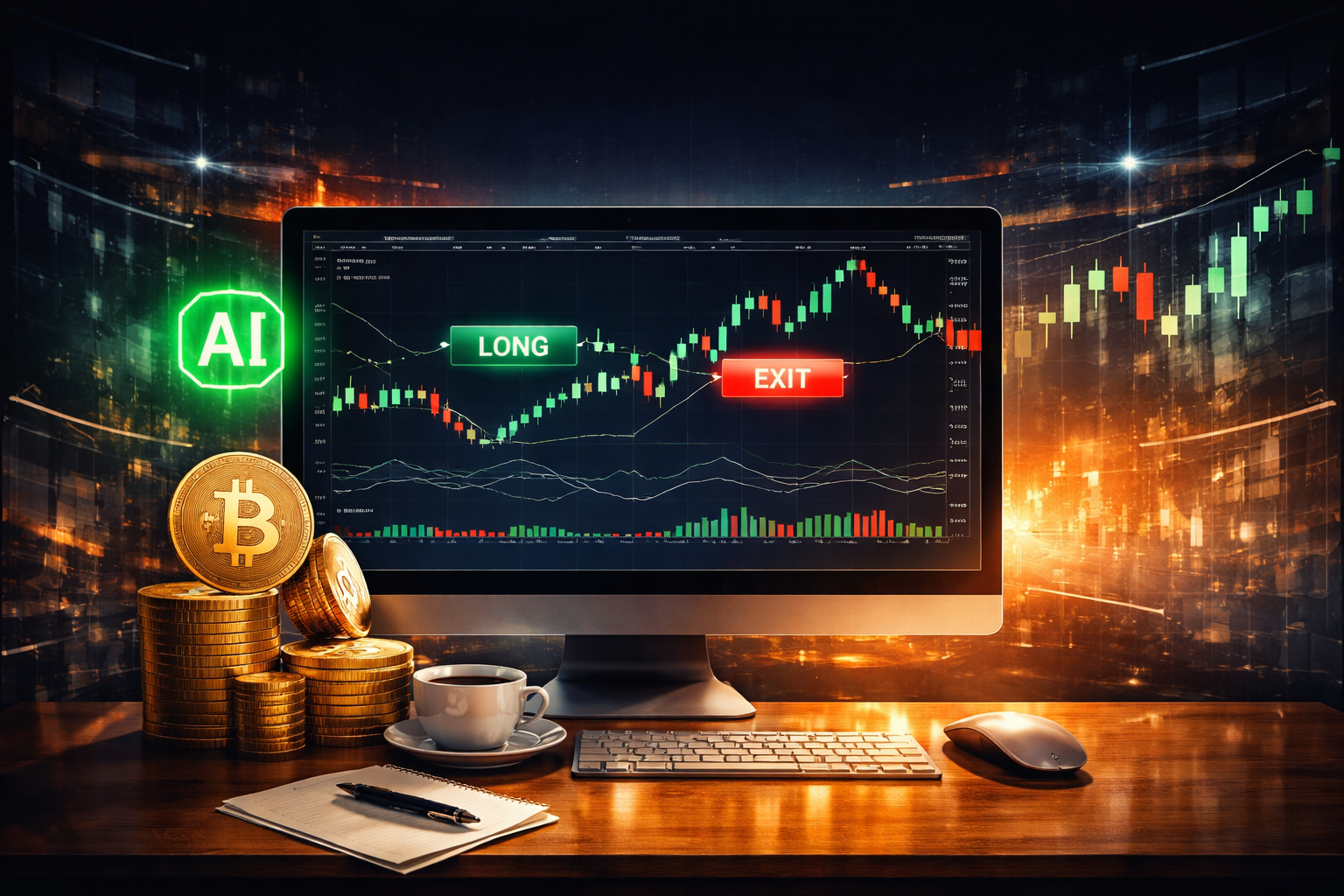
Crypto Just Landed on Jarvis. Here's Why That Changes Everything.
You've been trading crypto the hard way.
Watching five charts at once at 2 AM. Chasing the pump. Panic-selling the dip. Refreshing Twitter to see if some anonymous account with a laser-eye profile picture knows something you don't.
And every time you swear you'll be more disciplined next time — until the next candle moves and you're right back in the chaos.
Here's the thing: it's not your fault. Crypto has always been a market without guardrails. No closing bell. No circuit breakers. No structure. Just 24 hours of noise dressed up as opportunity, with your emotions invited to every single session.
That ends today.
Jarvis now supports crypto trading.
Why Crypto Traders Are the Most Emotionally Exposed Traders Alive
Options traders deal with time decay. Stock traders deal with earnings surprises. Crypto traders deal with all of it — plus a market that never closes, moves that happen while you're asleep, and a culture that rewards the loudest voice, not the most disciplined one.
The psychological warfare is non-stop.
You see Bitcoin climb 8% overnight and feel like you missed it. So you buy in at the top of the move. It retraces. You hold because you "believe in it." It drops another 12%. Now you're not trading anymore — you're coping.
Or you catch a real move. A clean 200% run on an altcoin. And instead of taking profit, you let greed whisper that this one's going to 500%. Then 1000%. Then it halves in four hours and you're back to flat.
Sound familiar?
This is the enemy inside every crypto trade. And it's the same enemy Jarvis was built to defeat.
What Jarvis Actually Does to a Crypto Chart
Jarvis doesn't add noise. It removes it.
Under the hood, Jarvis synthesizes the indicators that serious traders use — momentum signals, volume patterns, trend confirmation — and distills everything down to one thing on your screen: a signal telling you when to enter, and when to get out.
No Discord calls to verify. No influencer to follow. No gut feeling to second-guess.
You'll see a Long tag form. You enter. You'll see the signal break. You exit.
That's it. That's the whole game.
The traders who consistently profit aren't the ones with the most screens or the most conviction. They're the ones who follow a repeatable process and let it do its job — trade after trade, without interference.
Jarvis gives crypto traders that process for the first time.
The 24/7 Market Problem — Finally Solved
Here's what makes crypto uniquely brutal: the market never closes. Which means your temptation never closes either.
3 AM move? You're awake for it. Weekend pump? You're watching. Sunday night crash? You're in it.
Traditional traders get a break. They go home. The market closes. The psychological pressure resets. Crypto traders don't get that. And without a structured signal telling them when to actually act, they're always one sleepless trade away from a bad decision.
Jarvis changes the relationship you have with the clock. Instead of watching every candle waiting for something to happen, you wait for a signal. And when there's no signal, there's no trade. You close the screen. You live your life.
That is not a limitation. That is the strategy.
If You've Never Heard of Jarvis, Here's What You Need to Know
Jarvis was built by two traders who spent decades doing it the hard way — developing the intuition, logging the losses, building the process through years of trial and expensive error.
Then they asked a different question: What if you didn't have to?
What took them decades, Jarvis compresses into a single screen with clear signals. Options traders who found Jarvis reported understanding the system within a week of watching the live stream. Not months. Not years. A week.
The same system is now live for crypto.
If you've been trading crypto on instinct — or worse, on someone else's instinct — you now have something better. A proven signal framework built for the exact chaos that crypto throws at you.
The Market Doesn't Care About Your Conviction
This is the hardest truth in crypto, and almost nobody says it.
Your belief in a project doesn't protect your trade. Your research doesn't guarantee a return. The whitepaper you read, the community you trust, the influencer you follow — none of it moves the chart in your favor.
What moves the chart is price action. And what protects your account is the discipline to follow a signal instead of a story.
Crypto has always been a market that rewards storytelling. Jarvis is a tool built for traders, not believers. And for the first time, crypto traders can trade it that way.
Execute Clean. Take Profit. Be Content.
The same three-part equation that works in options works in crypto.
Execute Clean — Wait for the signal. Don't enter on a hunch, a feeling, or a fear of missing out. If there's no tag, there's no trade.
Take Profit — Exit when Jarvis tells you to exit. Not when you've calculated a bigger number in your head. Not after you've convinced yourself the move has more room. When the signal breaks, you step out.
Be Content — A 60% winner that you actually captured is worth more than a 400% winner you watched reverse in your account. The discipline to take what the market gives you — consistently, without interference — is what builds accounts over time.
Crypto traders have never had a system designed to protect them from themselves. Now they do.
This Is Your On-Ramp
If you've been grinding crypto charts without a signal framework, you already know what it costs. The missed exits. The emotional holds. The "I should have known" moments at 3 AM.
You don't have to know. You couldn't have known. But now you have something that does.
Jarvis is free for your first 30 days. Come watch the live stream, see the signals form in real time, and find out what it feels like to trade with structure in a market that has never offered any.
[Start your free 30-day trial →]
The crypto market is open right now. The question is: are you trading it, or is it trading you?
Trade examples are hypothetical and applied retroactively to demonstrate the Jarvis strategy. Trades were not executed in a live account. Results are based on exact signal execution and do not account for liquidity, slippage, or fees.
Frequently Asked Questions
Does Jarvis work for crypto the same way it works for stocks and options?
Yes. The same signal framework — Long/Short tags triggered by real-time indicator synthesis — now applies to crypto markets. You follow the tag, you exit when the signal breaks, and you stay out when there's no signal to follow.
Can I use Jarvis for crypto if I've never traded stocks or options?
Absolutely. Jarvis was built to eliminate the learning curve, not extend it. Crypto traders who come to Jarvis without any background in traditional trading can learn the system within a week of live-stream participation. You're not learning indicators — you're learning to follow a signal.
Crypto runs 24/7. How does Jarvis handle that?
Jarvis gives you structure inside the chaos. Instead of watching every candle and reacting to every move, you wait for a signal. No signal, no trade. This protects you from the biggest risk in 24/7 markets: the temptation to always be doing something.
What's the biggest mistake crypto traders make that Jarvis helps prevent?
Emotional overrides. Entering without a signal. Holding through a reversal because you "believe" in the move. These are the decisions that vaporize accounts. Jarvis takes the decision-making away from your emotions and gives it back to a system.
Is crypto on Jarvis available with the free trial?
Yes. Your first 30 days are free. That includes crypto signals, the live stream, and the full Jarvis interface — everything you need to see whether this changes the way you trade.
The information and trading signals provided on this site are for educational and informational purposes only and do not constitute financial, investment, or trading advice. Past performance is not indicative of future results. All trading involves substantial risk of loss.
More Stories
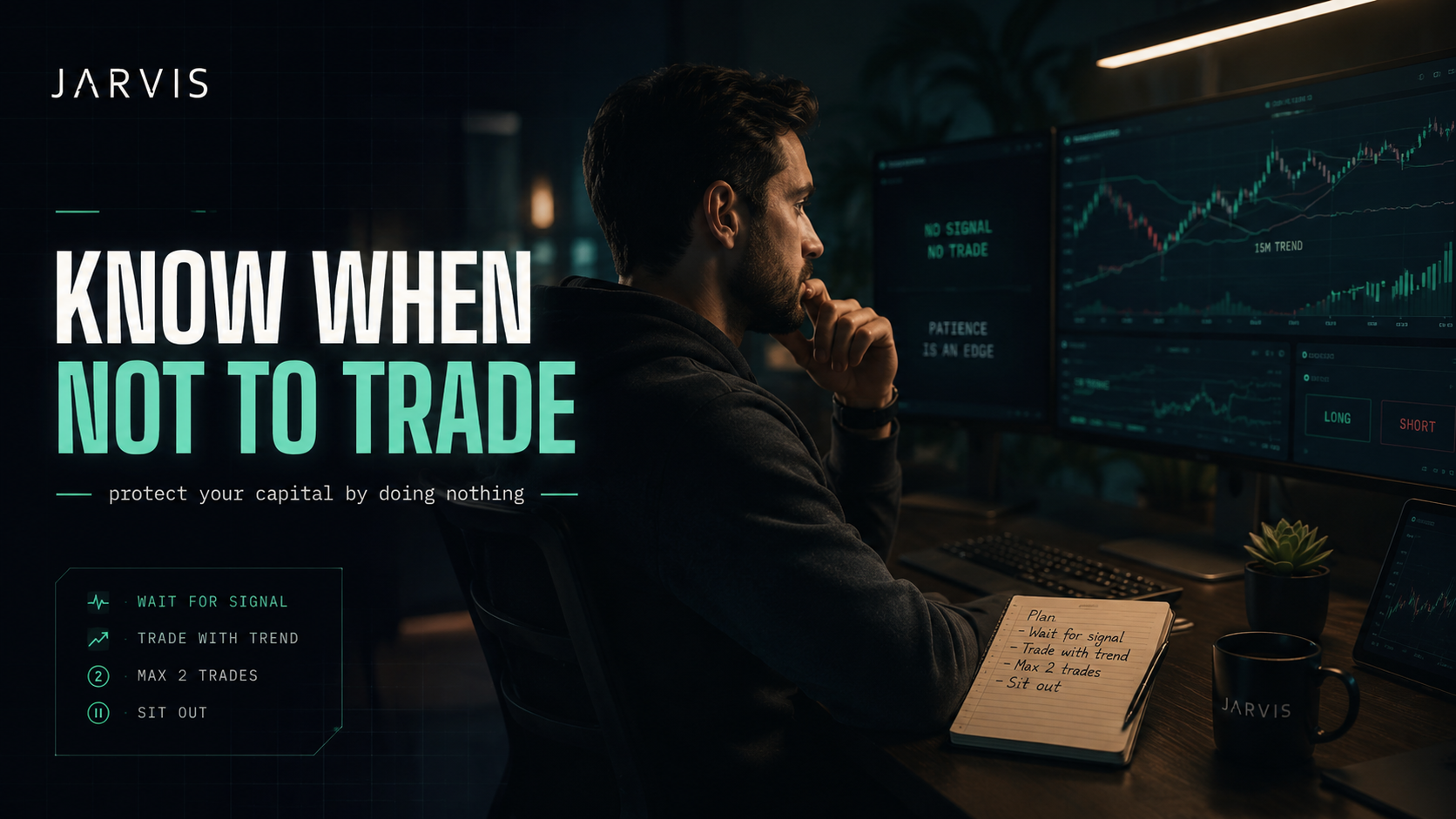
Know When NOT to Trade: How Traders Can Protect Their Capital by Doing Nothing
Know when NOT to trade: How traders can protect theircapital by doing nothing.
There are 23,400 seconds in a NYSE trading day. For high-speed securities like options day trading, that means there are 23,400 decisions to be made. For those wanting to join the select company of profitable traders, your greatest edge might not be knowing WHEN to trade, but when NOT to.
Signal trading tools like Jarvis give traders across all disciplines a powerful way to highlight the best setups each day. Here, we’ll show you signal strategies that can narrow down trading decisions, protect downside, and break the habit that blows up more accounts than any other: overtrading.
The psychology of overtrading
Let’s say you’re a new trader, and you’ve just logged your first month of trading real capital. At this stage, you’ve experienced a few wins and many losses. You're starting to unpack the reasons for your trading mistakes, looking for patterns.
Why do I keep overtrading?
Overtrading can become a habit before we even recognize we’re doing it. In every trader, there’s something that says, “Sitting out feels wrong.” As we sit still in our chairs, the emotions inside us are doing anything but that.
We experience:
- FOMO - We’ve seen trades run without us and fear missing the next one.
- Sunk Time - Giving our day to the screen, needing something to show for it.
- Boredom - The need to inject activity into sessions regardless of movement.
The market itself never creates urgency. It doesn’t need to—we do that all on our own. This same urgency is what causes us to force trades.
Why do trading losses compound?
Forcing trades may be the best way to explain why so many traders struggle to become profitable. If your losses seem to compound, it’s not just in your head. One study showed that traders who started their day with a loss were 16% more likely to engage in high-risk trades in the afternoon.
Losses affect us emotionally, whether we want to admit it or not. They can quickly distort our thinking, and have us abandon our strategy, and revert to Revenge Trading.
Read more about why Revenge Trading is so tempting, and so costly.
How can I stop overtrading?
Emotions are the reason our losses tend to compound. Instead of cautioning us to trade so frequently, a loss can actually entice us to trade more frequently, with less discretion. What’s the best way to fight emotional trading? Systems and tools.
How Jarvis helps build the habit of selective trading
It’s easy to look at a signal software like Jarvis and determine that the most important feature is the suite oft ags that flag the best entry opportunities. But an experienced trader will recognize that this tool tells us something even more important: when NOT to trade.
Rules for pressure-testing signals
Let’s look at a Jarvis chart and outline a few basic rules we teach the Jarvis traders in our daily Discord live sessions.

This chart depicts a day on SPY where Jarvis populated eight Long and Short signals. Some are better than others, and taking all of them would still count as overtrading. That’s why we’ve developed rules that help identify signals to avoid.
-
Don’t trade off the tags.
It seems basic, but even using Jarvis, it’s tempting to use signals in a secondary way and still trade by intuition. But when we show the discipline to never trade off-signal, we’ve already eliminated 99% of the trade considerations in our day. No signal…is a signal. -
Trade moving away from VWAP.
VWAP is a traditional indicator central to our strategy, and the trades we like best almost always start near VWAP and run away from it. That means Long trades above, and Short trades below. -
Trade with the trend.
Jarvis sets unique tags based on the chosen timeframe. When our 15m timeframe is green, we only want to consider Long tags trading on the 1m chart. We can rule out the Short tags until the 15m trend shifts in their favor. This 15m chart is red til 9:45, then green the rest of the day.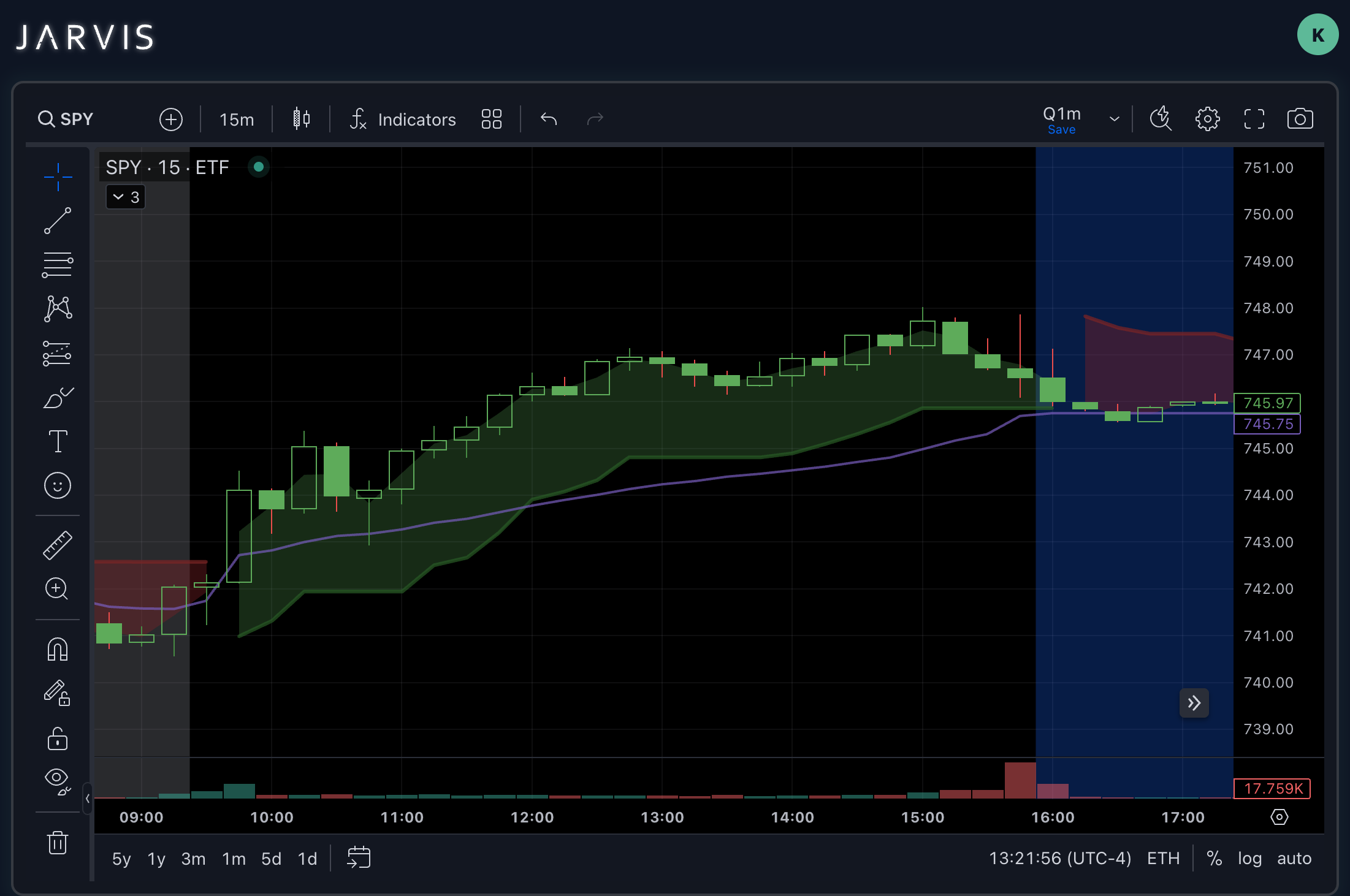
SPY 15-minute chart, June 30, 2026. -
Don’t trade once the run is done.
Once we’ve seen the trade of the day, we don’t try to force another one. -
No last-minute trading.
The last 10 minutes of the trading day are volatile but unpredictable. It’s a casino we don’t participate in.
Reviewing the results
Each tag represents an entry opportunity, and our exit is when the green/red cloud changes. Using our rules, there’s only one tag we’d consider optimal. Let’s see how it worked out:
There were two good trades on this day. Jarvis tags that followed all the rules put us in one of the two. It also kept us out of all six trades we’d want to avoid.
Learn more about how trading signals work.
Selectivity is a survival trait
Any trader who wants to last longer than three months needs a strategy to reduce losses. There are so many ways to do this wrong. Using the wrong tools is one of them. Using the right tools the wrong way is another. Jarvis was built to simplify trading. Simplicity is a fundamental need for every trader operating below the expert level (the top 1%). But tested rules and strategies have helped us further refine Jarvis's ability to keep traders from overtrading.
Taking fewer trades can feel counterintuitive. Your brain will be screaming at you while charts tick on without taking action. You’ll feel guilt and want to blame your strategy when it keeps you out of a profitable trade like the first one on this chart.
But overtrading is how you give away profits gained on winners. And profitable trading is about net winsoutpacing net losses.
That’s why we must learn when NOT to trade.
Build the sit-out habit
Any trader can start to build better habits. Here are some daily rules that can help anyone stop the bleeding and begin building more selective trading disciplines.
- Before the bell rings, recite your rules.
- Set a max number of trades for your session. Write it down.
- Define the daily trend on your chart before the morning begins.
- Log your trades. PnL and whether you broke your rules.
- Log trades you considered but skipped. Did your strategy block you, or save you?
- End-of-day review: Did you trade with a system, or your gut?
Don’t be afraid to trade less. It’s a sign of trading maturity. Every trader will have losses, but profitable traders learn consistent strategies to mitigate them.
Apply it to your trades
No need to feel shame if you’re struggling with overtrading. You’re facing thousands of trading decisions every day in a market designed to overwhelm you.
But if you’ve started to doubt your ability as a trader, Jarvis can help you build on a strategy that lets you trade like you believe. You’ll see signals on your live chart the whole trading day. Any symbol, any timeframe, for allt ypes of trading ranging from options to crypto and even investing.
And because the strategies shown above take discipline, and discipline takes time, your first month is free. We believe in Jarvis, and want you to see what it can do for your trades.
Stop Trading. Try Jarvis Today.
FAQ
- How do I know when not to trade?
- Using Jarvis tags and a tightly designed set of rules, Jarvis can help you avoid daily trading traps with a visual signals built on unemotional algo logic.
- Is it normal to go a full day without trading?
- Yes. Even day trading strategies can benefit from criteria that result in a lower trading cadence — sometimes just 3-4 trades a week.
- Does Jarvis tell you when to stay out of the market?
- Jarvis doesn’t formally recommend trading decisions. Those are always in your hands. But the Jarvis software and live Discord sessions provide daily help reviewing real-time charts and mastering strategies like those depicted on this page.
Know when NOT to trade: How traders can protect theircapital by doing nothing.
There are 23,400 seconds in a NYSE trading day. For high-speed securities like options day trading, that means there are 23,400 decisions to be made. For those wanting to join the select company of profitable traders, your greatest edge might not be knowing WHEN to trade, but when NOT to.
Signal trading tools like Jarvis give traders across all disciplines a powerful way to highlight the best setups each day. Here, we’ll show you signal strategies that can narrow down trading decisions, protect downside, and break the habit that blows up more accounts than any other: overtrading.
The psychology of overtrading
Let’s say you’re a new trader, and you’ve just logged your first month of trading real capital. At this stage, you’ve experienced a few wins and many losses. You're starting to unpack the reasons for your trading mistakes, looking for patterns.
Why do I keep overtrading?
Overtrading can become a habit before we even recognize we’re doing it. In every trader, there’s something that says, “Sitting out feels wrong.” As we sit still in our chairs, the emotions inside us are doing anything but that.
We experience:
- FOMO - We’ve seen trades run without us and fear missing the next one.
- Sunk Time - Giving our day to the screen, needing something to show for it.
- Boredom - The need to inject activity into sessions regardless of movement.
The market itself never creates urgency. It doesn’t need to—we do that all on our own. This same urgency is what causes us to force trades.
Why do trading losses compound?
Forcing trades may be the best way to explain why so many traders struggle to become profitable. If your losses seem to compound, it’s not just in your head. One study showed that traders who started their day with a loss were 16% more likely to engage in high-risk trades in the afternoon.
Losses affect us emotionally, whether we want to admit it or not. They can quickly distort our thinking, and have us abandon our strategy, and revert to Revenge Trading.
Read more about why Revenge Trading is so tempting, and so costly.
How can I stop overtrading?
Emotions are the reason our losses tend to compound. Instead of cautioning us to trade so frequently, a loss can actually entice us to trade more frequently, with less discretion. What’s the best way to fight emotional trading? Systems and tools.
How Jarvis helps build the habit of selective trading
It’s easy to look at a signal software like Jarvis and determine that the most important feature is the suite oft ags that flag the best entry opportunities. But an experienced trader will recognize that this tool tells us something even more important: when NOT to trade.
Rules for pressure-testing signals
Let’s look at a Jarvis chart and outline a few basic rules we teach the Jarvis traders in our daily Discord live sessions.
This chart depicts a day on SPY where Jarvis populated eight Long and Short signals. Some are better than others, and taking all of them would still count as overtrading. That’s why we’ve developed rules that help identify signals to avoid.
-
Don’t trade off the tags.
It seems basic, but even using Jarvis, it’s tempting to use signals in a secondary way and still trade by intuition. But when we show the discipline to never trade off-signal, we’ve already eliminated 99% of the trade considerations in our day. No signal…is a signal. -
Trade moving away from VWAP.
VWAP is a traditional indicator central to our strategy, and the trades we like best almost always start near VWAP and run away from it. That means Long trades above, and Short trades below. -
Trade with the trend.
Jarvis sets unique tags based on the chosen timeframe. When our 15m timeframe is green, we only want to consider Long tags trading on the 1m chart. We can rule out the Short tags until the 15m trend shifts in their favor. This 15m chart is red til 9:45, then green the rest of the day.
SPY 15-minute chart, June 30, 2026. -
Don’t trade once the run is done.
Once we’ve seen the trade of the day, we don’t try to force another one. -
No last-minute trading.
The last 10 minutes of the trading day are volatile but unpredictable. It’s a casino we don’t participate in.
Reviewing the results
Each tag represents an entry opportunity, and our exit is when the green/red cloud changes. Using our rules, there’s only one tag we’d consider optimal. Let’s see how it worked out:
There were two good trades on this day. Jarvis tags that followed all the rules put us in one of the two. It also kept us out of all six trades we’d want to avoid.
Learn more about how trading signals work.
Selectivity is a survival trait
Any trader who wants to last longer than three months needs a strategy to reduce losses. There are so many ways to do this wrong. Using the wrong tools is one of them. Using the right tools the wrong way is another. Jarvis was built to simplify trading. Simplicity is a fundamental need for every trader operating below the expert level (the top 1%). But tested rules and strategies have helped us further refine Jarvis's ability to keep traders from overtrading.
Taking fewer trades can feel counterintuitive. Your brain will be screaming at you while charts tick on without taking action. You’ll feel guilt and want to blame your strategy when it keeps you out of a profitable trade like the first one on this chart.
But overtrading is how you give away profits gained on winners. And profitable trading is about net winsoutpacing net losses.
That’s why we must learn when NOT to trade.
Build the sit-out habit
Any trader can start to build better habits. Here are some daily rules that can help anyone stop the bleeding and begin building more selective trading disciplines.
- Before the bell rings, recite your rules.
- Set a max number of trades for your session. Write it down.
- Define the daily trend on your chart before the morning begins.
- Log your trades. PnL and whether you broke your rules.
- Log trades you considered but skipped. Did your strategy block you, or save you?
- End-of-day review: Did you trade with a system, or your gut?
Don’t be afraid to trade less. It’s a sign of trading maturity. Every trader will have losses, but profitable traders learn consistent strategies to mitigate them.
Apply it to your trades
No need to feel shame if you’re struggling with overtrading. You’re facing thousands of trading decisions every day in a market designed to overwhelm you.
But if you’ve started to doubt your ability as a trader, Jarvis can help you build on a strategy that lets you trade like you believe. You’ll see signals on your live chart the whole trading day. Any symbol, any timeframe, for allt ypes of trading ranging from options to crypto and even investing.
And because the strategies shown above take discipline, and discipline takes time, your first month is free. We believe in Jarvis, and want you to see what it can do for your trades.
Stop Trading. Try Jarvis Today.
FAQ
- How do I know when not to trade?
- Using Jarvis tags and a tightly designed set of rules, Jarvis can help you avoid daily trading traps with a visual signals built on unemotional algo logic.
- Is it normal to go a full day without trading?
- Yes. Even day trading strategies can benefit from criteria that result in a lower trading cadence — sometimes just 3-4 trades a week.
- Does Jarvis tell you when to stay out of the market?
- Jarvis doesn’t formally recommend trading decisions. Those are always in your hands. But the Jarvis software and live Discord sessions provide daily help reviewing real-time charts and mastering strategies like those depicted on this page.
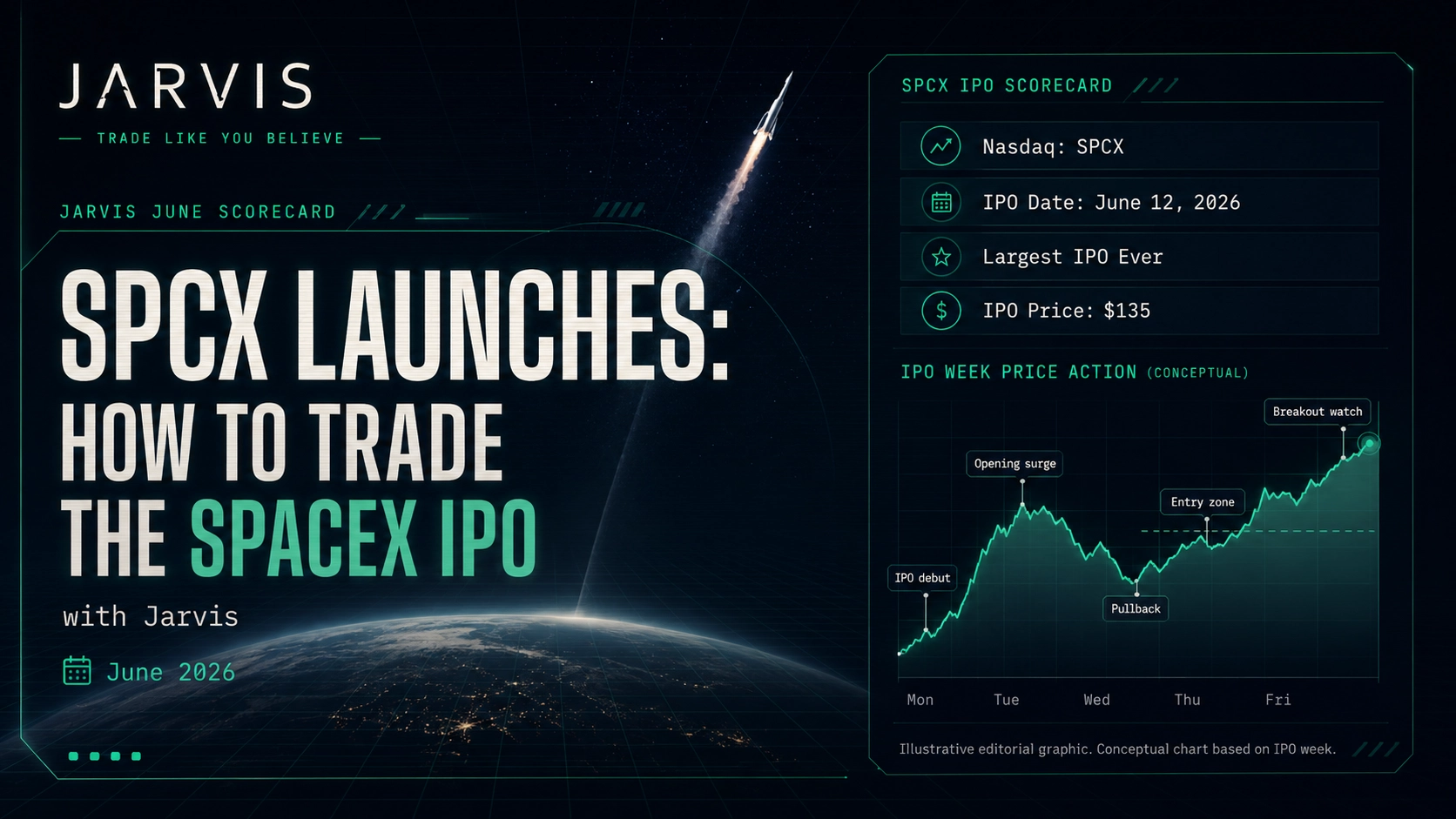
SPCX Launches: How to Trade the SpaceX IPO with Jarvis
June 2026 will be known for one trading headline only: Elon Musk’s SpaceX debuted as the largest IPO in market history on June 12, listing under the ticker SPCX.
The sweeping effect of this event was felt across every market and ticker, including a massive perceived volatility suppression that diminished returns on huge price movements during the launch week.
If you’re new here: Jarvis is an AI trading signals platform that produces zero-lag entry and exit tags across timeframes ranging from 1-minute to 1-day. It’s built for day traders, swing traders, and long-term investors alike. Below, we look at some of June’s best trades using Jarvis signals, plus a snapshot of the SPCX common stock chart in its debut month.
Trade examples are hypothetical and applied retroactively to demonstrate the Jarvis strategy. Trades were not executed in a live account. Results do not account for liquidity, slippage, or fees.
Trade 1
Day Trade Options | Timeframe: 1M
QQQ Put | June 5 | 11:06 am – 12:52 pm
P722 $1.08 → $6.49 | 500% profit
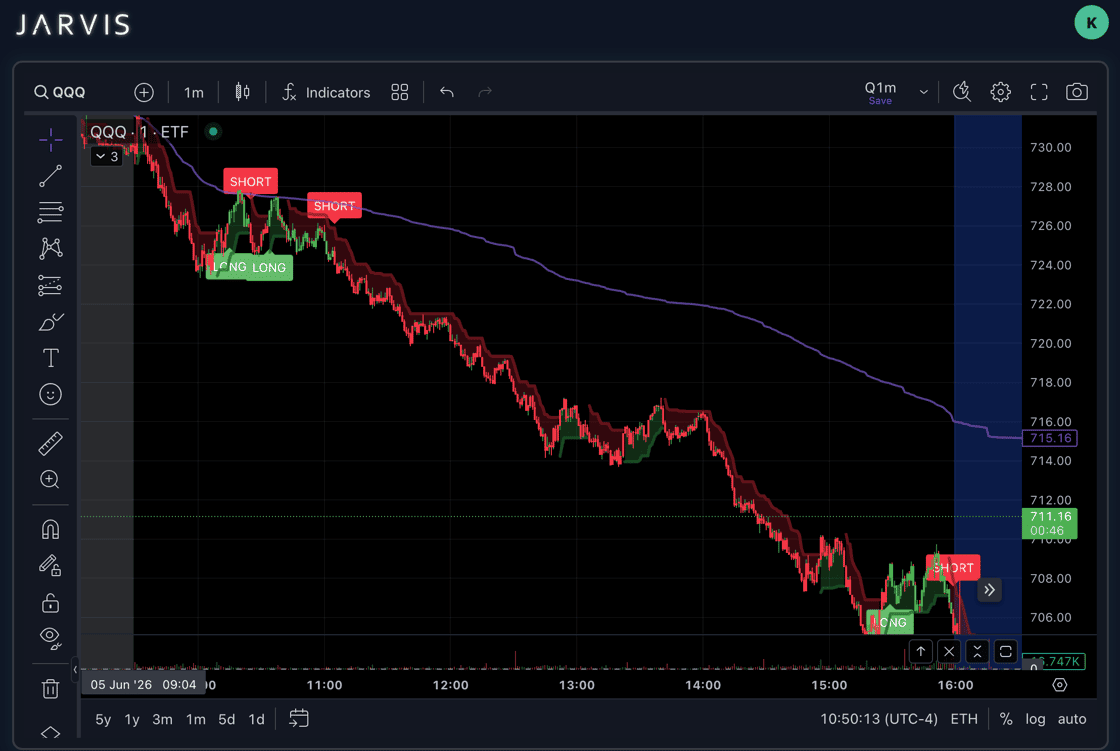
The first Short tag here looked just as appealing in real time, and produced a loss. So the second one tests our mettle. But when we have a negative trend and a Short tag below VWAP (Volume Weighted Average Price, a standard intraday benchmark), we act. Them’s the rules.
Once we’re in the second Short trade, this is a pretty smooth ride that lasts over an hour. The results on this options put are staggering, and it’s a good reminder that one missed setup on Jarvis should never derail our strategy. We trust the software here and bounce back with a month-making 500% trade.
Trade 2
Day Trade Options | Timeframe: 1M
QQQ Put | June 22 | 10:21 am – 11:00 am
P703 $1.12 → $4.13 | 268% profit
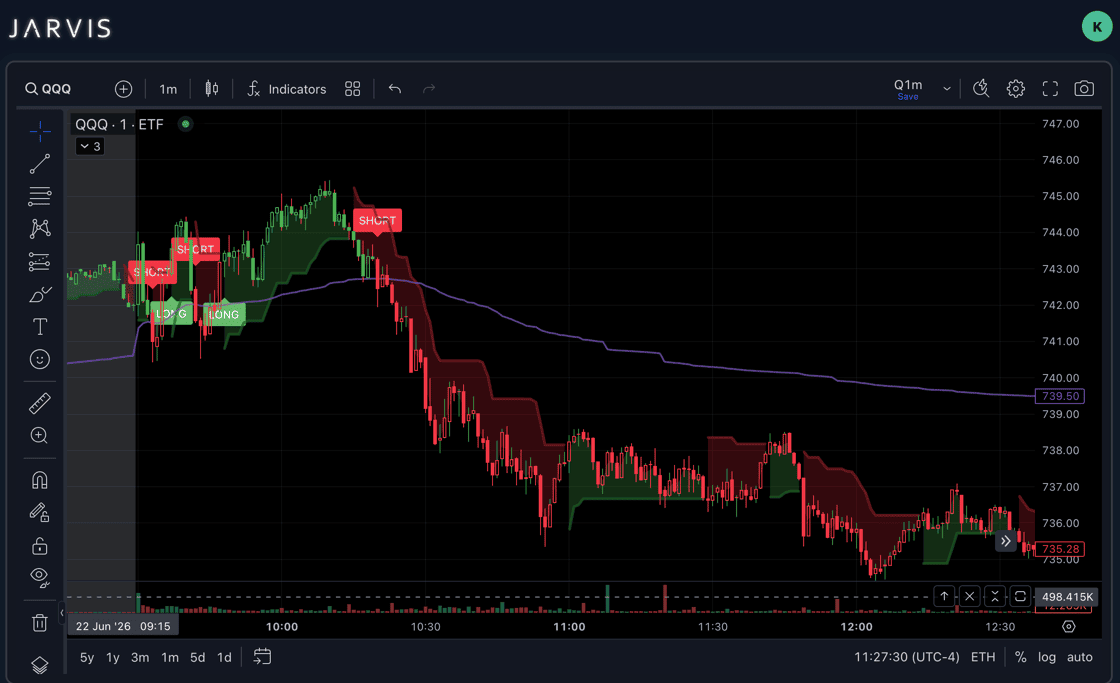
Many mornings start out choppy, and on stream we often warn traders that multiple tags can occur in the first 30 minutes. We typically want to allow time in the morning for a trend to prove itself, and not take every tag we see. This Short tag comes as we move through VWAP, and we enter when the candle closes, riding it to the next cloud break for a strong profit.
Trade 3
Common Stocks | Timeframe: 1H
SPCX ( as of June 26, 2026)
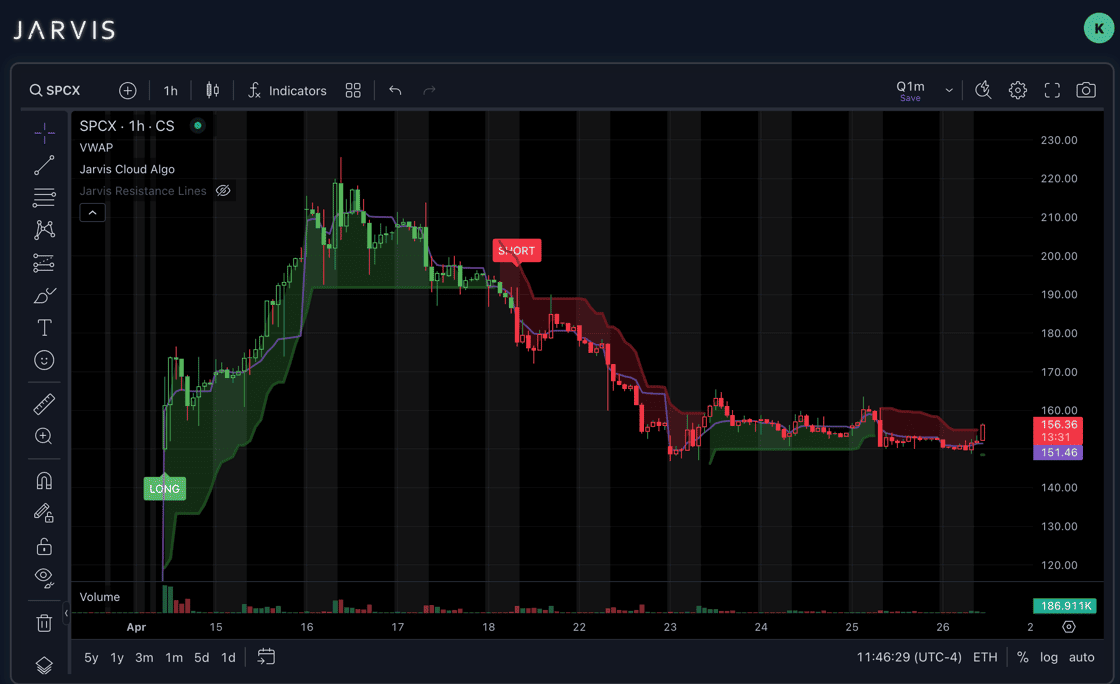
What is SPCX? SPCX is the ticker symbol for SpaceX, which listed on public markets on June 12, 2026 as the largest IPO in market history. The debut sparked heavy volume across every major index and pulled market attention away from typical volatility drivers for most of the launch week.
Moving outside of day trading options, let’s look at how Jarvis perceives the year’s biggest stock debut. The 1-hour candlestick view is the best way to vet opportunities for long-term investing.
As with many front-page IPOs, SpaceX opened with an explosive out-of-the-gate surge before stabilizing into a more reasonable trend. Stocks like SPCX are not always a sure thing, but investors using Jarvis will want to look for the next Long tag on the 1-hour chart to spot entry opportunities with qualified growth potential.
Note for options traders: SPCX got a lot of social media hype in options trading communities, but market makers have a way of staying ahead of the hype. In this opening month, perceived volatility was so extreme that achieving any meaningful profitability was particularly difficult.
The Lesson: Hype Attracts Market Suppression
In trading, extreme strategies are where movies are made, but conservative discipline is where consistently profitable traders are made.
SpaceX joins a long list of popular IPO openings that splash into the pool with a cannonball. But the reality here, and historically, is that the market is already prepared to feast on the sentiment of overeager traders until stabilization occurs. In other words: don’t trade with the hype.
That said, SPCX should join an exciting group of symbols worth monitoring across various trade disciplines, and we’re excited to see how Jarvis will help traders who want to invest and trade the IPO leading the next space race.
New to Jarvis?
Free trial members get full access to the daily JarvisLIVE stream and every signal, on every timeframe, for 30 days. If you want to see the next SPCX entry setup called live, that’s where it happens.
Thanks for trading with Jarvis, and helping create the greatest Discord trading community on the internet. We’ll see you out there.
It’s a great day to trade.
Jarvis
Risk Disclosure
Trading stocks, options, futures, and cryptocurrencies involves substantial risk and is not suitable for every investor. An investor could potentially lose all or more than the initial investment. Risk capital is money that can be lost without jeopardizing one’s financial security or lifestyle. Only risk capital should be used for trading. Past performance is not necessarily indicative of future results.
CFTC Rule 4.41
Simulated performance results have inherent limitations. Unlike an actual performance record, simulated results do not represent actual trading. Since trades have not been executed, results may have under- or over-compensated for the impact of certain market factors, such as a lack of liquidity. Simulated trading programs are generally designed with the benefit of hindsight. No representation is being made that any account will or is likely to achieve profits or losses similar to those shown.
Disclaimer
The information and trading signals provided by KTS Trading, LLC are for educational and informational purposes only and do not constitute investment advice or an offer or solicitation to buy or sell any security. We do not execute trades, manage accounts, or guarantee results. Testimonials presented may not be representative of the experience of other clients and are not a guarantee of future performance or success. All trading decisions are made solely by you at your own risk. You should consult with a licensed financial advisor before making any investment decisions. See our Terms of Service for complete details. KTS Trading, LLC is registered with the U.S. Securities and Exchange Commission.
June 2026 will be known for one trading headline only: Elon Musk’s SpaceX debuted as the largest IPO in market history on June 12, listing under the ticker SPCX.
The sweeping effect of this event was felt across every market and ticker, including a massive perceived volatility suppression that diminished returns on huge price movements during the launch week.
If you’re new here: Jarvis is an AI trading signals platform that produces zero-lag entry and exit tags across timeframes ranging from 1-minute to 1-day. It’s built for day traders, swing traders, and long-term investors alike. Below, we look at some of June’s best trades using Jarvis signals, plus a snapshot of the SPCX common stock chart in its debut month.
Trade examples are hypothetical and applied retroactively to demonstrate the Jarvis strategy. Trades were not executed in a live account. Results do not account for liquidity, slippage, or fees.
Trade 1
Day Trade Options | Timeframe: 1M
QQQ Put | June 5 | 11:06 am – 12:52 pm
P722 $1.08 → $6.49 | 500% profit
The first Short tag here looked just as appealing in real time, and produced a loss. So the second one tests our mettle. But when we have a negative trend and a Short tag below VWAP (Volume Weighted Average Price, a standard intraday benchmark), we act. Them’s the rules.
Once we’re in the second Short trade, this is a pretty smooth ride that lasts over an hour. The results on this options put are staggering, and it’s a good reminder that one missed setup on Jarvis should never derail our strategy. We trust the software here and bounce back with a month-making 500% trade.
Trade 2
Day Trade Options | Timeframe: 1M
QQQ Put | June 22 | 10:21 am – 11:00 am
P703 $1.12 → $4.13 | 268% profit
Many mornings start out choppy, and on stream we often warn traders that multiple tags can occur in the first 30 minutes. We typically want to allow time in the morning for a trend to prove itself, and not take every tag we see. This Short tag comes as we move through VWAP, and we enter when the candle closes, riding it to the next cloud break for a strong profit.
Trade 3
Common Stocks | Timeframe: 1H
SPCX ( as of June 26, 2026)
What is SPCX? SPCX is the ticker symbol for SpaceX, which listed on public markets on June 12, 2026 as the largest IPO in market history. The debut sparked heavy volume across every major index and pulled market attention away from typical volatility drivers for most of the launch week.
Moving outside of day trading options, let’s look at how Jarvis perceives the year’s biggest stock debut. The 1-hour candlestick view is the best way to vet opportunities for long-term investing.
As with many front-page IPOs, SpaceX opened with an explosive out-of-the-gate surge before stabilizing into a more reasonable trend. Stocks like SPCX are not always a sure thing, but investors using Jarvis will want to look for the next Long tag on the 1-hour chart to spot entry opportunities with qualified growth potential.
Note for options traders: SPCX got a lot of social media hype in options trading communities, but market makers have a way of staying ahead of the hype. In this opening month, perceived volatility was so extreme that achieving any meaningful profitability was particularly difficult.
The Lesson: Hype Attracts Market Suppression
In trading, extreme strategies are where movies are made, but conservative discipline is where consistently profitable traders are made.
SpaceX joins a long list of popular IPO openings that splash into the pool with a cannonball. But the reality here, and historically, is that the market is already prepared to feast on the sentiment of overeager traders until stabilization occurs. In other words: don’t trade with the hype.
That said, SPCX should join an exciting group of symbols worth monitoring across various trade disciplines, and we’re excited to see how Jarvis will help traders who want to invest and trade the IPO leading the next space race.
New to Jarvis?
Free trial members get full access to the daily JarvisLIVE stream and every signal, on every timeframe, for 30 days. If you want to see the next SPCX entry setup called live, that’s where it happens.
Thanks for trading with Jarvis, and helping create the greatest Discord trading community on the internet. We’ll see you out there.
It’s a great day to trade.
Jarvis
Risk Disclosure
Trading stocks, options, futures, and cryptocurrencies involves substantial risk and is not suitable for every investor. An investor could potentially lose all or more than the initial investment. Risk capital is money that can be lost without jeopardizing one’s financial security or lifestyle. Only risk capital should be used for trading. Past performance is not necessarily indicative of future results.
CFTC Rule 4.41
Simulated performance results have inherent limitations. Unlike an actual performance record, simulated results do not represent actual trading. Since trades have not been executed, results may have under- or over-compensated for the impact of certain market factors, such as a lack of liquidity. Simulated trading programs are generally designed with the benefit of hindsight. No representation is being made that any account will or is likely to achieve profits or losses similar to those shown.
Disclaimer
The information and trading signals provided by KTS Trading, LLC are for educational and informational purposes only and do not constitute investment advice or an offer or solicitation to buy or sell any security. We do not execute trades, manage accounts, or guarantee results. Testimonials presented may not be representative of the experience of other clients and are not a guarantee of future performance or success. All trading decisions are made solely by you at your own risk. You should consult with a licensed financial advisor before making any investment decisions. See our Terms of Service for complete details. KTS Trading, LLC is registered with the U.S. Securities and Exchange Commission.