
Options Trading Software
For Intermediate Traders
Options trading software can amplify your ability to learn, build systems, and trade with greater confidence. But before diving in with the first options service that promises you profit, know that every tool is designed for a specific style of trader, and not everything will fit your needs.
This guide breaks down the criteria experienced traders use to evaluate software so you can find the right tool that takes your trading further.
Key Takeaways
- Match software to your hold time: scalpers, day traders, and swing traders.
- Real-time data + software fees $50–$200/month
- Signal clarity outperforms feature overload for the majority of traders
- Always test tools during free trials to check latency and win-rate consistency
- Most consistent traders use a broker + an analysis or signal system
What Is Options Trading?
An options contract gives you the right—but not the obligation—to buy or sell a stock at a set price before expiration. Options allow greater leverage than shares, but they also lose value as expiration approaches, making timing a more urgent component in every options trade. This is why many traders use options for short-term strategies like day trading, momentum trading, and hedging around major events.
Two core options contract types:
Calls: You’re betting the stock will rise
Puts: You’re betting the stock will fall
Options require traders to manage many moving parts—price, volume, time decay, volatility, and strike/expires. A quality options software helps traders synthesize these variables and take better-informed action on trades.
Want a deeper dive on calls and puts? See Nerdwallet’s definitive guide.
What Is Options Trading Software?
Options trading software comes in many forms, but its key function is to help traders identify high-probability setups and execute trades faster. The software sorts data internally, providing outputs that simplify or deliver key insights to make trade decisions clearer. There are three main categories of options software:
1. Brokerage Platforms(ThinkorSwim, Tastytrade, Webull)
Upside: Best for order execution, charting, and managing positions.
Limitations: they won’t identify trade opportunities for you.
2. Analysis & Screening Tools(OptionStrat, Unusual Whales, Barchart)
Upside: Great for exploring strategies and testing ideas.
Limitations: puts you at risk of overcomplication without results.
3. Signal & Alert Systems(Jarvis, FlowAlgo, OptionsPlay)
Upside: These provide real-time trigger points for entries and exits.
Limitations: they don’t execute trades—your broker does.
Most traders rely on a single broker plus one complementary tool. The law of diminishing returns applies to trading tools: one is essential, two are optimized. The more you add after that, the further you are from effective trading.
4 Criteria for Evaluating Options Trading Software
1. Match Your Tool To Your Timeframe
Scalping, day trading, and swing trading have one key difference: holding time. Hold time dictates the data speed and features you’ll need from an options software.
2. Data Accuracy vs. Speed
Real-time options feeds cost money, but the value of accuracy can’t be overstated. Free feeds use 15-minute delayed data, which is passable for swing trading, but day trading requires extremely precise entry timing. Two seconds is too late.
What to verify before subscribing:
Data source: OPRA, CBOE, Nasdaq are examples of reliable sources
Refresh rate: “Real-time” should mean sub-second, not 5–30 seconds
Bid/ask accuracy: Alerts should reference executable live prices
New volume filters: Distinguish real activity from old open interest
Cost expectations:
Software subscription: $50–$300/month
Data feed: $50–$200/month
Exchange fees: $1–$5 per exchange
The total for serious real-time options data often lands between $100–$500/month.
3. Simplification vs. Customization
Many services will promote a robust list of tools, tickers, and chart trackers, but the reality is that most traders use just 20% of their platform’s features. Cumbersome customization slows execution, which makes trading even harder for intermediate traders.
What a good signal includes:
- Entry tag
- Strike and expiration
- Profit target
- Stop loss range
4. Integration With Your Broker
Signal tools rarely integrate directly with brokers, and every level of latency between alerts and action creates a “workflow tax”.
If you receive a trade alert while away from your setup, you start a process: Open brokerage app, find ticker, select expiration, select strike, confirm price, enter contract quantity, execute order.
Those steps, along with buffering time, create significant lag in instrument pricing, making it imperative to understand the integration level of your options trading software.
Integration levels:
- None: You manually type everything
- Templates: Tools give copy-paste order strings
- One-click routing: (Rare outside institutional platforms)
Most retail tools fall into the first category, so plan a prepared workflow that gives you the responsiveness demanded by your trading format.
Which Software Do You Really Need?
If you want a more trader-centric approach to determining the right product, here are some great questions to ask:
Step 1: How often do you trade?
- 1-2x Monthly: Your broker is enough
- Weekly: Consider a signals service
- Daily: Signals, scanners, or dedicated analysis tools
Step 2: What’s your biggest pain point?
Missing entries → real-time alerts
Overtrading → automated algo signalsCan’t watch charts all day → mobile-first systems
Step 3: What’s your experience level?Beginner/Intermediate: Pre-built signals
Advanced: Full scanner control and backtesting
How to Test Options Software Before Paying
Most trading software offers a free trial (7-30 days) that is sufficient to determine whether it works for you. Here’s how to optimize your trial window:
1. Identify Win Rates
If a software shows winning trades in promotional material, that gives you the ceiling. Now you need to determine whether it can consistently reproduce results.
Spend a few days tracking signals and alerts without risking money on real trades. Paper trading services offered by brokers like ThinkorSwim will help you log real entry/exit/profit data.
Most software services will include training videos and resources. Review these so you understand the platform. Some services are more nuanced than they seem at a glance, and you don’t want to throw out a good tool because you didn’t take time to comprehend it.
What to track:
- What % of alerts hit target vs. stop loss?
- What's the average reward-to-risk ratio over the last 90 days?
2. Test Alert Latency Side-by-Side
Set up a split screen with software alerts and your broker's live chart side by side. Do alerts fire BEFORE you see the move on your charts, or after?
If before: The software is giving you an edge
If after: The algorithm is tailing, and can compromise your trades
3. Measure Support Responsiveness
Options move fast. Underdelivered services belong to overpromised products. If they’re asking you to pay a subscription, expect them to earn it. If support takes 48 hours to answer questions, imagine how frustrating live trading will be.
Common Mistakes When Choosing Software
Once you’ve found a trading software that helps you win, no one has to sell you a long-term commitment—you’ll want it. So don’t rush the process. Traders who hurry to turn their portfolio around are susceptible to every internal and external pitfall.
1. Trusting Paid Influencer Endorsements
Social media traders get paid to promote platforms. A one-off review video is usually a red flag that their endorsement is compromised.
2. Assuming Expensive = Better
Some $500/month platforms are just repackaged TradingView indicators with aggressive marketing.
3. Unrealistic Time Expectations
Certain styles like day trading demand your focus. Winning trades without committing to screen time isn’t a reality.
4. Overbuying Features You'll Never Use
Several softwares offer 1,000+ indicators. You'll use 5. Start with the simplest tool that covers your core strategy.
Top Options Trading Software by Use Care in 2025
1. Jarvis - Best for Day/Swing/Portfolio Signals
What it does: This algo software makes setups easier to understand than anything on the market. Red and green Long/Short tags – anyone can understand it.
Key features:
- Easy-to-interpret entry signals with zero lag
- Maximum simplicity: designed for single-screen trading
- Experienced Discord mods and daily trading sessions
Best for: Intermediate traders who understand options basics but want instant entry recognition without interpreting charts all day.
Pricing: Subscription-based with data included
2. Thinkorswim - Best All-in-One Brokerage
What it does: Full-featured broker with advanced charting and analysis tools
Key features:
- Professional-grade charting
- Paper trading for strategy testing
- Custom scanner creation
- Trustworthy brokerage backed by Schwaab
Best for: Traders who want everything in one platform and have time to learn complex tools
3. Interactive Brokers - Best for Advanced Traders
What it does: Institutional-grade platform with API access for custom algorithm deployment
Key features:
- Direct market access with low latency
- Customizable scanners and alerts
- API for automated trading strategies
- Extensive international markets coverage
Best for: Advanced traders building proprietary strategies or trading high volume
4. OptionStrat - Best for Backtesting
What it does: Strategy builder with historical performance testing
Key features:
- Build and test custom options strategies
- Historical price data for backtesting
- Risk/reward visualization tools
- Free basic version available
Best for: Traders who want to validate strategy ideas before risking real money
Simplify Options Trading With Jarvis
Traders looking for options trading software have traditionally struggled with two things:
1. Their existing strategy is partially informed, and they’re losing money.
2. The tools that can make them better traders require a massive leap in complexity.
The fundamental reality of the human brain is that we can become better at performing a task when it’s made less complex. Jarvis is designed to keep trading simple.
Jarvis is a sophisticated algo software that waits for multiple momentum indicators to align before generating a signal. All of the analysis happens under the hood, reducing noisy trading charts to a handful of easy entry decisions each day.
Signals focus on only the critical information traders need:
- Precise entry tags
- Tailing stop-loss indicator
- Algo-generated resistance lines
- Timeframe-adjusted for day/swing/portfolio trading
Who Jarvis is for: Intermediate traders who understand options but continually overtrade or misfire on entries. You get simple signal confirmation and can quickly learn the platform on the daily livestream on Discord.
What Jarvis isn't: Not a broker where you’ll execute Buy/Sells. Not a tool for scalpers.
You can see for yourself why trading is so simple on Jarvis. Try Jarvis free for 30 days.
Final Takeaway
The best options trading software is the one that fits your trading style. Ignore hype and test tools. Investigate services and let brands prove their worth for a long-term partnership.
Options are an exciting way to trade, and at the end of the day, it’s simple: the best options software is the one that helps you become a profitable trader.
Because clarity beats customization. Most intermediate traders don’t need 1,000 indicators—they need clean entries, defined exits, and fewer decisions. Signal-first tools strip out noise so you can execute without overthinking, which is why they lead to better consistency for most traders.
Use the trial like you would use the live product. Track alerts for a few days. Compare signal timing against your broker’s chart. Log wins and stops. If the software consistently fires before the move and fits your workflow, you’ve found value. If not, move on.
Usually not. Most traders use one broker for execution and one external tool for signals or analysis. Anything beyond that creates clutter and slows down your workflow. The law of diminishing returns hits fast—simplicity wins.
If you day trade, yes—without question. Two seconds of delay can flip a winning setup into a losing one. Swing traders can survive on delayed feeds, but intraday traders should treat real-time data as a requirement, not a luxury. The edge comes from accuracy and speed, not more indicators.
Start by matching the tool to your hold time. Scalpers need sub-second data and instant execution. Day traders need real-time alerts with clear entries.
Swing traders can use delayed feeds and focus on strategy modeling. When the software’s speed matches your timeframe, your decision-making tightens and your trades improve.
Explore More
Smart traders make great decisions using Jarvis. Here are some resources to guide you along your trading journey.
The Day Trading Trifecta: A Rules-Based Options Strategy
Jarvis was built first and foremost on simplicity, making it possible for anyone to trade. But once you’re comfortable, the goal is improving consistency. That takes discipline, but it also requires a strategy.
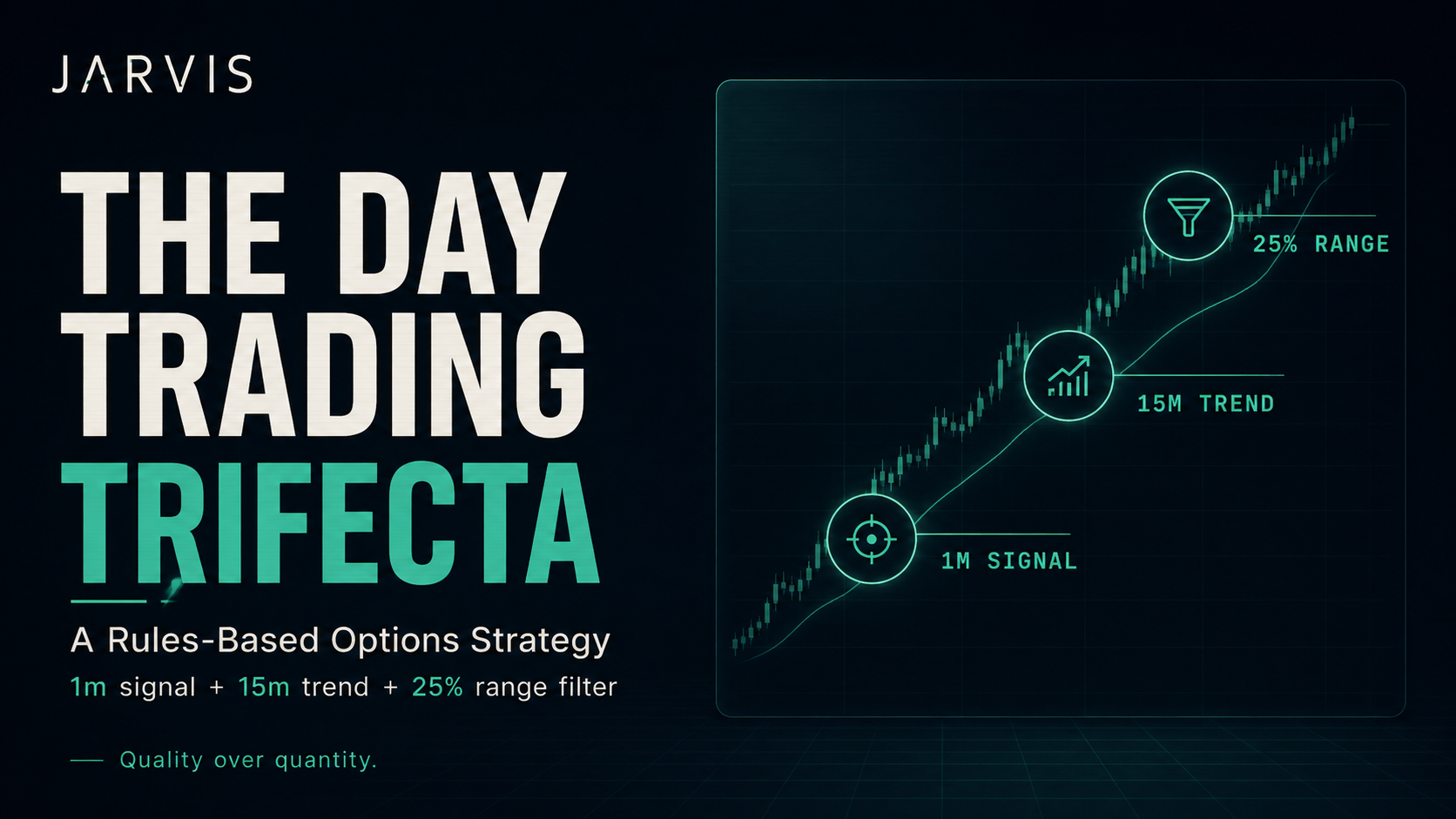
This month on stream, we’ve been practicing what we call the Day Trading Trifecta: a rules-based approach to day trading options that stacks the standard Jarvis 1-minute signal with two additional filters designed to rule out low-quality setups.
If you’re new here: Jarvis is an AI trading signals platform that produces zero-lag entry and exit tags (called LONG and SHORT) across timeframes from 1-minute to 1-day. The Trifecta is one of the strategies we teach on the JarvisLIVE Discord stream, and it’s built to be simple enough for regular retail traders to execute consistently.
The Day Trading Trifecta: 3 Rules
All three conditions must align before entering a trade:
- Signal. A 1-minute Jarvis tag (LONG or SHORT) fires and confirms on the candle close.
- Trend agreement. The 15-minute chart is trending the same direction as the entry (green cloud for a LONG, red cloud for a SHORT). This confirms the longer-term move supports the trade.
- Range check. The instrument is within 25% of its opening range. This filter helps avoid chasing a move that’s already extended.
If any one of these fails, we pass on the tag. The point is not to trade more, but to trade cleaner.
Trade 1: Novice
Day Trade Options | Timeframe: 1MSPY Put | July 31 | 9:39 am startP743 $1.01 → $5.00+ | 395%+ profit
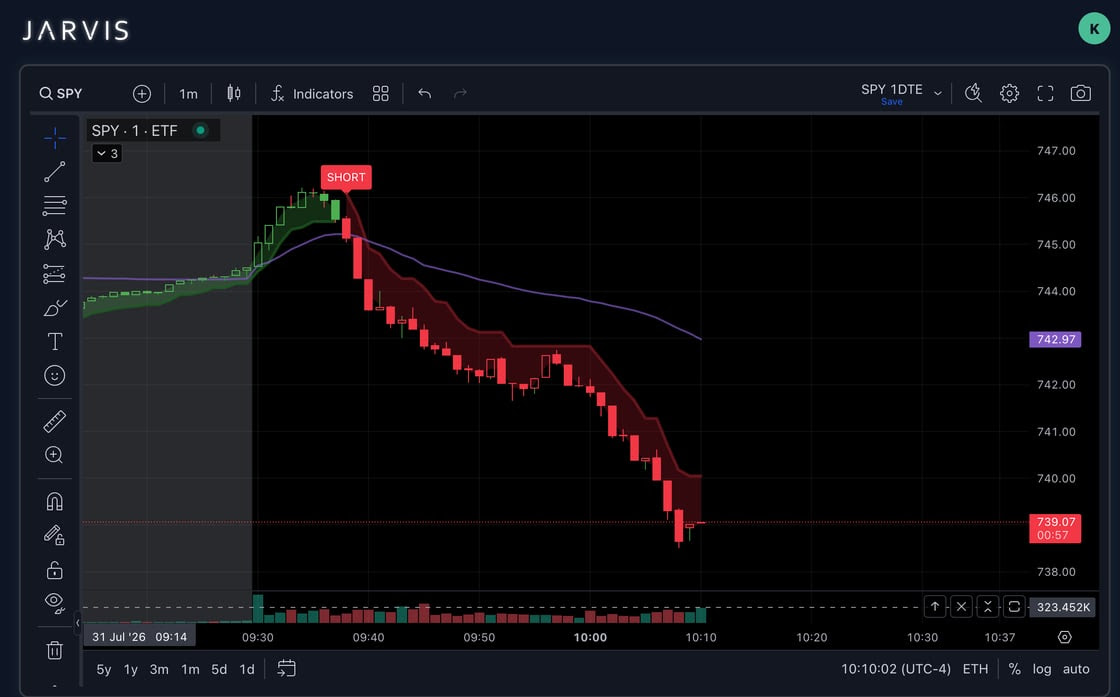
This trade was active as we drafted the July recap. It’s a textbook setup that even novice traders can identify using Jarvis.
This trade represents the most basic Jarvis strategy: trade on tags when the candle closes, moving away from VWAP (Volume Weighted Average Price, a standard intraday benchmark).This trade also had time to establish a trend, going green-to-red rather than starting out choppy as some days do. A lot of good signs for a simple trade that happens to precede a long, smooth run.
Exit Rule: While our default exit target is a cloud break (when the Jarvis colored cloud flips against the trade), locking in profit at a moment like this after a run of this scale is standard risk management.
Trade 2: Intermediate
Day Trade Options | Timeframe: 1MSPY Call | July 27 | 9:42 am – 10:49 amC739 $0.76 → $3.72 | 389% profit
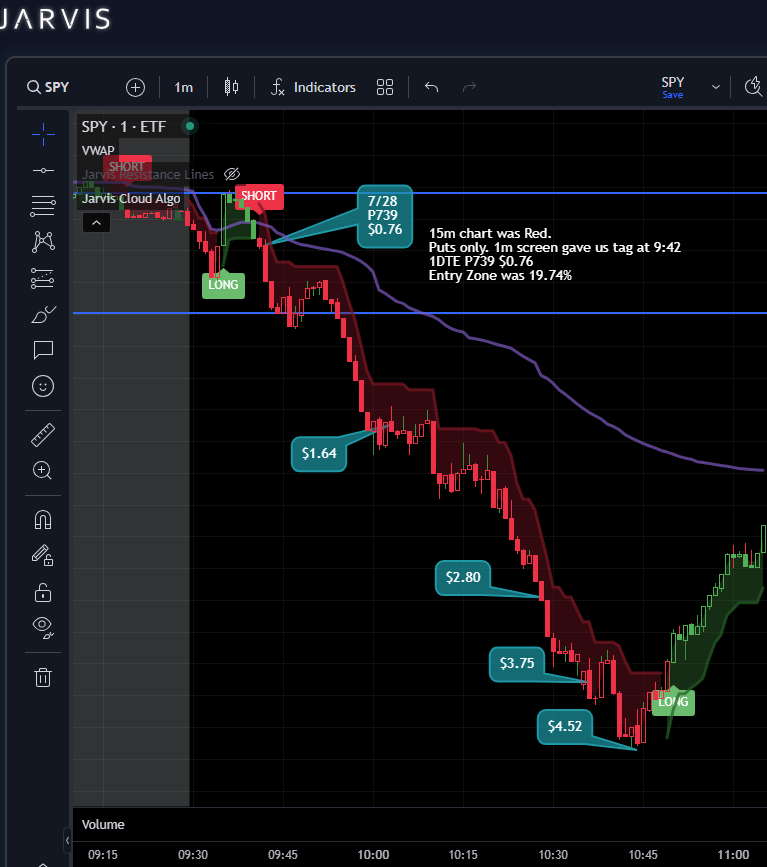
Our Trifecta strategy is built to rule out even more signals on the screen. It kept us out of the LONG tag we see at the top of the chart, and got us into the SHORT.
- This is the 1-minute view of the chart. The 15-minute view showed a red trend, which is why we’re only considering options puts and ignoring calls.
- We drew a range on our instrument chart in ThinkorSwim to ensure our 1-minute entry signal was within 25% of the chart’s open. This one came in at 19.74%.
- So when we see the 1-minute SHORT tag, check, check, check. Trifecta.
The Lesson: Quality Over Quantity
Overtrading absolutely kills long-term P&L across disciplines. Even with Jarvis, we recognize that repeatable strategies can reduce the number of tags we’re willing to consider. Every strategy we introduce is an effort to trade smarter, while keeping our process simple enough for regular retail traders to execute.
If you want to see this model practiced or explained further, our live stream on Discord is the place to be. It’s included in our 30-day free trial.
New to Jarvis?
Free trial members get full access to the daily JarvisLIVE stream and every signal on every timeframe for 30 days. Want to see the next Trifecta setup called live? That’s where it happens.
Thanks for trading with Jarvis, and helping create the greatest Discord trading community on the internet. We’ll see you out there.
It’s a great day to trade.
Jarvis
Risk Disclosure
Trading stocks, options, futures, and cryptocurrencies involves substantial risk and is not suitable for every investor. An investor could potentially lose all or more than the initial investment. Risk capital is money that can be lost without jeopardizing one’s financial security or lifestyle. Only risk capital should be used for trading. Past performance is not necessarily indicative of future results.
CFTC Rule 4.41
Simulated performance results have inherent limitations. Unlike an actual performance record, simulated results do not represent actual trading. Since trades have not been executed, results may have under- or over-compensated for the impact of certain market factors, such as a lack of liquidity. Simulated trading programs are generally designed with the benefit of hindsight. No representation is being made that any account will or is likely to achieve profits or losses similar to those shown.
Disclaimer
The information and trading signals provided by KTS Trading, LLC are for educational and informational purposes only and do not constitute investment advice or an offer or solicitation to buy or sell any security. We do not execute trades, manage accounts, or guarantee results. Testimonials presented may not be representative of the experience of other clients and are nota guarantee of future performance or success. All trading decisions are made solely by you at your own risk. You should consult with a licensed financial advisor before making any investment decisions. See our Terms of Service for complete details. KTS Trading, LLC is registered with the U.S. Securities and Exchange Commission.
Jarvis was built first and foremost on simplicity, making it possible for anyone to trade. But once you’re comfortable, the goal is improving consistency. That takes discipline, but it also requires a strategy.
This month on stream, we’ve been practicing what we call the Day Trading Trifecta: a rules-based approach to day trading options that stacks the standard Jarvis 1-minute signal with two additional filters designed to rule out low-quality setups.
If you’re new here: Jarvis is an AI trading signals platform that produces zero-lag entry and exit tags (called LONG and SHORT) across timeframes from 1-minute to 1-day. The Trifecta is one of the strategies we teach on the JarvisLIVE Discord stream, and it’s built to be simple enough for regular retail traders to execute consistently.
The Day Trading Trifecta: 3 Rules
All three conditions must align before entering a trade:
- Signal. A 1-minute Jarvis tag (LONG or SHORT) fires and confirms on the candle close.
- Trend agreement. The 15-minute chart is trending the same direction as the entry (green cloud for a LONG, red cloud for a SHORT). This confirms the longer-term move supports the trade.
- Range check. The instrument is within 25% of its opening range. This filter helps avoid chasing a move that’s already extended.
If any one of these fails, we pass on the tag. The point is not to trade more, but to trade cleaner.
Trade 1: Novice
Day Trade Options | Timeframe: 1MSPY Put | July 31 | 9:39 am startP743 $1.01 → $5.00+ | 395%+ profit
This trade was active as we drafted the July recap. It’s a textbook setup that even novice traders can identify using Jarvis.
This trade represents the most basic Jarvis strategy: trade on tags when the candle closes, moving away from VWAP (Volume Weighted Average Price, a standard intraday benchmark).This trade also had time to establish a trend, going green-to-red rather than starting out choppy as some days do. A lot of good signs for a simple trade that happens to precede a long, smooth run.
Exit Rule: While our default exit target is a cloud break (when the Jarvis colored cloud flips against the trade), locking in profit at a moment like this after a run of this scale is standard risk management.
Trade 2: Intermediate
Day Trade Options | Timeframe: 1MSPY Call | July 27 | 9:42 am – 10:49 amC739 $0.76 → $3.72 | 389% profit
Our Trifecta strategy is built to rule out even more signals on the screen. It kept us out of the LONG tag we see at the top of the chart, and got us into the SHORT.
- This is the 1-minute view of the chart. The 15-minute view showed a red trend, which is why we’re only considering options puts and ignoring calls.
- We drew a range on our instrument chart in ThinkorSwim to ensure our 1-minute entry signal was within 25% of the chart’s open. This one came in at 19.74%.
- So when we see the 1-minute SHORT tag, check, check, check. Trifecta.
The Lesson: Quality Over Quantity
Overtrading absolutely kills long-term P&L across disciplines. Even with Jarvis, we recognize that repeatable strategies can reduce the number of tags we’re willing to consider. Every strategy we introduce is an effort to trade smarter, while keeping our process simple enough for regular retail traders to execute.
If you want to see this model practiced or explained further, our live stream on Discord is the place to be. It’s included in our 30-day free trial.
New to Jarvis?
Free trial members get full access to the daily JarvisLIVE stream and every signal on every timeframe for 30 days. Want to see the next Trifecta setup called live? That’s where it happens.
Thanks for trading with Jarvis, and helping create the greatest Discord trading community on the internet. We’ll see you out there.
It’s a great day to trade.
Jarvis
Risk Disclosure
Trading stocks, options, futures, and cryptocurrencies involves substantial risk and is not suitable for every investor. An investor could potentially lose all or more than the initial investment. Risk capital is money that can be lost without jeopardizing one’s financial security or lifestyle. Only risk capital should be used for trading. Past performance is not necessarily indicative of future results.
CFTC Rule 4.41
Simulated performance results have inherent limitations. Unlike an actual performance record, simulated results do not represent actual trading. Since trades have not been executed, results may have under- or over-compensated for the impact of certain market factors, such as a lack of liquidity. Simulated trading programs are generally designed with the benefit of hindsight. No representation is being made that any account will or is likely to achieve profits or losses similar to those shown.
Disclaimer
The information and trading signals provided by KTS Trading, LLC are for educational and informational purposes only and do not constitute investment advice or an offer or solicitation to buy or sell any security. We do not execute trades, manage accounts, or guarantee results. Testimonials presented may not be representative of the experience of other clients and are nota guarantee of future performance or success. All trading decisions are made solely by you at your own risk. You should consult with a licensed financial advisor before making any investment decisions. See our Terms of Service for complete details. KTS Trading, LLC is registered with the U.S. Securities and Exchange Commission.
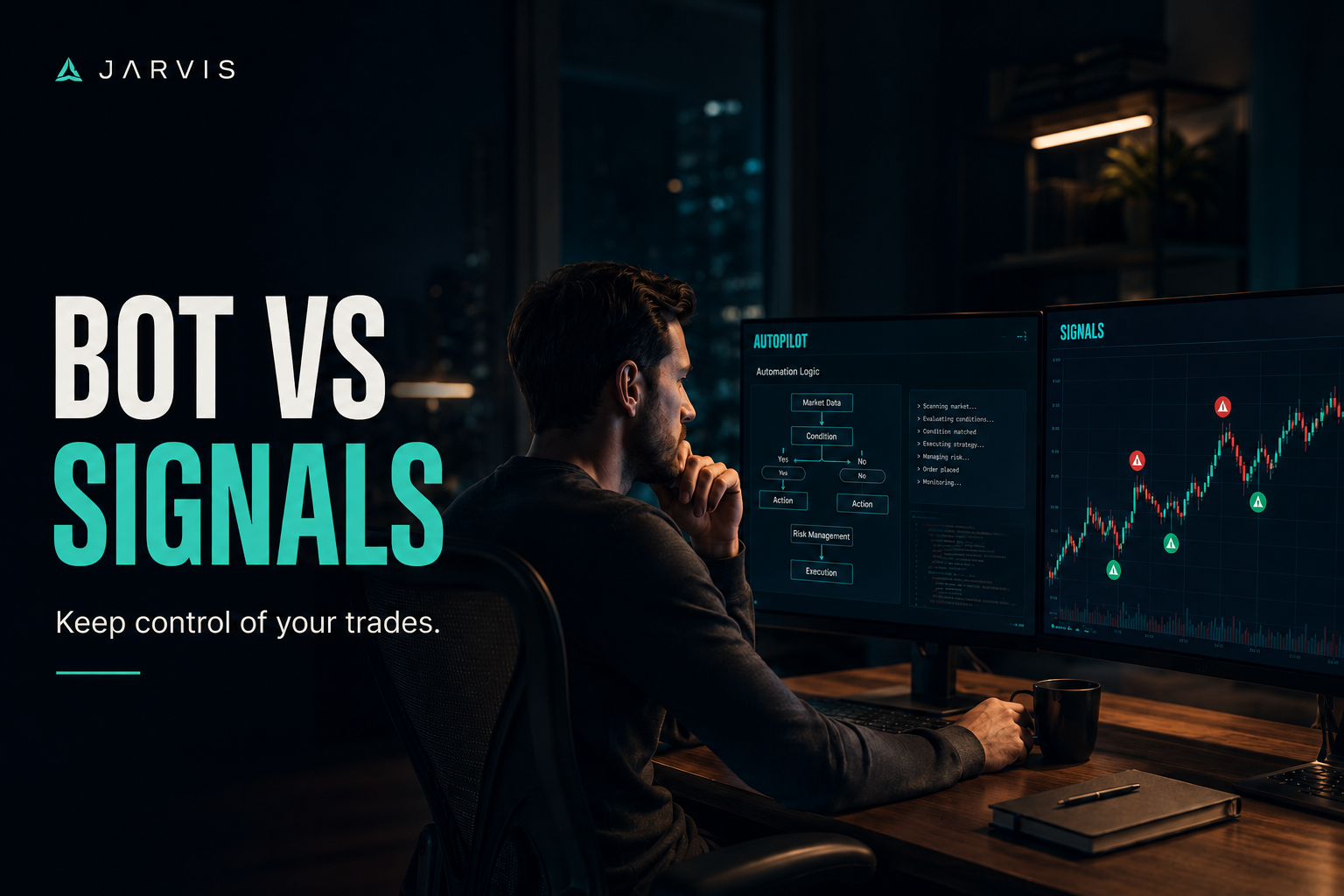
Trading bot vs signals: Should you give up control of your trades?
Trading bot vs signals: Should you give up control of your trades?
“Can I get a bot to trade for me?”
Before AI ever went mainstream, this question was already on every trader’s mind. Finding the right answer comes down to two things: whether fully automated trading bots are effective, and whether traders should hand over that kind of control in the first place.
Let’s examine the trade-offs between trading bots and real-time signals, examine where automation exposes traders the most, and show how traders can leverage algorithmic speed without giving up control of your trades.
How to tell a trading signal from a bot
Every trader uses tools to navigate the market, and the functions of trading tools fit into a few categorical buckets:
- Information: feeds and market data
- Education: trading guidance and disciplines
- Analysis: indicators and visual signals
- Execution: order placement and brokers
- Automation: trade execution by bots
Signals and bots are both built on algorithmic rule sets that determine their actions. The distinction between them comes down to who executes the trades.
Signal services analyze historic and live data giving traders real-time visual context for discretionary execution.
Trading bots take that analysis a step further, routing orders directly to a brokerage based on preset conditional logic.
Who are trading bots best for?
Experienced traders know that the greatest danger to your capital is often your own emotions. Fear, greed, and panic can disrupt strategies and derail a trader’s day before it even begins.
It’s easy to see the appeal, then, of an automated trading platform that is truly unemotional, both in analysis and execution.
In fact, all of this happens without the trader having to sit staring at a screen or managing active positions. The time-investment comes on the front end, fine-tuning your bot’s dials for backtesting and eventually live trading.
Because of this, trading bots are best suited for traders with a strong grasp of technical indicators like RSI and MACD, understand performance metrics like maximum drawdown, and want to apply their trading logic without spending all day on the screen.
All of this upside would be incredible for most traders if there weren’t risks attached to it. So what’s the catch?
Weighing automated trading risk
Automated trading features can feel more like hypothesis than reality once you’ve put real capital behind the bots you’ve built. It doesn’t take a human sitting at the station for errors to compromise a trading strategy, or for you to feel a knot of dread your stomach knowing that your capital is on the line.
Traders should weigh out a few things before putting a bot behind the wheel of their brokerage account:
API permission risks
Bots require full API execution access to your brokerage account. This means an automation has full permission to lose your capital, and all the liability rests on you.
Logic errors & parameter drift
Unemotional bots continuously execute orders that fulfill its instructions even when market regimes shift, or tuning mistakes trigger avoidable losses. A bot has no judgment to shut off the valve without human intervention.
Complexity & skill barrier
Setting effective parameters requires experienced knowledge of market microstructure. Bots can amplify financial risks to unimaginable proportions in the hands of the unprepared.
No promised results
There is no trading tool that can guarantee success. For the novices looking for a solution to trade profitably without experience or involvement, automation is not the answer. Market makers have more sophisticated tools than you can imagine. Yes, that includes your Claude vibe-trader.
None of this means that automated trading can’t work. Like any other form of trading, bots have their pros and cons. There is simply a reality of time investment, expertise, and risk that automated AI trading services can’t eliminate.
How to use signals without losing control of your trades
You don’t need to hand over control of your account to benefit from algorithmic speed.
Many traders appreciate the mathematical automation offered by AI trading bots, but want the final say in their trades. Trading signal suites like Jarvis are perfect for traders seeking this intersection of algo logic and human control.
Jarvis: for trader enhancement, not replacement
Instead of connecting to your brokerage and executing trades on your behalf, Jarvis focuses on distilling complex market data into the simplest format to help you make trading decisions in the moment.
Long & short signals can be fitted to any symbol or timeframe for day trading, investing, crypto, and more. Every signal you see is a real-time indicator surfacing entry opportunities for your selected asset and trading style.
Single screen trading reduces visual noise to prevent the information overload that leads to hesitation or overtrading. Jarvis works side-by side with your brokerage.
Manually execute trades only on the signals you feel totally confident about. The Jarvis algorithm is hard at work 24/7 to find the best entries. Acting on them is 100% your choice.
Is automated trading right for you?
For traders with a knack for experimentation, automated trading offers limitless options. New services emerge weekly, offering nearly infinite automation configurations. Just be careful not to be swept up in overpromised results, remembering that anything in trading that seems too good to be true, probably is.
And if you feel like you’re the only one who thinks maybe automated trading isn’t really the future of trading–at least not yet–know that you’re not alone. Human intuition will always play a role, because at the end of the trading day, no one has to answer for your results…except you.
FAQ
Q: Does Jarvis place trades for you automatically?
No. Jarvis is a visual trading tool that distills live information into simple signals that traders then use to execute trades within their own brokerage account.
Q: What’s the difference between a trading signal and a trading bot?
A trading signal is a single-moment indicator that highlights potential market setups for manual execution. A trading bot is an automated script that routes orders according to a predefined set of rules.
Q: Do I need experience to use Jarvis if it doesn’t trade for me?
Jarvis is quick to learn, and most users show strong comprehension after a week of participating in our live stream. It’s also important that you know your way around your brokerage platform, understanding exactly how to enter, exit, and size your trades for the correct instruments. That is where your capital is at stake and it’s important that you know how to use it.
Trading bot vs signals: Should you give up control of your trades?
“Can I get a bot to trade for me?”
Before AI ever went mainstream, this question was already on every trader’s mind. Finding the right answer comes down to two things: whether fully automated trading bots are effective, and whether traders should hand over that kind of control in the first place.
Let’s examine the trade-offs between trading bots and real-time signals, examine where automation exposes traders the most, and show how traders can leverage algorithmic speed without giving up control of your trades.
How to tell a trading signal from a bot
Every trader uses tools to navigate the market, and the functions of trading tools fit into a few categorical buckets:
- Information: feeds and market data
- Education: trading guidance and disciplines
- Analysis: indicators and visual signals
- Execution: order placement and brokers
- Automation: trade execution by bots
Signals and bots are both built on algorithmic rule sets that determine their actions. The distinction between them comes down to who executes the trades.
Signal services analyze historic and live data giving traders real-time visual context for discretionary execution.
Trading bots take that analysis a step further, routing orders directly to a brokerage based on preset conditional logic.
Who are trading bots best for?
Experienced traders know that the greatest danger to your capital is often your own emotions. Fear, greed, and panic can disrupt strategies and derail a trader’s day before it even begins.
It’s easy to see the appeal, then, of an automated trading platform that is truly unemotional, both in analysis and execution.
In fact, all of this happens without the trader having to sit staring at a screen or managing active positions. The time-investment comes on the front end, fine-tuning your bot’s dials for backtesting and eventually live trading.
Because of this, trading bots are best suited for traders with a strong grasp of technical indicators like RSI and MACD, understand performance metrics like maximum drawdown, and want to apply their trading logic without spending all day on the screen.
All of this upside would be incredible for most traders if there weren’t risks attached to it. So what’s the catch?
Weighing automated trading risk
Automated trading features can feel more like hypothesis than reality once you’ve put real capital behind the bots you’ve built. It doesn’t take a human sitting at the station for errors to compromise a trading strategy, or for you to feel a knot of dread your stomach knowing that your capital is on the line.
Traders should weigh out a few things before putting a bot behind the wheel of their brokerage account:
API permission risks
Bots require full API execution access to your brokerage account. This means an automation has full permission to lose your capital, and all the liability rests on you.
Logic errors & parameter drift
Unemotional bots continuously execute orders that fulfill its instructions even when market regimes shift, or tuning mistakes trigger avoidable losses. A bot has no judgment to shut off the valve without human intervention.
Complexity & skill barrier
Setting effective parameters requires experienced knowledge of market microstructure. Bots can amplify financial risks to unimaginable proportions in the hands of the unprepared.
No promised results
There is no trading tool that can guarantee success. For the novices looking for a solution to trade profitably without experience or involvement, automation is not the answer. Market makers have more sophisticated tools than you can imagine. Yes, that includes your Claude vibe-trader.
None of this means that automated trading can’t work. Like any other form of trading, bots have their pros and cons. There is simply a reality of time investment, expertise, and risk that automated AI trading services can’t eliminate.
How to use signals without losing control of your trades
You don’t need to hand over control of your account to benefit from algorithmic speed.
Many traders appreciate the mathematical automation offered by AI trading bots, but want the final say in their trades. Trading signal suites like Jarvis are perfect for traders seeking this intersection of algo logic and human control.
Jarvis: for trader enhancement, not replacement
Instead of connecting to your brokerage and executing trades on your behalf, Jarvis focuses on distilling complex market data into the simplest format to help you make trading decisions in the moment.
Long & short signals can be fitted to any symbol or timeframe for day trading, investing, crypto, and more. Every signal you see is a real-time indicator surfacing entry opportunities for your selected asset and trading style.
Single screen trading reduces visual noise to prevent the information overload that leads to hesitation or overtrading. Jarvis works side-by side with your brokerage.
Manually execute trades only on the signals you feel totally confident about. The Jarvis algorithm is hard at work 24/7 to find the best entries. Acting on them is 100% your choice.
Is automated trading right for you?
For traders with a knack for experimentation, automated trading offers limitless options. New services emerge weekly, offering nearly infinite automation configurations. Just be careful not to be swept up in overpromised results, remembering that anything in trading that seems too good to be true, probably is.
And if you feel like you’re the only one who thinks maybe automated trading isn’t really the future of trading–at least not yet–know that you’re not alone. Human intuition will always play a role, because at the end of the trading day, no one has to answer for your results…except you.
FAQ
Q: Does Jarvis place trades for you automatically?
No. Jarvis is a visual trading tool that distills live information into simple signals that traders then use to execute trades within their own brokerage account.
Q: What’s the difference between a trading signal and a trading bot?
A trading signal is a single-moment indicator that highlights potential market setups for manual execution. A trading bot is an automated script that routes orders according to a predefined set of rules.
Q: Do I need experience to use Jarvis if it doesn’t trade for me?
Jarvis is quick to learn, and most users show strong comprehension after a week of participating in our live stream. It’s also important that you know your way around your brokerage platform, understanding exactly how to enter, exit, and size your trades for the correct instruments. That is where your capital is at stake and it’s important that you know how to use it.
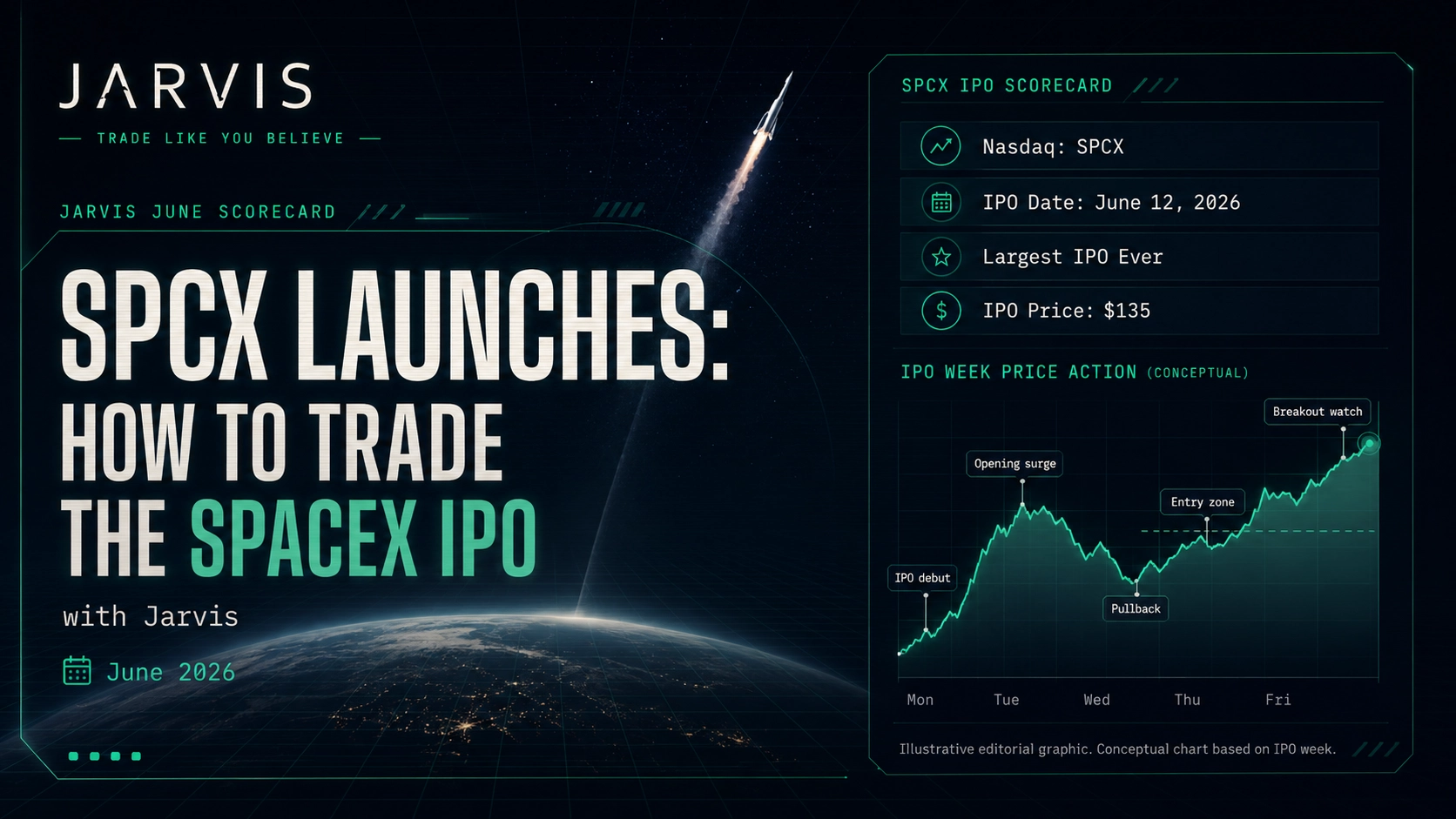
SPCX Launches: How to Trade the SpaceX IPO with Jarvis
June 2026 will be known for one trading headline only: Elon Musk’s SpaceX debuted as the largest IPO in market history on June 12, listing under the ticker SPCX.
The sweeping effect of this event was felt across every market and ticker, including a massive perceived volatility suppression that diminished returns on huge price movements during the launch week.
If you’re new here: Jarvis is an AI trading signals platform that produces zero-lag entry and exit tags across timeframes ranging from 1-minute to 1-day. It’s built for day traders, swing traders, and long-term investors alike. Below, we look at some of June’s best trades using Jarvis signals, plus a snapshot of the SPCX common stock chart in its debut month.
Trade examples are hypothetical and applied retroactively to demonstrate the Jarvis strategy. Trades were not executed in a live account. Results do not account for liquidity, slippage, or fees.
Trade 1
Day Trade Options | Timeframe: 1M
QQQ Put | June 5 | 11:06 am – 12:52 pm
P722 $1.08 → $6.49 | 500% profit
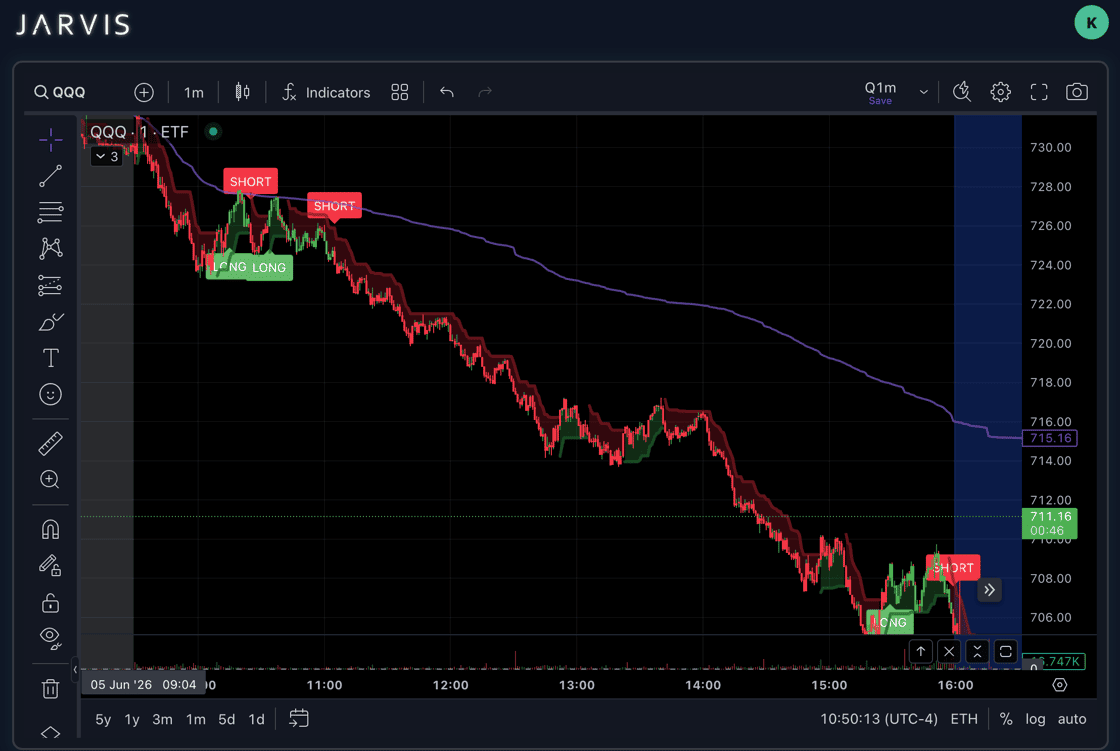
The first Short tag here looked just as appealing in real time, and produced a loss. So the second one tests our mettle. But when we have a negative trend and a Short tag below VWAP (Volume Weighted Average Price, a standard intraday benchmark), we act. Them’s the rules.
Once we’re in the second Short trade, this is a pretty smooth ride that lasts over an hour. The results on this options put are staggering, and it’s a good reminder that one missed setup on Jarvis should never derail our strategy. We trust the software here and bounce back with a month-making 500% trade.
Trade 2
Day Trade Options | Timeframe: 1M
QQQ Put | June 22 | 10:21 am – 11:00 am
P703 $1.12 → $4.13 | 268% profit
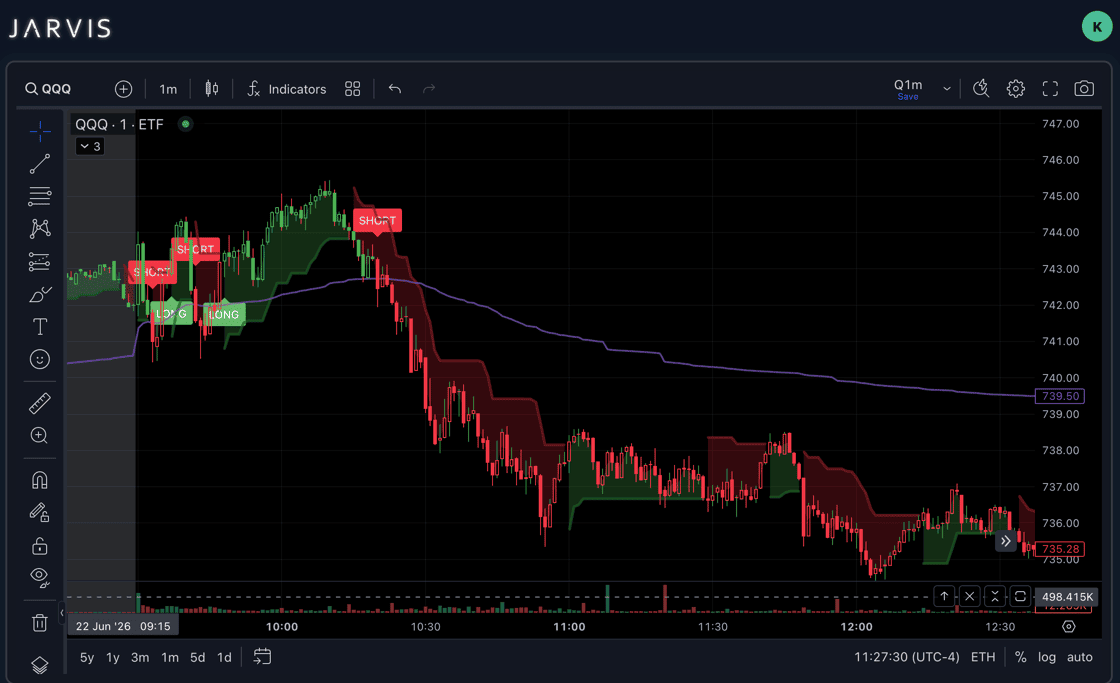
Many mornings start out choppy, and on stream we often warn traders that multiple tags can occur in the first 30 minutes. We typically want to allow time in the morning for a trend to prove itself, and not take every tag we see. This Short tag comes as we move through VWAP, and we enter when the candle closes, riding it to the next cloud break for a strong profit.
Trade 3
Common Stocks | Timeframe: 1H
SPCX ( as of June 26, 2026)
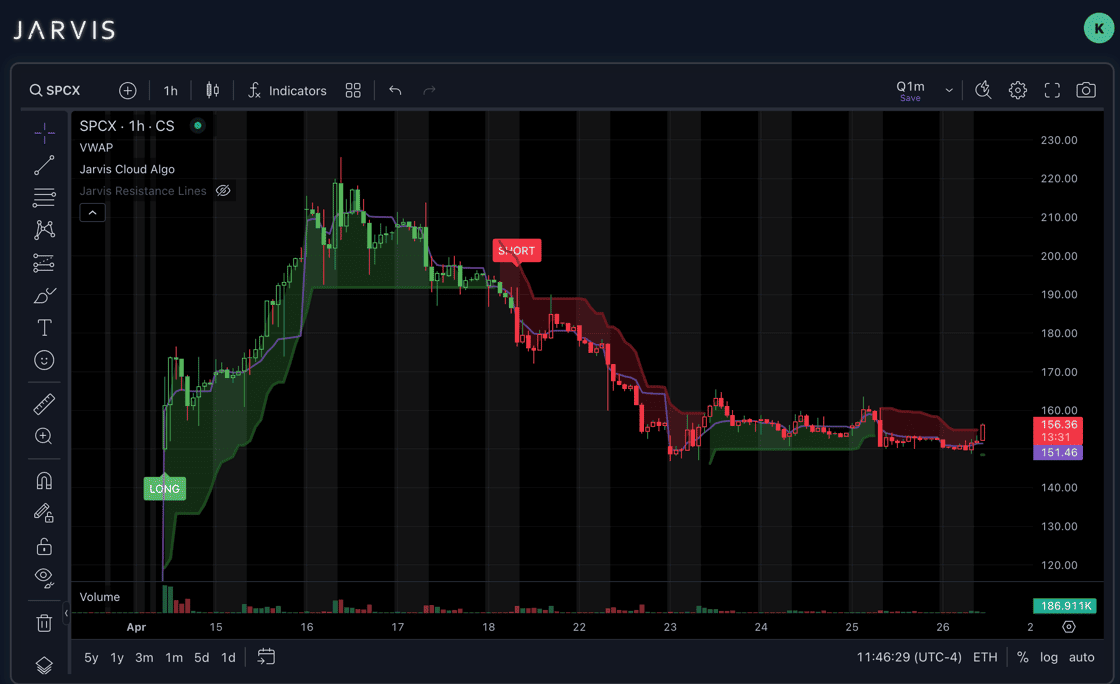
What is SPCX? SPCX is the ticker symbol for SpaceX, which listed on public markets on June 12, 2026 as the largest IPO in market history. The debut sparked heavy volume across every major index and pulled market attention away from typical volatility drivers for most of the launch week.
Moving outside of day trading options, let’s look at how Jarvis perceives the year’s biggest stock debut. The 1-hour candlestick view is the best way to vet opportunities for long-term investing.
As with many front-page IPOs, SpaceX opened with an explosive out-of-the-gate surge before stabilizing into a more reasonable trend. Stocks like SPCX are not always a sure thing, but investors using Jarvis will want to look for the next Long tag on the 1-hour chart to spot entry opportunities with qualified growth potential.
Note for options traders: SPCX got a lot of social media hype in options trading communities, but market makers have a way of staying ahead of the hype. In this opening month, perceived volatility was so extreme that achieving any meaningful profitability was particularly difficult.
The Lesson: Hype Attracts Market Suppression
In trading, extreme strategies are where movies are made, but conservative discipline is where consistently profitable traders are made.
SpaceX joins a long list of popular IPO openings that splash into the pool with a cannonball. But the reality here, and historically, is that the market is already prepared to feast on the sentiment of overeager traders until stabilization occurs. In other words: don’t trade with the hype.
That said, SPCX should join an exciting group of symbols worth monitoring across various trade disciplines, and we’re excited to see how Jarvis will help traders who want to invest and trade the IPO leading the next space race.
New to Jarvis?
Free trial members get full access to the daily JarvisLIVE stream and every signal, on every timeframe, for 30 days. If you want to see the next SPCX entry setup called live, that’s where it happens.
Thanks for trading with Jarvis, and helping create the greatest Discord trading community on the internet. We’ll see you out there.
It’s a great day to trade.
Jarvis
Risk Disclosure
Trading stocks, options, futures, and cryptocurrencies involves substantial risk and is not suitable for every investor. An investor could potentially lose all or more than the initial investment. Risk capital is money that can be lost without jeopardizing one’s financial security or lifestyle. Only risk capital should be used for trading. Past performance is not necessarily indicative of future results.
CFTC Rule 4.41
Simulated performance results have inherent limitations. Unlike an actual performance record, simulated results do not represent actual trading. Since trades have not been executed, results may have under- or over-compensated for the impact of certain market factors, such as a lack of liquidity. Simulated trading programs are generally designed with the benefit of hindsight. No representation is being made that any account will or is likely to achieve profits or losses similar to those shown.
Disclaimer
The information and trading signals provided by KTS Trading, LLC are for educational and informational purposes only and do not constitute investment advice or an offer or solicitation to buy or sell any security. We do not execute trades, manage accounts, or guarantee results. Testimonials presented may not be representative of the experience of other clients and are not a guarantee of future performance or success. All trading decisions are made solely by you at your own risk. You should consult with a licensed financial advisor before making any investment decisions. See our Terms of Service for complete details. KTS Trading, LLC is registered with the U.S. Securities and Exchange Commission.
June 2026 will be known for one trading headline only: Elon Musk’s SpaceX debuted as the largest IPO in market history on June 12, listing under the ticker SPCX.
The sweeping effect of this event was felt across every market and ticker, including a massive perceived volatility suppression that diminished returns on huge price movements during the launch week.
If you’re new here: Jarvis is an AI trading signals platform that produces zero-lag entry and exit tags across timeframes ranging from 1-minute to 1-day. It’s built for day traders, swing traders, and long-term investors alike. Below, we look at some of June’s best trades using Jarvis signals, plus a snapshot of the SPCX common stock chart in its debut month.
Trade examples are hypothetical and applied retroactively to demonstrate the Jarvis strategy. Trades were not executed in a live account. Results do not account for liquidity, slippage, or fees.
Trade 1
Day Trade Options | Timeframe: 1M
QQQ Put | June 5 | 11:06 am – 12:52 pm
P722 $1.08 → $6.49 | 500% profit
The first Short tag here looked just as appealing in real time, and produced a loss. So the second one tests our mettle. But when we have a negative trend and a Short tag below VWAP (Volume Weighted Average Price, a standard intraday benchmark), we act. Them’s the rules.
Once we’re in the second Short trade, this is a pretty smooth ride that lasts over an hour. The results on this options put are staggering, and it’s a good reminder that one missed setup on Jarvis should never derail our strategy. We trust the software here and bounce back with a month-making 500% trade.
Trade 2
Day Trade Options | Timeframe: 1M
QQQ Put | June 22 | 10:21 am – 11:00 am
P703 $1.12 → $4.13 | 268% profit
Many mornings start out choppy, and on stream we often warn traders that multiple tags can occur in the first 30 minutes. We typically want to allow time in the morning for a trend to prove itself, and not take every tag we see. This Short tag comes as we move through VWAP, and we enter when the candle closes, riding it to the next cloud break for a strong profit.
Trade 3
Common Stocks | Timeframe: 1H
SPCX ( as of June 26, 2026)
What is SPCX? SPCX is the ticker symbol for SpaceX, which listed on public markets on June 12, 2026 as the largest IPO in market history. The debut sparked heavy volume across every major index and pulled market attention away from typical volatility drivers for most of the launch week.
Moving outside of day trading options, let’s look at how Jarvis perceives the year’s biggest stock debut. The 1-hour candlestick view is the best way to vet opportunities for long-term investing.
As with many front-page IPOs, SpaceX opened with an explosive out-of-the-gate surge before stabilizing into a more reasonable trend. Stocks like SPCX are not always a sure thing, but investors using Jarvis will want to look for the next Long tag on the 1-hour chart to spot entry opportunities with qualified growth potential.
Note for options traders: SPCX got a lot of social media hype in options trading communities, but market makers have a way of staying ahead of the hype. In this opening month, perceived volatility was so extreme that achieving any meaningful profitability was particularly difficult.
The Lesson: Hype Attracts Market Suppression
In trading, extreme strategies are where movies are made, but conservative discipline is where consistently profitable traders are made.
SpaceX joins a long list of popular IPO openings that splash into the pool with a cannonball. But the reality here, and historically, is that the market is already prepared to feast on the sentiment of overeager traders until stabilization occurs. In other words: don’t trade with the hype.
That said, SPCX should join an exciting group of symbols worth monitoring across various trade disciplines, and we’re excited to see how Jarvis will help traders who want to invest and trade the IPO leading the next space race.
New to Jarvis?
Free trial members get full access to the daily JarvisLIVE stream and every signal, on every timeframe, for 30 days. If you want to see the next SPCX entry setup called live, that’s where it happens.
Thanks for trading with Jarvis, and helping create the greatest Discord trading community on the internet. We’ll see you out there.
It’s a great day to trade.
Jarvis
Risk Disclosure
Trading stocks, options, futures, and cryptocurrencies involves substantial risk and is not suitable for every investor. An investor could potentially lose all or more than the initial investment. Risk capital is money that can be lost without jeopardizing one’s financial security or lifestyle. Only risk capital should be used for trading. Past performance is not necessarily indicative of future results.
CFTC Rule 4.41
Simulated performance results have inherent limitations. Unlike an actual performance record, simulated results do not represent actual trading. Since trades have not been executed, results may have under- or over-compensated for the impact of certain market factors, such as a lack of liquidity. Simulated trading programs are generally designed with the benefit of hindsight. No representation is being made that any account will or is likely to achieve profits or losses similar to those shown.
Disclaimer
The information and trading signals provided by KTS Trading, LLC are for educational and informational purposes only and do not constitute investment advice or an offer or solicitation to buy or sell any security. We do not execute trades, manage accounts, or guarantee results. Testimonials presented may not be representative of the experience of other clients and are not a guarantee of future performance or success. All trading decisions are made solely by you at your own risk. You should consult with a licensed financial advisor before making any investment decisions. See our Terms of Service for complete details. KTS Trading, LLC is registered with the U.S. Securities and Exchange Commission.
This Is Your Time
Are you ready to discover what trading can do for your life?
Get Jarvis FREE for 30 days, and see for yourself—the proof is in the profit.