

The Enemy Inside Your Winning Trade
You just closed a trade with 430% profit. Your account balance just jumped. Your strategy worked flawlessly. And yet, somehow, you feel like you lost.
The most dangerous opponent in trading lives in your own mind. And he’s whispering:
That wasn't enough.
Greed silently teaches you to mistrust your strategy and sabotage it with what-ifs. Profitable traders are the ones who learn to accept what their strategy affords them with gratitude. They have the ability to be satisfied with a win.
Trade examples are hypothetical and applied retroactively to demonstrate the Jarvis strategy. Trades were not executed in a live account. Results are based on exact signal execution and do not account for liquidity, slippage, or fees.
What this looks like in real trading
Let us show you two Jarvis options day trades from January 2026 that perfectly capture this psychological warfare.
The 430% Winner You Criticize
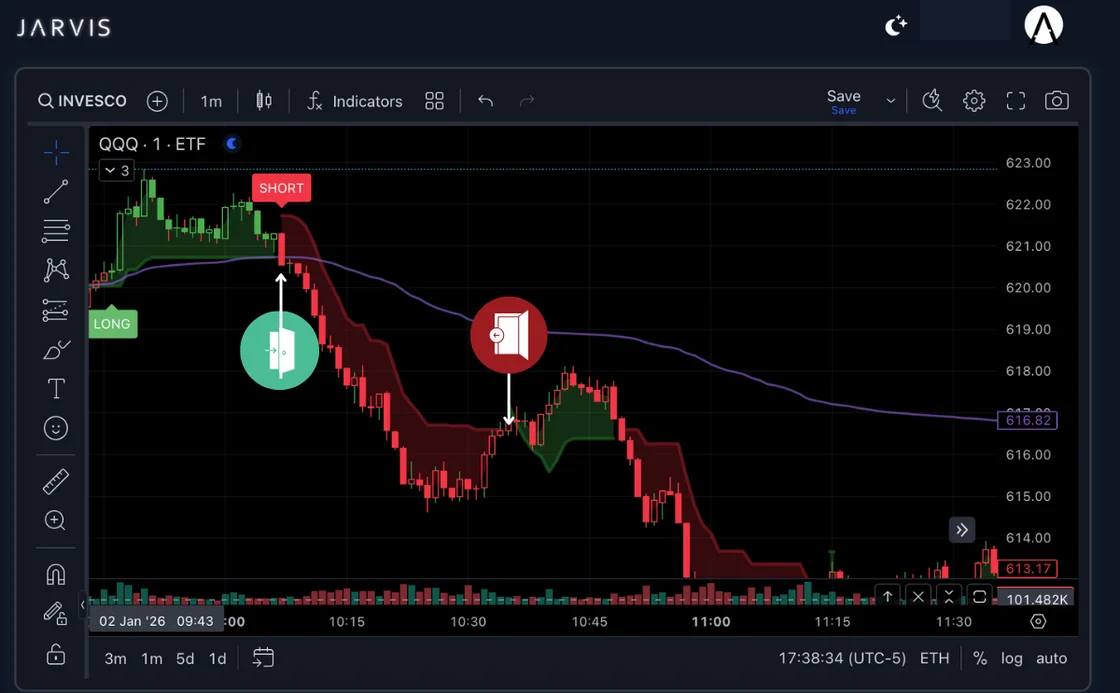
On January 2nd, a QQQ Put signal triggered at 10:07 AM. Entry at $0.73, exit at 10:34 AM for $3.88. A 430% profit in 27 minutes.
But in those final four minutes before the cloud break signaled the exit, the price retraced. You watched some of your profit evaporate. Not enough to turn it into a loss—you still walked away with over 400% gains—but enough to trigger that voice:
I should have held longer.
I should have taken profit earlier.
I should have known.
Greed masquerades as wisdom, as instinct, as being a "better" trader. But here's what it really is: the refusal to let a profitable strategy satisfy you.
This is the trap. In that moment, you cannot know if the retracement will reverse or continue. You cannot know if holding would have given you more or cost you everything.
Greed is telling you “I should have known.”
You shouldn’t have.
Because you couldn’t have.
The win that feels like a loss
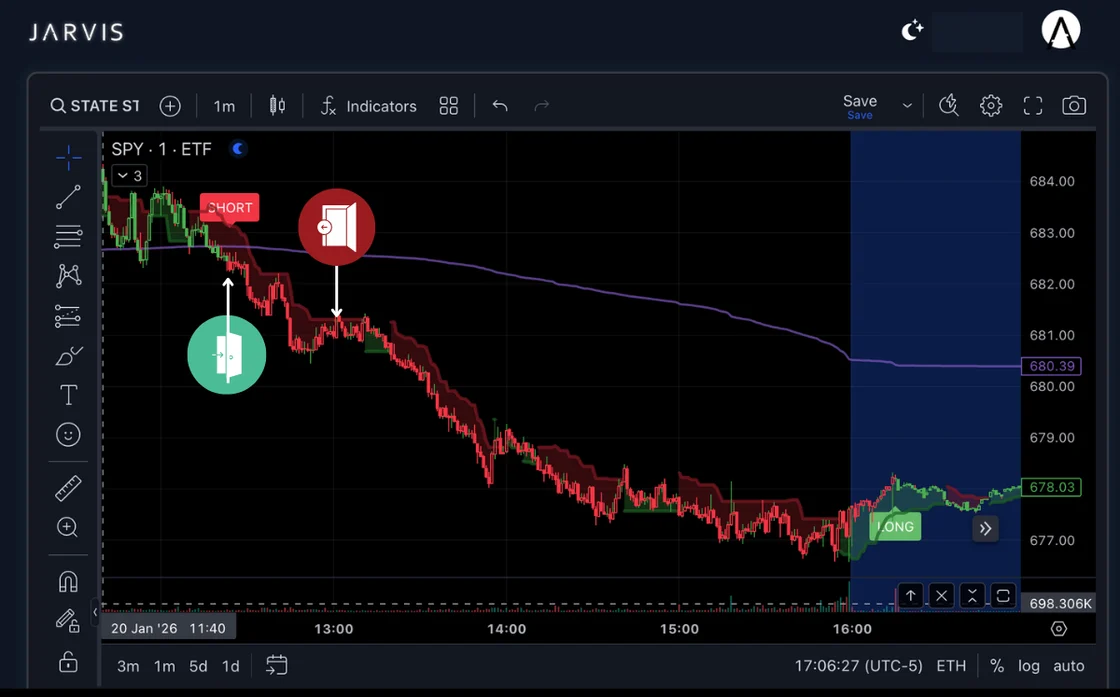
On January 20th, a SPY Put entry at 12:24 PM and exit at 1:10 PM delivered 71% profit under an hour. Most traders would celebrate this.
Then the rest of the day’s chart unfolds as a full-out continuation that you’re not in. Still celebrating?
By 2 PM, that same position would have hit 280%. The continuation ran right after the exit, and suddenly 71% feels like a failure. "What was I thinking? The candles barely broke the cloud!"
Here's the brutal truth: The greed that keeps you in for the rare 10% of continuations will also trap you in 90% of the reversals.
How much is enough?
This is the question at the heart of every trade, and the heart of every human:
How much is enough?
430% profit? Not enough if you think about the retracement you "could have avoided."
71% in an hour? Not enough when you see the continuation you "could have caught."
The trades were winners. The issue is that you're measuring success against an impossible standard: perfection.
Perfection is a Trap
You want to maximize every single trade. You want to enter at the absolute bottom and exit at the absolute top. You want to capture 100% of every move while avoiding 100% of every pullback. This sounds like good trading, but it's actually the mindset that destroys accounts.
There is no one, no bot, and no algorithm doing this. And there never will be. But let’s keep the focus on you. Because you have to learn how to deal with this inner-voice.
Chasing perfection means you'll break your rules. You'll override your signals. You'll convince yourself that this time you know better than your strategy. In an effort to “optimize strategy” you’ll guarantee your losses.
Jarvis brings information to the table. You bring discipline.
Conservative Wins Beat Perfect Losses
Jarvis is designed for more than predictive probabilities. It’s designed to protect you from yourself.
The conservative approach prioritizes safety over recklessly attempting to maximize each individual trade. Your entries and exits are meant to capture substantial profits while protecting you from the reversals that wipe out accounts.
Sometimes you'll exit before the absolute peak. Sometimes you'll feel like you "left money on the table."
That feeling is proof that a conservative strategy is working.
Consistency Over Heroics
Think about what you're really building here. You're not trying to hit the lottery on a single perfect trade. You're building a repeatable process that generates consistent profits while protecting you from devastating losses.
That 71% gain compounds. That 430% winner builds your account. Successes executed with discipline within a proven strategy.
The traders who blow up their accounts are the ones who can't accept a win without chasing the shadow of a bigger one. Their motto is: "this time is different." They obey emotions while pretending to trust strategy.
An Equation to Live By
Execute Clean + Take Profit = Be Content
This is your path to becoming a confident trader. One who can execute a strategy, capture wins, and walk away satisfied.
1. Execute Clean
Follow the signals. Trust the tags and clouds on your ticker. Don’t enter when there’s no tag. The strategy is built on data and expertise that took years to develop. Your job is to execute it, not reinvent it in real-time.
2. Take Profit
Exit when Jarvis tells you to exit. Not when your emotions think it's time. Not when you've calculated some arbitrary profit target. When the cloud breaks, step out. This is how you build consistency.
3. Be Content
This is the hardest part—and the most important. Accept that you captured a win within a profitable strategy. Let go of the fantasy that you'll one day develop such perfect instincts that you'll know exactly when to override your strategy.
The trade of the century happens every day. Content traders understand that more profits don’t come from trade perfection, but through patience. Another great opportunity is always around the corner.
Trust the Process
Some of the best instinct and process traders in our community—people with years of experience and profitable track records—still look at Jarvis's signals and think, "That was better than what I did."
If experienced, profitable traders can recognize that Jarvis's systematic approach outperforms their own discretionary decisions, what makes you think your emotional override in the heat of the moment will be better?
Jarvis simplifies trading so you don't have to be a superhuman decision-maker. When you stop fighting the strategy and start trusting it, something shifts. The anxiety decreases. The second-guessing fades. You start to feel like a trader who knows what they're doing—because you do. You're executing a proven strategy with discipline.
Trade Better Together
This isn't a journey you have to take alone. Our community on Discord is full of traders wrestling with these same psychological battles, celebrating clean executions, and supporting each other through the learning curve.
Join us for daily live-stream coaching on JarvisLIVE, where we break down setups in real-time, discuss signals as they happen, and help you build the mental fortitude to trade with confidence.
Because here's what we've discovered: Trading is for everyone. And when you have the right tools and the right community, you can master the discipline that turns ordinary people into confident traders.
Every trader who masters their greed and learns to be content with wins is proving that this industry doesn't belong to the elites anymore.
It belongs to you.
Still not subscribed to Jarvis? Time to get in here! Use this link to claim 30 days for free and see the Jarvis strategy in action.
More Stories
Trading bot vs signals: Should you give up control of your trades?
Trading bot vs signals: Should you give up control of your trades?
“Can I get a bot to trade for me?”
Before AI ever went mainstream, this question was already on every trader’s mind. Finding the right answer comes down to two things: whether fully automated trading bots are effective, and whether traders should hand over that kind of control in the first place.
Let’s examine the trade-offs between trading bots and real-time signals, examine where automation exposes traders the most, and show how traders can leverage algorithmic speed without giving up control of your trades.
How to tell a trading signal from a bot
Every trader uses tools to navigate the market, and the functions of trading tools fit into a few categorical buckets:
- Information: feeds and market data
- Education: trading guidance and disciplines
- Analysis: indicators and visual signals
- Execution: order placement and brokers
- Automation: trade execution by bots
Signals and bots are both built on algorithmic rule sets that determine their actions. The distinction between them comes down to who executes the trades.
Signal services analyze historic and live data giving traders real-time visual context for discretionary execution.
Trading bots take that analysis a step further, routing orders directly to a brokerage based on preset conditional logic.
Who are trading bots best for?
Experienced traders know that the greatest danger to your capital is often your own emotions. Fear, greed, and panic can disrupt strategies and derail a trader’s day before it even begins.
It’s easy to see the appeal, then, of an automated trading platform that is truly unemotional, both in analysis and execution.
In fact, all of this happens without the trader having to sit staring at a screen or managing active positions. The time-investment comes on the front end, fine-tuning your bot’s dials for backtesting and eventually live trading.
Because of this, trading bots are best suited for traders with a strong grasp of technical indicators like RSI and MACD, understand performance metrics like maximum drawdown, and want to apply their trading logic without spending all day on the screen.
All of this upside would be incredible for most traders if there weren’t risks attached to it. So what’s the catch?
Weighing automated trading risk
Automated trading features can feel more like hypothesis than reality once you’ve put real capital behind the bots you’ve built. It doesn’t take a human sitting at the station for errors to compromise a trading strategy, or for you to feel a knot of dread your stomach knowing that your capital is on the line.
Traders should weigh out a few things before putting a bot behind the wheel of their brokerage account:
API permission risks
Bots require full API execution access to your brokerage account. This means an automation has full permission to lose your capital, and all the liability rests on you.
Logic errors & parameter drift
Unemotional bots continuously execute orders that fulfill its instructions even when market regimes shift, or tuning mistakes trigger avoidable losses. A bot has no judgment to shut off the valve without human intervention.
Complexity & skill barrier
Setting effective parameters requires experienced knowledge of market microstructure. Bots can amplify financial risks to unimaginable proportions in the hands of the unprepared.
No promised results
There is no trading tool that can guarantee success. For the novices looking for a solution to trade profitably without experience or involvement, automation is not the answer. Market makers have more sophisticated tools than you can imagine. Yes, that includes your Claude vibe-trader.
None of this means that automated trading can’t work. Like any other form of trading, bots have their pros and cons. There is simply a reality of time investment, expertise, and risk that automated AI trading services can’t eliminate.
How to use signals without losing control of your trades
You don’t need to hand over control of your account to benefit from algorithmic speed.
Many traders appreciate the mathematical automation offered by AI trading bots, but want the final say in their trades. Trading signal suites like Jarvis are perfect for traders seeking this intersection of algo logic and human control.
Jarvis: for trader enhancement, not replacement
Instead of connecting to your brokerage and executing trades on your behalf, Jarvis focuses on distilling complex market data into the simplest format to help you make trading decisions in the moment.
Long & short signals can be fitted to any symbol or timeframe for day trading, investing, crypto, and more. Every signal you see is a real-time indicator surfacing entry opportunities for your selected asset and trading style.
Single screen trading reduces visual noise to prevent the information overload that leads to hesitation or overtrading. Jarvis works side-by side with your brokerage.
Manually execute trades only on the signals you feel totally confident about. The Jarvis algorithm is hard at work 24/7 to find the best entries. Acting on them is 100% your choice.
Is automated trading right for you?
For traders with a knack for experimentation, automated trading offers limitless options. New services emerge weekly, offering nearly infinite automation configurations. Just be careful not to be swept up in overpromised results, remembering that anything in trading that seems too good to be true, probably is.
And if you feel like you’re the only one who thinks maybe automated trading isn’t really the future of trading–at least not yet–know that you’re not alone. Human intuition will always play a role, because at the end of the trading day, no one has to answer for your results…except you.
FAQ
Q: Does Jarvis place trades for you automatically?
No. Jarvis is a visual trading tool that distills live information into simple signals that traders then use to execute trades within their own brokerage account.
Q: What’s the difference between a trading signal and a trading bot?
A trading signal is a single-moment indicator that highlights potential market setups for manual execution. A trading bot is an automated script that routes orders according to a predefined set of rules.
Q: Do I need experience to use Jarvis if it doesn’t trade for me?
Jarvis is quick to learn, and most users show strong comprehension after a week of participating in our live stream. It’s also important that you know your way around your brokerage platform, understanding exactly how to enter, exit, and size your trades for the correct instruments. That is where your capital is at stake and it’s important that you know how to use it.
Trading bot vs signals: Should you give up control of your trades?
“Can I get a bot to trade for me?”
Before AI ever went mainstream, this question was already on every trader’s mind. Finding the right answer comes down to two things: whether fully automated trading bots are effective, and whether traders should hand over that kind of control in the first place.
Let’s examine the trade-offs between trading bots and real-time signals, examine where automation exposes traders the most, and show how traders can leverage algorithmic speed without giving up control of your trades.
How to tell a trading signal from a bot
Every trader uses tools to navigate the market, and the functions of trading tools fit into a few categorical buckets:
- Information: feeds and market data
- Education: trading guidance and disciplines
- Analysis: indicators and visual signals
- Execution: order placement and brokers
- Automation: trade execution by bots
Signals and bots are both built on algorithmic rule sets that determine their actions. The distinction between them comes down to who executes the trades.
Signal services analyze historic and live data giving traders real-time visual context for discretionary execution.
Trading bots take that analysis a step further, routing orders directly to a brokerage based on preset conditional logic.
Who are trading bots best for?
Experienced traders know that the greatest danger to your capital is often your own emotions. Fear, greed, and panic can disrupt strategies and derail a trader’s day before it even begins.
It’s easy to see the appeal, then, of an automated trading platform that is truly unemotional, both in analysis and execution.
In fact, all of this happens without the trader having to sit staring at a screen or managing active positions. The time-investment comes on the front end, fine-tuning your bot’s dials for backtesting and eventually live trading.
Because of this, trading bots are best suited for traders with a strong grasp of technical indicators like RSI and MACD, understand performance metrics like maximum drawdown, and want to apply their trading logic without spending all day on the screen.
All of this upside would be incredible for most traders if there weren’t risks attached to it. So what’s the catch?
Weighing automated trading risk
Automated trading features can feel more like hypothesis than reality once you’ve put real capital behind the bots you’ve built. It doesn’t take a human sitting at the station for errors to compromise a trading strategy, or for you to feel a knot of dread your stomach knowing that your capital is on the line.
Traders should weigh out a few things before putting a bot behind the wheel of their brokerage account:
API permission risks
Bots require full API execution access to your brokerage account. This means an automation has full permission to lose your capital, and all the liability rests on you.
Logic errors & parameter drift
Unemotional bots continuously execute orders that fulfill its instructions even when market regimes shift, or tuning mistakes trigger avoidable losses. A bot has no judgment to shut off the valve without human intervention.
Complexity & skill barrier
Setting effective parameters requires experienced knowledge of market microstructure. Bots can amplify financial risks to unimaginable proportions in the hands of the unprepared.
No promised results
There is no trading tool that can guarantee success. For the novices looking for a solution to trade profitably without experience or involvement, automation is not the answer. Market makers have more sophisticated tools than you can imagine. Yes, that includes your Claude vibe-trader.
None of this means that automated trading can’t work. Like any other form of trading, bots have their pros and cons. There is simply a reality of time investment, expertise, and risk that automated AI trading services can’t eliminate.
How to use signals without losing control of your trades
You don’t need to hand over control of your account to benefit from algorithmic speed.
Many traders appreciate the mathematical automation offered by AI trading bots, but want the final say in their trades. Trading signal suites like Jarvis are perfect for traders seeking this intersection of algo logic and human control.
Jarvis: for trader enhancement, not replacement
Instead of connecting to your brokerage and executing trades on your behalf, Jarvis focuses on distilling complex market data into the simplest format to help you make trading decisions in the moment.
Long & short signals can be fitted to any symbol or timeframe for day trading, investing, crypto, and more. Every signal you see is a real-time indicator surfacing entry opportunities for your selected asset and trading style.
Single screen trading reduces visual noise to prevent the information overload that leads to hesitation or overtrading. Jarvis works side-by side with your brokerage.
Manually execute trades only on the signals you feel totally confident about. The Jarvis algorithm is hard at work 24/7 to find the best entries. Acting on them is 100% your choice.
Is automated trading right for you?
For traders with a knack for experimentation, automated trading offers limitless options. New services emerge weekly, offering nearly infinite automation configurations. Just be careful not to be swept up in overpromised results, remembering that anything in trading that seems too good to be true, probably is.
And if you feel like you’re the only one who thinks maybe automated trading isn’t really the future of trading–at least not yet–know that you’re not alone. Human intuition will always play a role, because at the end of the trading day, no one has to answer for your results…except you.
FAQ
Q: Does Jarvis place trades for you automatically?
No. Jarvis is a visual trading tool that distills live information into simple signals that traders then use to execute trades within their own brokerage account.
Q: What’s the difference between a trading signal and a trading bot?
A trading signal is a single-moment indicator that highlights potential market setups for manual execution. A trading bot is an automated script that routes orders according to a predefined set of rules.
Q: Do I need experience to use Jarvis if it doesn’t trade for me?
Jarvis is quick to learn, and most users show strong comprehension after a week of participating in our live stream. It’s also important that you know your way around your brokerage platform, understanding exactly how to enter, exit, and size your trades for the correct instruments. That is where your capital is at stake and it’s important that you know how to use it.
The Day Trading Trifecta: A Rules-Based Options Strategy
Jarvis was built first and foremost on simplicity, making it possible for anyone to trade. But once you’re comfortable, the goal is improving consistency. That takes discipline, but it also requires a strategy.
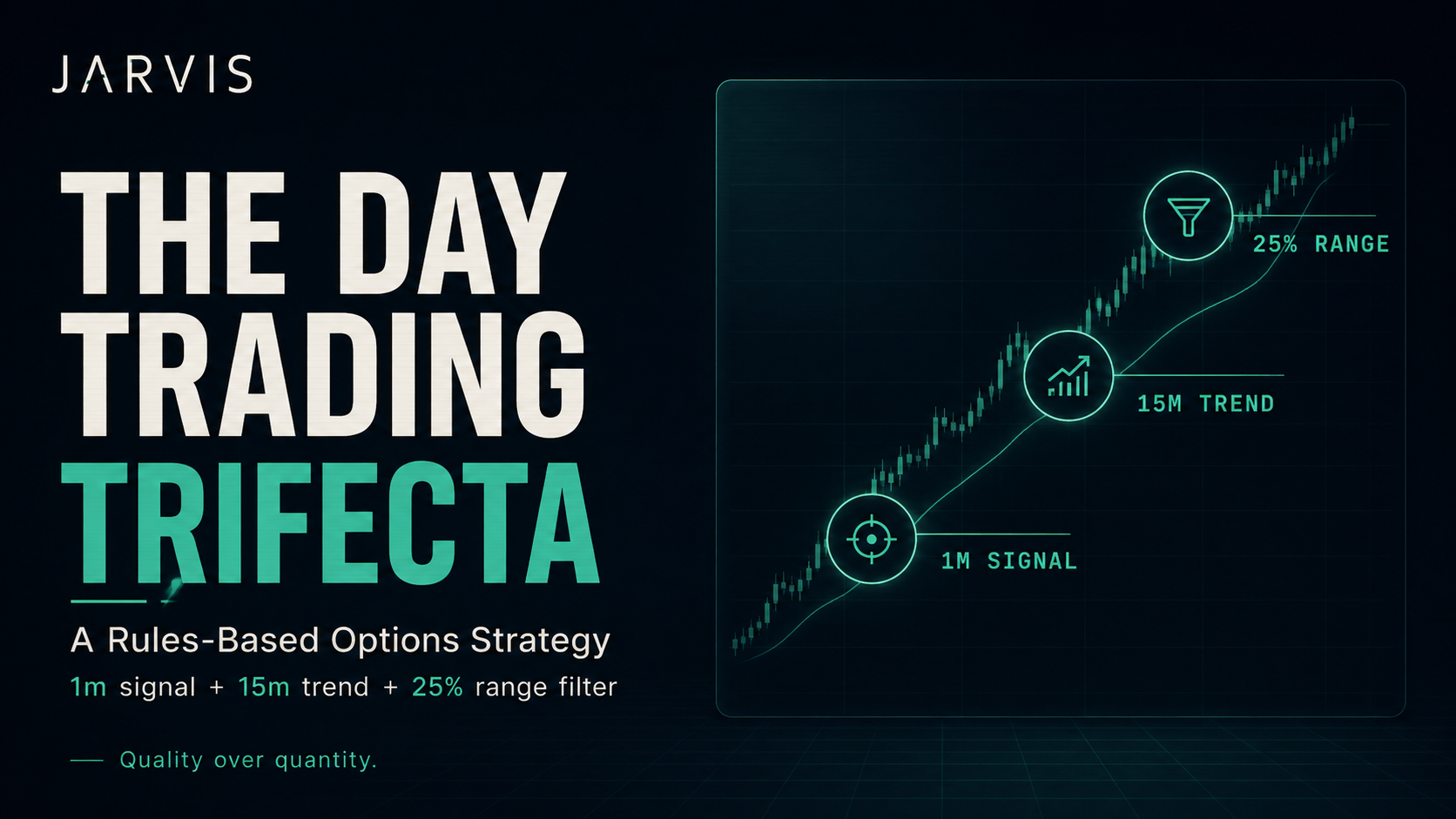
This month on stream, we’ve been practicing what we call the Day Trading Trifecta: a rules-based approach to day trading options that stacks the standard Jarvis 1-minute signal with two additional filters designed to rule out low-quality setups.
If you’re new here: Jarvis is an AI trading signals platform that produces zero-lag entry and exit tags (called LONG and SHORT) across timeframes from 1-minute to 1-day. The Trifecta is one of the strategies we teach on the JarvisLIVE Discord stream, and it’s built to be simple enough for regular retail traders to execute consistently.
The Day Trading Trifecta: 3 Rules
All three conditions must align before entering a trade:
- Signal. A 1-minute Jarvis tag (LONG or SHORT) fires and confirms on the candle close.
- Trend agreement. The 15-minute chart is trending the same direction as the entry (green cloud for a LONG, red cloud for a SHORT). This confirms the longer-term move supports the trade.
- Range check. The instrument is within 25% of its opening range. This filter helps avoid chasing a move that’s already extended.
If any one of these fails, we pass on the tag. The point is not to trade more, but to trade cleaner.
Trade 1: Novice
Day Trade Options | Timeframe: 1MSPY Put | July 31 | 9:39 am startP743 $1.01 → $5.00+ | 395%+ profit
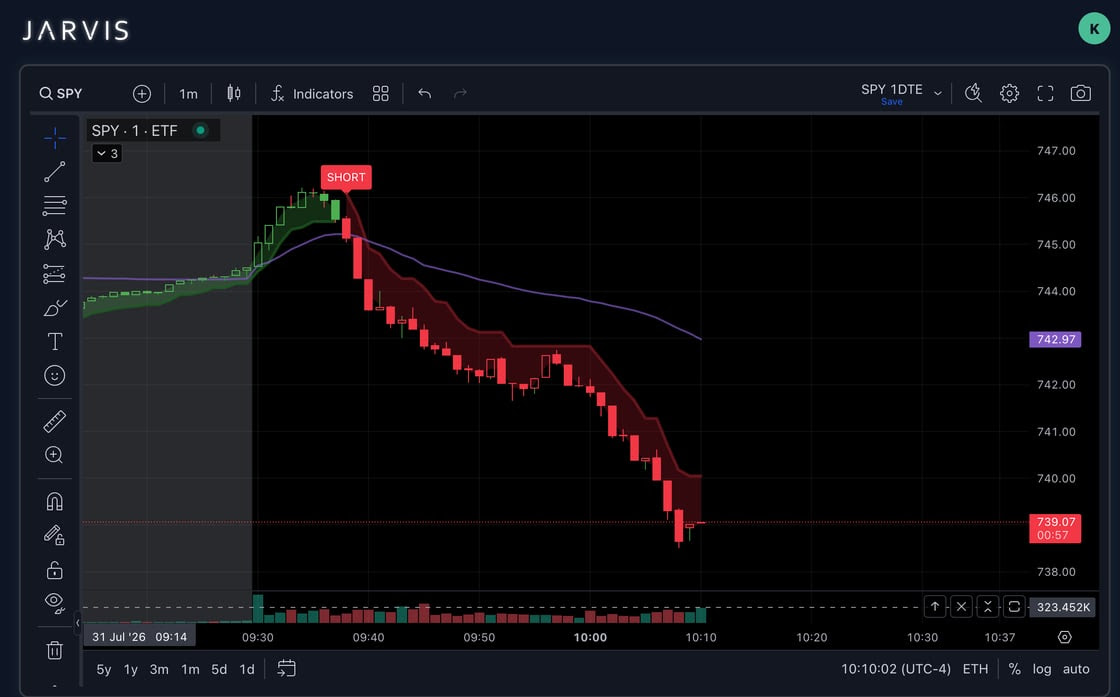
This trade was active as we drafted the July recap. It’s a textbook setup that even novice traders can identify using Jarvis.
This trade represents the most basic Jarvis strategy: trade on tags when the candle closes, moving away from VWAP (Volume Weighted Average Price, a standard intraday benchmark).This trade also had time to establish a trend, going green-to-red rather than starting out choppy as some days do. A lot of good signs for a simple trade that happens to precede a long, smooth run.
Exit Rule: While our default exit target is a cloud break (when the Jarvis colored cloud flips against the trade), locking in profit at a moment like this after a run of this scale is standard risk management.
Trade 2: Intermediate
Day Trade Options | Timeframe: 1MSPY Call | July 27 | 9:42 am – 10:49 amC739 $0.76 → $3.72 | 389% profit
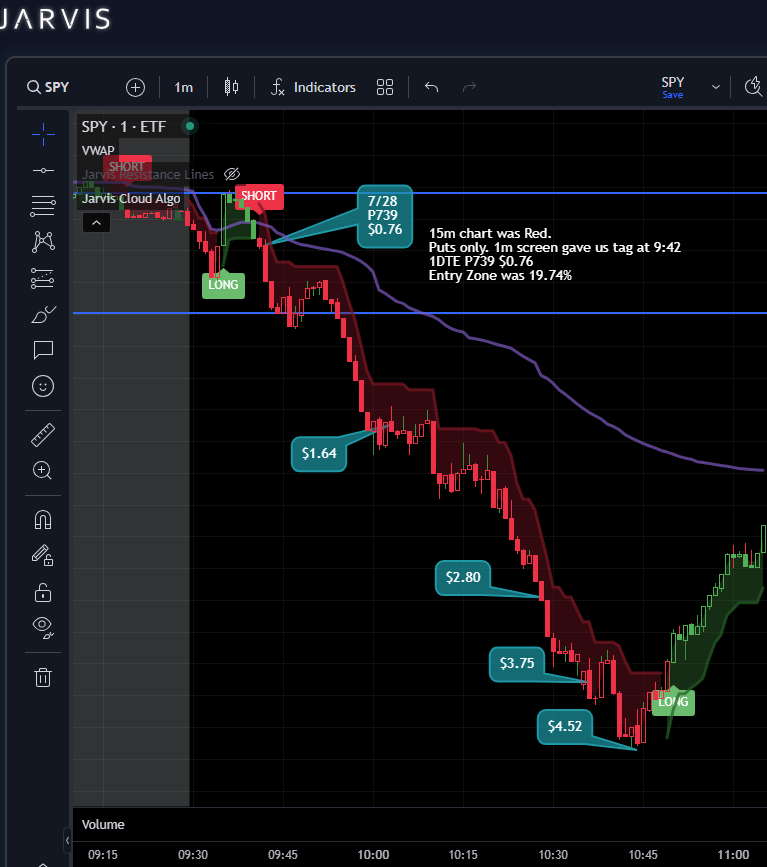
Our Trifecta strategy is built to rule out even more signals on the screen. It kept us out of the LONG tag we see at the top of the chart, and got us into the SHORT.
- This is the 1-minute view of the chart. The 15-minute view showed a red trend, which is why we’re only considering options puts and ignoring calls.
- We drew a range on our instrument chart in ThinkorSwim to ensure our 1-minute entry signal was within 25% of the chart’s open. This one came in at 19.74%.
- So when we see the 1-minute SHORT tag, check, check, check. Trifecta.
The Lesson: Quality Over Quantity
Overtrading absolutely kills long-term P&L across disciplines. Even with Jarvis, we recognize that repeatable strategies can reduce the number of tags we’re willing to consider. Every strategy we introduce is an effort to trade smarter, while keeping our process simple enough for regular retail traders to execute.
If you want to see this model practiced or explained further, our live stream on Discord is the place to be. It’s included in our 30-day free trial.
New to Jarvis?
Free trial members get full access to the daily JarvisLIVE stream and every signal on every timeframe for 30 days. Want to see the next Trifecta setup called live? That’s where it happens.
Thanks for trading with Jarvis, and helping create the greatest Discord trading community on the internet. We’ll see you out there.
It’s a great day to trade.
Jarvis
Risk Disclosure
Trading stocks, options, futures, and cryptocurrencies involves substantial risk and is not suitable for every investor. An investor could potentially lose all or more than the initial investment. Risk capital is money that can be lost without jeopardizing one’s financial security or lifestyle. Only risk capital should be used for trading. Past performance is not necessarily indicative of future results.
CFTC Rule 4.41
Simulated performance results have inherent limitations. Unlike an actual performance record, simulated results do not represent actual trading. Since trades have not been executed, results may have under- or over-compensated for the impact of certain market factors, such as a lack of liquidity. Simulated trading programs are generally designed with the benefit of hindsight. No representation is being made that any account will or is likely to achieve profits or losses similar to those shown.
Disclaimer
The information and trading signals provided by KTS Trading, LLC are for educational and informational purposes only and do not constitute investment advice or an offer or solicitation to buy or sell any security. We do not execute trades, manage accounts, or guarantee results. Testimonials presented may not be representative of the experience of other clients and are nota guarantee of future performance or success. All trading decisions are made solely by you at your own risk. You should consult with a licensed financial advisor before making any investment decisions. See our Terms of Service for complete details. KTS Trading, LLC is registered with the U.S. Securities and Exchange Commission.
Jarvis was built first and foremost on simplicity, making it possible for anyone to trade. But once you’re comfortable, the goal is improving consistency. That takes discipline, but it also requires a strategy.
This month on stream, we’ve been practicing what we call the Day Trading Trifecta: a rules-based approach to day trading options that stacks the standard Jarvis 1-minute signal with two additional filters designed to rule out low-quality setups.
If you’re new here: Jarvis is an AI trading signals platform that produces zero-lag entry and exit tags (called LONG and SHORT) across timeframes from 1-minute to 1-day. The Trifecta is one of the strategies we teach on the JarvisLIVE Discord stream, and it’s built to be simple enough for regular retail traders to execute consistently.
The Day Trading Trifecta: 3 Rules
All three conditions must align before entering a trade:
- Signal. A 1-minute Jarvis tag (LONG or SHORT) fires and confirms on the candle close.
- Trend agreement. The 15-minute chart is trending the same direction as the entry (green cloud for a LONG, red cloud for a SHORT). This confirms the longer-term move supports the trade.
- Range check. The instrument is within 25% of its opening range. This filter helps avoid chasing a move that’s already extended.
If any one of these fails, we pass on the tag. The point is not to trade more, but to trade cleaner.
Trade 1: Novice
Day Trade Options | Timeframe: 1MSPY Put | July 31 | 9:39 am startP743 $1.01 → $5.00+ | 395%+ profit
This trade was active as we drafted the July recap. It’s a textbook setup that even novice traders can identify using Jarvis.
This trade represents the most basic Jarvis strategy: trade on tags when the candle closes, moving away from VWAP (Volume Weighted Average Price, a standard intraday benchmark).This trade also had time to establish a trend, going green-to-red rather than starting out choppy as some days do. A lot of good signs for a simple trade that happens to precede a long, smooth run.
Exit Rule: While our default exit target is a cloud break (when the Jarvis colored cloud flips against the trade), locking in profit at a moment like this after a run of this scale is standard risk management.
Trade 2: Intermediate
Day Trade Options | Timeframe: 1MSPY Call | July 27 | 9:42 am – 10:49 amC739 $0.76 → $3.72 | 389% profit
Our Trifecta strategy is built to rule out even more signals on the screen. It kept us out of the LONG tag we see at the top of the chart, and got us into the SHORT.
- This is the 1-minute view of the chart. The 15-minute view showed a red trend, which is why we’re only considering options puts and ignoring calls.
- We drew a range on our instrument chart in ThinkorSwim to ensure our 1-minute entry signal was within 25% of the chart’s open. This one came in at 19.74%.
- So when we see the 1-minute SHORT tag, check, check, check. Trifecta.
The Lesson: Quality Over Quantity
Overtrading absolutely kills long-term P&L across disciplines. Even with Jarvis, we recognize that repeatable strategies can reduce the number of tags we’re willing to consider. Every strategy we introduce is an effort to trade smarter, while keeping our process simple enough for regular retail traders to execute.
If you want to see this model practiced or explained further, our live stream on Discord is the place to be. It’s included in our 30-day free trial.
New to Jarvis?
Free trial members get full access to the daily JarvisLIVE stream and every signal on every timeframe for 30 days. Want to see the next Trifecta setup called live? That’s where it happens.
Thanks for trading with Jarvis, and helping create the greatest Discord trading community on the internet. We’ll see you out there.
It’s a great day to trade.
Jarvis
Risk Disclosure
Trading stocks, options, futures, and cryptocurrencies involves substantial risk and is not suitable for every investor. An investor could potentially lose all or more than the initial investment. Risk capital is money that can be lost without jeopardizing one’s financial security or lifestyle. Only risk capital should be used for trading. Past performance is not necessarily indicative of future results.
CFTC Rule 4.41
Simulated performance results have inherent limitations. Unlike an actual performance record, simulated results do not represent actual trading. Since trades have not been executed, results may have under- or over-compensated for the impact of certain market factors, such as a lack of liquidity. Simulated trading programs are generally designed with the benefit of hindsight. No representation is being made that any account will or is likely to achieve profits or losses similar to those shown.
Disclaimer
The information and trading signals provided by KTS Trading, LLC are for educational and informational purposes only and do not constitute investment advice or an offer or solicitation to buy or sell any security. We do not execute trades, manage accounts, or guarantee results. Testimonials presented may not be representative of the experience of other clients and are nota guarantee of future performance or success. All trading decisions are made solely by you at your own risk. You should consult with a licensed financial advisor before making any investment decisions. See our Terms of Service for complete details. KTS Trading, LLC is registered with the U.S. Securities and Exchange Commission.