
Options Trading Software
For Intermediate Traders
Options trading software can amplify your ability to learn, build systems, and trade with greater confidence. But before diving in with the first options service that promises you profit, know that every tool is designed for a specific style of trader, and not everything will fit your needs.
This guide breaks down the criteria experienced traders use to evaluate software so you can find the right tool that takes your trading further.
Key Takeaways
- Match software to your hold time: scalpers, day traders, and swing traders.
- Real-time data + software fees $50–$200/month
- Signal clarity outperforms feature overload for the majority of traders
- Always test tools during free trials to check latency and win-rate consistency
- Most consistent traders use a broker + an analysis or signal system
What Is Options Trading?
An options contract gives you the right—but not the obligation—to buy or sell a stock at a set price before expiration. Options allow greater leverage than shares, but they also lose value as expiration approaches, making timing a more urgent component in every options trade. This is why many traders use options for short-term strategies like day trading, momentum trading, and hedging around major events.
Two core options contract types:
Calls: You’re betting the stock will rise
Puts: You’re betting the stock will fall
Options require traders to manage many moving parts—price, volume, time decay, volatility, and strike/expires. A quality options software helps traders synthesize these variables and take better-informed action on trades.
Want a deeper dive on calls and puts? See Nerdwallet’s definitive guide.
What Is Options Trading Software?
Options trading software comes in many forms, but its key function is to help traders identify high-probability setups and execute trades faster. The software sorts data internally, providing outputs that simplify or deliver key insights to make trade decisions clearer. There are three main categories of options software:
1. Brokerage Platforms(ThinkorSwim, Tastytrade, Webull)
Upside: Best for order execution, charting, and managing positions.
Limitations: they won’t identify trade opportunities for you.
2. Analysis & Screening Tools(OptionStrat, Unusual Whales, Barchart)
Upside: Great for exploring strategies and testing ideas.
Limitations: puts you at risk of overcomplication without results.
3. Signal & Alert Systems(Jarvis, FlowAlgo, OptionsPlay)
Upside: These provide real-time trigger points for entries and exits.
Limitations: they don’t execute trades—your broker does.
Most traders rely on a single broker plus one complementary tool. The law of diminishing returns applies to trading tools: one is essential, two are optimized. The more you add after that, the further you are from effective trading.
4 Criteria for Evaluating Options Trading Software
1. Match Your Tool To Your Timeframe
Scalping, day trading, and swing trading have one key difference: holding time. Hold time dictates the data speed and features you’ll need from an options software.
2. Data Accuracy vs. Speed
Real-time options feeds cost money, but the value of accuracy can’t be overstated. Free feeds use 15-minute delayed data, which is passable for swing trading, but day trading requires extremely precise entry timing. Two seconds is too late.
What to verify before subscribing:
Data source: OPRA, CBOE, Nasdaq are examples of reliable sources
Refresh rate: “Real-time” should mean sub-second, not 5–30 seconds
Bid/ask accuracy: Alerts should reference executable live prices
New volume filters: Distinguish real activity from old open interest
Cost expectations:
Software subscription: $50–$300/month
Data feed: $50–$200/month
Exchange fees: $1–$5 per exchange
The total for serious real-time options data often lands between $100–$500/month.
3. Simplification vs. Customization
Many services will promote a robust list of tools, tickers, and chart trackers, but the reality is that most traders use just 20% of their platform’s features. Cumbersome customization slows execution, which makes trading even harder for intermediate traders.
What a good signal includes:
- Entry tag
- Strike and expiration
- Profit target
- Stop loss range
4. Integration With Your Broker
Signal tools rarely integrate directly with brokers, and every level of latency between alerts and action creates a “workflow tax”.
If you receive a trade alert while away from your setup, you start a process: Open brokerage app, find ticker, select expiration, select strike, confirm price, enter contract quantity, execute order.
Those steps, along with buffering time, create significant lag in instrument pricing, making it imperative to understand the integration level of your options trading software.
Integration levels:
- None: You manually type everything
- Templates: Tools give copy-paste order strings
- One-click routing: (Rare outside institutional platforms)
Most retail tools fall into the first category, so plan a prepared workflow that gives you the responsiveness demanded by your trading format.
Which Software Do You Really Need?
If you want a more trader-centric approach to determining the right product, here are some great questions to ask:
Step 1: How often do you trade?
- 1-2x Monthly: Your broker is enough
- Weekly: Consider a signals service
- Daily: Signals, scanners, or dedicated analysis tools
Step 2: What’s your biggest pain point?
Missing entries → real-time alerts
Overtrading → automated algo signalsCan’t watch charts all day → mobile-first systems
Step 3: What’s your experience level?Beginner/Intermediate: Pre-built signals
Advanced: Full scanner control and backtesting
How to Test Options Software Before Paying
Most trading software offers a free trial (7-30 days) that is sufficient to determine whether it works for you. Here’s how to optimize your trial window:
1. Identify Win Rates
If a software shows winning trades in promotional material, that gives you the ceiling. Now you need to determine whether it can consistently reproduce results.
Spend a few days tracking signals and alerts without risking money on real trades. Paper trading services offered by brokers like ThinkorSwim will help you log real entry/exit/profit data.
Most software services will include training videos and resources. Review these so you understand the platform. Some services are more nuanced than they seem at a glance, and you don’t want to throw out a good tool because you didn’t take time to comprehend it.
What to track:
- What % of alerts hit target vs. stop loss?
- What's the average reward-to-risk ratio over the last 90 days?
2. Test Alert Latency Side-by-Side
Set up a split screen with software alerts and your broker's live chart side by side. Do alerts fire BEFORE you see the move on your charts, or after?
If before: The software is giving you an edge
If after: The algorithm is tailing, and can compromise your trades
3. Measure Support Responsiveness
Options move fast. Underdelivered services belong to overpromised products. If they’re asking you to pay a subscription, expect them to earn it. If support takes 48 hours to answer questions, imagine how frustrating live trading will be.
Common Mistakes When Choosing Software
Once you’ve found a trading software that helps you win, no one has to sell you a long-term commitment—you’ll want it. So don’t rush the process. Traders who hurry to turn their portfolio around are susceptible to every internal and external pitfall.
1. Trusting Paid Influencer Endorsements
Social media traders get paid to promote platforms. A one-off review video is usually a red flag that their endorsement is compromised.
2. Assuming Expensive = Better
Some $500/month platforms are just repackaged TradingView indicators with aggressive marketing.
3. Unrealistic Time Expectations
Certain styles like day trading demand your focus. Winning trades without committing to screen time isn’t a reality.
4. Overbuying Features You'll Never Use
Several softwares offer 1,000+ indicators. You'll use 5. Start with the simplest tool that covers your core strategy.
Top Options Trading Software by Use Care in 2025
1. Jarvis - Best for Day/Swing/Portfolio Signals
What it does: This algo software makes setups easier to understand than anything on the market. Red and green Long/Short tags – anyone can understand it.
Key features:
- Easy-to-interpret entry signals with zero lag
- Maximum simplicity: designed for single-screen trading
- Experienced Discord mods and daily trading sessions
Best for: Intermediate traders who understand options basics but want instant entry recognition without interpreting charts all day.
Pricing: Subscription-based with data included
2. Thinkorswim - Best All-in-One Brokerage
What it does: Full-featured broker with advanced charting and analysis tools
Key features:
- Professional-grade charting
- Paper trading for strategy testing
- Custom scanner creation
- Trustworthy brokerage backed by Schwaab
Best for: Traders who want everything in one platform and have time to learn complex tools
3. Interactive Brokers - Best for Advanced Traders
What it does: Institutional-grade platform with API access for custom algorithm deployment
Key features:
- Direct market access with low latency
- Customizable scanners and alerts
- API for automated trading strategies
- Extensive international markets coverage
Best for: Advanced traders building proprietary strategies or trading high volume
4. OptionStrat - Best for Backtesting
What it does: Strategy builder with historical performance testing
Key features:
- Build and test custom options strategies
- Historical price data for backtesting
- Risk/reward visualization tools
- Free basic version available
Best for: Traders who want to validate strategy ideas before risking real money
Simplify Options Trading With Jarvis
Traders looking for options trading software have traditionally struggled with two things:
1. Their existing strategy is partially informed, and they’re losing money.
2. The tools that can make them better traders require a massive leap in complexity.
The fundamental reality of the human brain is that we can become better at performing a task when it’s made less complex. Jarvis is designed to keep trading simple.
Jarvis is a sophisticated algo software that waits for multiple momentum indicators to align before generating a signal. All of the analysis happens under the hood, reducing noisy trading charts to a handful of easy entry decisions each day.
Signals focus on only the critical information traders need:
- Precise entry tags
- Tailing stop-loss indicator
- Algo-generated resistance lines
- Timeframe-adjusted for day/swing/portfolio trading
Who Jarvis is for: Intermediate traders who understand options but continually overtrade or misfire on entries. You get simple signal confirmation and can quickly learn the platform on the daily livestream on Discord.
What Jarvis isn't: Not a broker where you’ll execute Buy/Sells. Not a tool for scalpers.
You can see for yourself why trading is so simple on Jarvis. Try Jarvis free for 30 days.
Final Takeaway
The best options trading software is the one that fits your trading style. Ignore hype and test tools. Investigate services and let brands prove their worth for a long-term partnership.
Options are an exciting way to trade, and at the end of the day, it’s simple: the best options software is the one that helps you become a profitable trader.
Because clarity beats customization. Most intermediate traders don’t need 1,000 indicators—they need clean entries, defined exits, and fewer decisions. Signal-first tools strip out noise so you can execute without overthinking, which is why they lead to better consistency for most traders.
Use the trial like you would use the live product. Track alerts for a few days. Compare signal timing against your broker’s chart. Log wins and stops. If the software consistently fires before the move and fits your workflow, you’ve found value. If not, move on.
Usually not. Most traders use one broker for execution and one external tool for signals or analysis. Anything beyond that creates clutter and slows down your workflow. The law of diminishing returns hits fast—simplicity wins.
If you day trade, yes—without question. Two seconds of delay can flip a winning setup into a losing one. Swing traders can survive on delayed feeds, but intraday traders should treat real-time data as a requirement, not a luxury. The edge comes from accuracy and speed, not more indicators.
Start by matching the tool to your hold time. Scalpers need sub-second data and instant execution. Day traders need real-time alerts with clear entries.
Swing traders can use delayed feeds and focus on strategy modeling. When the software’s speed matches your timeframe, your decision-making tightens and your trades improve.
Explore More
Smart traders make great decisions using Jarvis. Here are some resources to guide you along your trading journey.

The Enemy Inside Your Winning Trade
You just closed a trade with 430% profit. Your account balance just jumped. Your strategy worked flawlessly. And yet, somehow, you feel like you lost.
The most dangerous opponent in trading lives in your own mind. And he’s whispering:
That wasn't enough.
Greed silently teaches you to mistrust your strategy and sabotage it with what-ifs. Profitable traders are the ones who learn to accept what their strategy affords them with gratitude. They have the ability to be satisfied with a win.
Trade examples are hypothetical and applied retroactively to demonstrate the Jarvis strategy. Trades were not executed in a live account. Results are based on exact signal execution and do not account for liquidity, slippage, or fees.
What this looks like in real trading
Let us show you two Jarvis options day trades from January 2026 that perfectly capture this psychological warfare.
The 430% Winner You Criticize
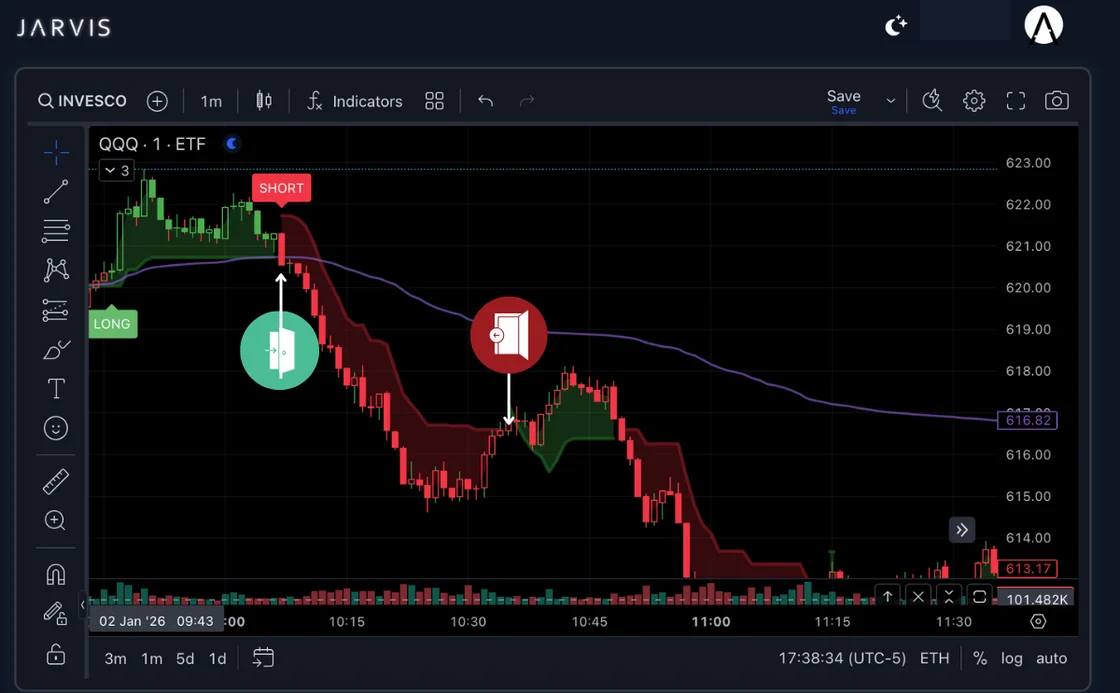
On January 2nd, a QQQ Put signal triggered at 10:07 AM. Entry at $0.73, exit at 10:34 AM for $3.88. A 430% profit in 27 minutes.
But in those final four minutes before the cloud break signaled the exit, the price retraced. You watched some of your profit evaporate. Not enough to turn it into a loss—you still walked away with over 400% gains—but enough to trigger that voice:
I should have held longer.
I should have taken profit earlier.
I should have known.
Greed masquerades as wisdom, as instinct, as being a "better" trader. But here's what it really is: the refusal to let a profitable strategy satisfy you.
This is the trap. In that moment, you cannot know if the retracement will reverse or continue. You cannot know if holding would have given you more or cost you everything.
Greed is telling you “I should have known.”
You shouldn’t have.
Because you couldn’t have.
The win that feels like a loss
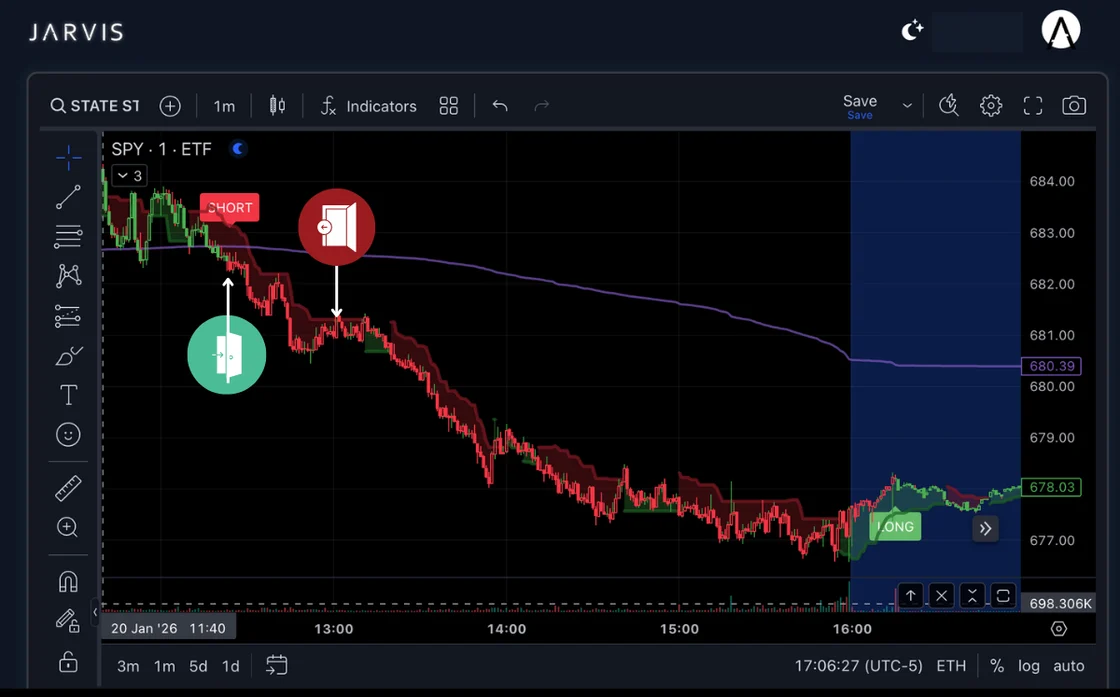
On January 20th, a SPY Put entry at 12:24 PM and exit at 1:10 PM delivered 71% profit under an hour. Most traders would celebrate this.
Then the rest of the day’s chart unfolds as a full-out continuation that you’re not in. Still celebrating?
By 2 PM, that same position would have hit 280%. The continuation ran right after the exit, and suddenly 71% feels like a failure. "What was I thinking? The candles barely broke the cloud!"
Here's the brutal truth: The greed that keeps you in for the rare 10% of continuations will also trap you in 90% of the reversals.
How much is enough?
This is the question at the heart of every trade, and the heart of every human:
How much is enough?
430% profit? Not enough if you think about the retracement you "could have avoided."
71% in an hour? Not enough when you see the continuation you "could have caught."
The trades were winners. The issue is that you're measuring success against an impossible standard: perfection.
Perfection is a Trap
You want to maximize every single trade. You want to enter at the absolute bottom and exit at the absolute top. You want to capture 100% of every move while avoiding 100% of every pullback. This sounds like good trading, but it's actually the mindset that destroys accounts.
There is no one, no bot, and no algorithm doing this. And there never will be. But let’s keep the focus on you. Because you have to learn how to deal with this inner-voice.
Chasing perfection means you'll break your rules. You'll override your signals. You'll convince yourself that this time you know better than your strategy. In an effort to “optimize strategy” you’ll guarantee your losses.
Jarvis brings information to the table. You bring discipline.
Conservative Wins Beat Perfect Losses
Jarvis is designed for more than predictive probabilities. It’s designed to protect you from yourself.
The conservative approach prioritizes safety over recklessly attempting to maximize each individual trade. Your entries and exits are meant to capture substantial profits while protecting you from the reversals that wipe out accounts.
Sometimes you'll exit before the absolute peak. Sometimes you'll feel like you "left money on the table."
That feeling is proof that a conservative strategy is working.
Consistency Over Heroics
Think about what you're really building here. You're not trying to hit the lottery on a single perfect trade. You're building a repeatable process that generates consistent profits while protecting you from devastating losses.
That 71% gain compounds. That 430% winner builds your account. Successes executed with discipline within a proven strategy.
The traders who blow up their accounts are the ones who can't accept a win without chasing the shadow of a bigger one. Their motto is: "this time is different." They obey emotions while pretending to trust strategy.
An Equation to Live By
Execute Clean + Take Profit = Be Content
This is your path to becoming a confident trader. One who can execute a strategy, capture wins, and walk away satisfied.
1. Execute Clean
Follow the signals. Trust the tags and clouds on your ticker. Don’t enter when there’s no tag. The strategy is built on data and expertise that took years to develop. Your job is to execute it, not reinvent it in real-time.
2. Take Profit
Exit when Jarvis tells you to exit. Not when your emotions think it's time. Not when you've calculated some arbitrary profit target. When the cloud breaks, step out. This is how you build consistency.
3. Be Content
This is the hardest part—and the most important. Accept that you captured a win within a profitable strategy. Let go of the fantasy that you'll one day develop such perfect instincts that you'll know exactly when to override your strategy.
The trade of the century happens every day. Content traders understand that more profits don’t come from trade perfection, but through patience. Another great opportunity is always around the corner.
Trust the Process
Some of the best instinct and process traders in our community—people with years of experience and profitable track records—still look at Jarvis's signals and think, "That was better than what I did."
If experienced, profitable traders can recognize that Jarvis's systematic approach outperforms their own discretionary decisions, what makes you think your emotional override in the heat of the moment will be better?
Jarvis simplifies trading so you don't have to be a superhuman decision-maker. When you stop fighting the strategy and start trusting it, something shifts. The anxiety decreases. The second-guessing fades. You start to feel like a trader who knows what they're doing—because you do. You're executing a proven strategy with discipline.
Trade Better Together
This isn't a journey you have to take alone. Our community on Discord is full of traders wrestling with these same psychological battles, celebrating clean executions, and supporting each other through the learning curve.
Join us for daily live-stream coaching on JarvisLIVE, where we break down setups in real-time, discuss signals as they happen, and help you build the mental fortitude to trade with confidence.
Because here's what we've discovered: Trading is for everyone. And when you have the right tools and the right community, you can master the discipline that turns ordinary people into confident traders.
Every trader who masters their greed and learns to be content with wins is proving that this industry doesn't belong to the elites anymore.
It belongs to you.
Still not subscribed to Jarvis? Time to get in here! Use this link to claim 30 days for free and see the Jarvis strategy in action.
You just closed a trade with 430% profit. Your account balance just jumped. Your strategy worked flawlessly. And yet, somehow, you feel like you lost.
The most dangerous opponent in trading lives in your own mind. And he’s whispering:
That wasn't enough.
Greed silently teaches you to mistrust your strategy and sabotage it with what-ifs. Profitable traders are the ones who learn to accept what their strategy affords them with gratitude. They have the ability to be satisfied with a win.
Trade examples are hypothetical and applied retroactively to demonstrate the Jarvis strategy. Trades were not executed in a live account. Results are based on exact signal execution and do not account for liquidity, slippage, or fees.
What this looks like in real trading
Let us show you two Jarvis options day trades from January 2026 that perfectly capture this psychological warfare.
The 430% Winner You Criticize
On January 2nd, a QQQ Put signal triggered at 10:07 AM. Entry at $0.73, exit at 10:34 AM for $3.88. A 430% profit in 27 minutes.
But in those final four minutes before the cloud break signaled the exit, the price retraced. You watched some of your profit evaporate. Not enough to turn it into a loss—you still walked away with over 400% gains—but enough to trigger that voice:
I should have held longer.
I should have taken profit earlier.
I should have known.
Greed masquerades as wisdom, as instinct, as being a "better" trader. But here's what it really is: the refusal to let a profitable strategy satisfy you.
This is the trap. In that moment, you cannot know if the retracement will reverse or continue. You cannot know if holding would have given you more or cost you everything.
Greed is telling you “I should have known.”
You shouldn’t have.
Because you couldn’t have.
The win that feels like a loss
On January 20th, a SPY Put entry at 12:24 PM and exit at 1:10 PM delivered 71% profit under an hour. Most traders would celebrate this.
Then the rest of the day’s chart unfolds as a full-out continuation that you’re not in. Still celebrating?
By 2 PM, that same position would have hit 280%. The continuation ran right after the exit, and suddenly 71% feels like a failure. "What was I thinking? The candles barely broke the cloud!"
Here's the brutal truth: The greed that keeps you in for the rare 10% of continuations will also trap you in 90% of the reversals.
How much is enough?
This is the question at the heart of every trade, and the heart of every human:
How much is enough?
430% profit? Not enough if you think about the retracement you "could have avoided."
71% in an hour? Not enough when you see the continuation you "could have caught."
The trades were winners. The issue is that you're measuring success against an impossible standard: perfection.
Perfection is a Trap
You want to maximize every single trade. You want to enter at the absolute bottom and exit at the absolute top. You want to capture 100% of every move while avoiding 100% of every pullback. This sounds like good trading, but it's actually the mindset that destroys accounts.
There is no one, no bot, and no algorithm doing this. And there never will be. But let’s keep the focus on you. Because you have to learn how to deal with this inner-voice.
Chasing perfection means you'll break your rules. You'll override your signals. You'll convince yourself that this time you know better than your strategy. In an effort to “optimize strategy” you’ll guarantee your losses.
Jarvis brings information to the table. You bring discipline.
Conservative Wins Beat Perfect Losses
Jarvis is designed for more than predictive probabilities. It’s designed to protect you from yourself.
The conservative approach prioritizes safety over recklessly attempting to maximize each individual trade. Your entries and exits are meant to capture substantial profits while protecting you from the reversals that wipe out accounts.
Sometimes you'll exit before the absolute peak. Sometimes you'll feel like you "left money on the table."
That feeling is proof that a conservative strategy is working.
Consistency Over Heroics
Think about what you're really building here. You're not trying to hit the lottery on a single perfect trade. You're building a repeatable process that generates consistent profits while protecting you from devastating losses.
That 71% gain compounds. That 430% winner builds your account. Successes executed with discipline within a proven strategy.
The traders who blow up their accounts are the ones who can't accept a win without chasing the shadow of a bigger one. Their motto is: "this time is different." They obey emotions while pretending to trust strategy.
An Equation to Live By
Execute Clean + Take Profit = Be Content
This is your path to becoming a confident trader. One who can execute a strategy, capture wins, and walk away satisfied.
1. Execute Clean
Follow the signals. Trust the tags and clouds on your ticker. Don’t enter when there’s no tag. The strategy is built on data and expertise that took years to develop. Your job is to execute it, not reinvent it in real-time.
2. Take Profit
Exit when Jarvis tells you to exit. Not when your emotions think it's time. Not when you've calculated some arbitrary profit target. When the cloud breaks, step out. This is how you build consistency.
3. Be Content
This is the hardest part—and the most important. Accept that you captured a win within a profitable strategy. Let go of the fantasy that you'll one day develop such perfect instincts that you'll know exactly when to override your strategy.
The trade of the century happens every day. Content traders understand that more profits don’t come from trade perfection, but through patience. Another great opportunity is always around the corner.
Trust the Process
Some of the best instinct and process traders in our community—people with years of experience and profitable track records—still look at Jarvis's signals and think, "That was better than what I did."
If experienced, profitable traders can recognize that Jarvis's systematic approach outperforms their own discretionary decisions, what makes you think your emotional override in the heat of the moment will be better?
Jarvis simplifies trading so you don't have to be a superhuman decision-maker. When you stop fighting the strategy and start trusting it, something shifts. The anxiety decreases. The second-guessing fades. You start to feel like a trader who knows what they're doing—because you do. You're executing a proven strategy with discipline.
Trade Better Together
This isn't a journey you have to take alone. Our community on Discord is full of traders wrestling with these same psychological battles, celebrating clean executions, and supporting each other through the learning curve.
Join us for daily live-stream coaching on JarvisLIVE, where we break down setups in real-time, discuss signals as they happen, and help you build the mental fortitude to trade with confidence.
Because here's what we've discovered: Trading is for everyone. And when you have the right tools and the right community, you can master the discipline that turns ordinary people into confident traders.
Every trader who masters their greed and learns to be content with wins is proving that this industry doesn't belong to the elites anymore.
It belongs to you.
Still not subscribed to Jarvis? Time to get in here! Use this link to claim 30 days for free and see the Jarvis strategy in action.

The Top 3 Mistakes Even Pro Traders Can’t Escape
Trading is a constant internal battle.
Professional traders move millions in daily volume, yet they still fall victim to the same emotional traps that derail beginners. What sets them apart? Pros recognize their emotional triggers, refusing to recycle the same costly mistakes that vaporize new accounts.
Jarvis puts institutional-grade analysis at your fingertips, but without emotional discipline, even the best tools can be sabotaged by emotional triggers. Here are three common emotional pitfalls that plague traders at every level, and how to use Jarvis to stay disciplined when your instincts are at war with your intel.
1. Overtrading
The market whispers the same alluring promise to every trader: You can get more today.
Maybe you catch a euphoric run and want to duplicate it on the reversal. Or perhaps you begin by getting ground up in a channel. Now you’re sure the next tag will be the breakout. No matter how your first trade performed, greed is lurking.
Amateurs chase every setup, but pro traders routinely silence the devil on their shoulder in favor of a proven, unemotional strategy.
With Jarvis
You'll typically see 1-3 strong trade opportunities in a day with Jarvis. But days with more than 8 Long/Short tags make it difficult to distinguish profitable setups from traps.
Overtagging (3+ tags in 5-10 minutes) usually signals a channel or reveals that the day is a wash. Go into each day knowing that executing more than three trades is not a profitable formula. Take note of overtagging patterns as a sign to step back–Jarvis is trying to tell you something. Wait for the return of momentum in the market. Even if that’s tomorrow.
2. Revenge Trading
Getting caught out in a reversal is a deeply emotional experience that will crank up the volume on your inner critic.
- I got it wrong. Do I know what I’m doing?
- I lost money. Can I afford to keep this up?
- I let people down. Should my firm or family trust me with their money?
You feel like a failure, so you set out to prove that you’re not. That's revenge trading, and once you start trading emotionally, your process is compromised. Don’t let your inner voice write your trading narrative.
If you’ve ever found yourself trying to “win back” a loss, you’re not alone. Master the 3 fears that haunt every trader and learn how to stop revenge trades before they start.
On Jarvis
What is the one surefire sign of revenge trading when using Jarvis?
Trading off the tags. We call it riding bareback.
When you've entered a tag that turns into a reversal, or sat down at your monitor two minutes late for a run, you will want to trade before the next tag. And you will regret it. Stay in the saddle and wait for the next tag to form, or the only one you get revenge on will be you.
3. Chasing Runs
The most painful lessons come from watching profits evaporate when you've jumped in after missing the initial setup. Fast-moving price action tempts you to believe you can still catch the move, but this is how fortunes disappear in seconds.
By the time retail traders notice a "hot stock" trending, institutional money is already planning its exit. Savvy pros would tell you you're not catching the wave—you're becoming the liquidity that institutional money is poised to sell into.
Think you're immune to FOMO? Check if you're overestimating your trading instincts and see how self-awareness can save your account from impulsive entries.
On Jarvis
Jarvis tags form before major moves, not during them.
Entering a trade well after a tag has formed is a rookie mistake. Rather than chasing the current move, walk away and give the market time to build another setup. No need to take losses that leave you saying, "I knew better than that".
The Pro Pattern for Profits
Professional traders mitigate emotions, executing complex processes with machine-like precision. Your task is simpler: trust Jarvis.
Jarvis shortcuts the professional training process by simplifying a winning strategy into a few green and red tags. Now it's up to you to develop the inner disciplines that transform instinctive reactions into calm, rational routines.
The market isn’t in your control, but your emotions are. Every day is a new chance to train your brain and trust Jarvis.
Discipline builds confidence. Discover why Jarvis is the go-to tool for intermediate traders ready to level up their process and stay sharp under pressure.
What We Learned (FAQs)
Q: What are the biggest emotional mistakes traders make, and how can Jarvis help?
A: The top mistakes are overtrading, revenge trading, and chasing runs. Jarvis helps by flagging high-probability setups with clear trade tags, making it easier to step back and avoid costly emotional decisions.
Q: How do professional traders stay disciplined when emotions run high?
Pros follow rules and stick to proven setups instead of chasing every move. With Jarvis, you can do the same by trading only when signals are fresh and avoiding impulsive entries.
Q: Why is emotional discipline more important than trading tools?
A: Because even the best software can’t save a trader from poor decisions. Jarvis provides accurate signals, but it’s discipline. Knowing when not to trade - that keeps accounts growing.
Trading is a constant internal battle.
Professional traders move millions in daily volume, yet they still fall victim to the same emotional traps that derail beginners. What sets them apart? Pros recognize their emotional triggers, refusing to recycle the same costly mistakes that vaporize new accounts.
Jarvis puts institutional-grade analysis at your fingertips, but without emotional discipline, even the best tools can be sabotaged by emotional triggers. Here are three common emotional pitfalls that plague traders at every level, and how to use Jarvis to stay disciplined when your instincts are at war with your intel.
1. Overtrading
The market whispers the same alluring promise to every trader: You can get more today.
Maybe you catch a euphoric run and want to duplicate it on the reversal. Or perhaps you begin by getting ground up in a channel. Now you’re sure the next tag will be the breakout. No matter how your first trade performed, greed is lurking.
Amateurs chase every setup, but pro traders routinely silence the devil on their shoulder in favor of a proven, unemotional strategy.
With Jarvis
You'll typically see 1-3 strong trade opportunities in a day with Jarvis. But days with more than 8 Long/Short tags make it difficult to distinguish profitable setups from traps.
Overtagging (3+ tags in 5-10 minutes) usually signals a channel or reveals that the day is a wash. Go into each day knowing that executing more than three trades is not a profitable formula. Take note of overtagging patterns as a sign to step back–Jarvis is trying to tell you something. Wait for the return of momentum in the market. Even if that’s tomorrow.
2. Revenge Trading
Getting caught out in a reversal is a deeply emotional experience that will crank up the volume on your inner critic.
- I got it wrong. Do I know what I’m doing?
- I lost money. Can I afford to keep this up?
- I let people down. Should my firm or family trust me with their money?
You feel like a failure, so you set out to prove that you’re not. That's revenge trading, and once you start trading emotionally, your process is compromised. Don’t let your inner voice write your trading narrative.
If you’ve ever found yourself trying to “win back” a loss, you’re not alone. Master the 3 fears that haunt every trader and learn how to stop revenge trades before they start.
On Jarvis
What is the one surefire sign of revenge trading when using Jarvis?
Trading off the tags. We call it riding bareback.
When you've entered a tag that turns into a reversal, or sat down at your monitor two minutes late for a run, you will want to trade before the next tag. And you will regret it. Stay in the saddle and wait for the next tag to form, or the only one you get revenge on will be you.
3. Chasing Runs
The most painful lessons come from watching profits evaporate when you've jumped in after missing the initial setup. Fast-moving price action tempts you to believe you can still catch the move, but this is how fortunes disappear in seconds.
By the time retail traders notice a "hot stock" trending, institutional money is already planning its exit. Savvy pros would tell you you're not catching the wave—you're becoming the liquidity that institutional money is poised to sell into.
Think you're immune to FOMO? Check if you're overestimating your trading instincts and see how self-awareness can save your account from impulsive entries.
On Jarvis
Jarvis tags form before major moves, not during them.
Entering a trade well after a tag has formed is a rookie mistake. Rather than chasing the current move, walk away and give the market time to build another setup. No need to take losses that leave you saying, "I knew better than that".
The Pro Pattern for Profits
Professional traders mitigate emotions, executing complex processes with machine-like precision. Your task is simpler: trust Jarvis.
Jarvis shortcuts the professional training process by simplifying a winning strategy into a few green and red tags. Now it's up to you to develop the inner disciplines that transform instinctive reactions into calm, rational routines.
The market isn’t in your control, but your emotions are. Every day is a new chance to train your brain and trust Jarvis.
Discipline builds confidence. Discover why Jarvis is the go-to tool for intermediate traders ready to level up their process and stay sharp under pressure.
What We Learned (FAQs)
Q: What are the biggest emotional mistakes traders make, and how can Jarvis help?
A: The top mistakes are overtrading, revenge trading, and chasing runs. Jarvis helps by flagging high-probability setups with clear trade tags, making it easier to step back and avoid costly emotional decisions.
Q: How do professional traders stay disciplined when emotions run high?
Pros follow rules and stick to proven setups instead of chasing every move. With Jarvis, you can do the same by trading only when signals are fresh and avoiding impulsive entries.
Q: Why is emotional discipline more important than trading tools?
A: Because even the best software can’t save a trader from poor decisions. Jarvis provides accurate signals, but it’s discipline. Knowing when not to trade - that keeps accounts growing.

School’s Out: Master Day Trading Without the Homework
How long are you willing to lose money trading before you throw in the towel?
Options traders have always experienced a razor-sharp learning curve, making day trading feel like you’re enrolled in a university. You’re paying high tuition in losses while logging years of head-scratching homework.
“It’s the cost of learning! This will all pay off when it finally clicks.”
But with day trading, you’re not guaranteed a degree. Most studious traders never come close to their dream of full-time trading.
But what if homework isn’t really the answer?
How Long Does It Take to Learn Day Trading?
The two individuals who created Jarvis toiled through decades of options trading to achieve consistent success and personal wealth. Rest assured, at Jarvis, we have a lot of respect for traditional traders—y’all have seen some stuff!
Most traditional day traders struggle to turn the corner of consistent profit before year three. 1-2year mastery highlights the prodigies, and 5-6 years marks the most die-hard (or are they deluded?) traders who must win at any cost.
That’s a long time to operate in the red. And those traders put in far more than 6 hours of daily trading time on a screen.
They also invested endless hours on morning market prep, weekly trade reviews, scouring the news for FOMC meetings, and YouTube sessions dissecting other traders' strategies or the next hot securities.
Traditional traders can easily invest 40 or even 80 hours each month on extracurriculars looking for an edge. Because, inside those trading hours, the losses are piling up.
All of this points to one harsh, inexorable truth:
I still haven’t learned how to trade.
Don't Learn How to Trade
This is the line that offends the trading purists—and we’re fine with that.
Because when you see retail traders hung out to dry for two years saying, “I know I can make it!”that’s not grit. It’s evidence of a vampiric system designed to use your ego against you and deplete your account while selling you hope in the form of homework.
When we built Jarvis, we knew the day trading learning curve had to be solved. To do this, we set two goals:
1. Reduce trading to a single screen. Nothing embodies trading ego more than the quad monitor setup (or more!) that has become the icon of advanced trading. If traders can’t win, we want to look smarter while losing!
2. Signal accurate trade entries. Expert traders know when to trade. But behind the curtain, those trade wizards use dozens of on-screen data points and years of mentally ingrained experience to inform critical split-second decisions.
Traditional traders who found success the hard way–bless your souls–did it that way because they had to.
They didn’t have Jarvis reducing 6 hours of on-screen trading to 3 or 4 high-probability entry signals. They didn’t have four screens of data points summed up in a single predictive Jarvis ticker.
Now, traders with Jarvis–who didn’t spend years on homework, webinars, and YouTube sessions–can watch a live Long/Short tag form, and Know When To Trade.

Mastering Jarvis Is Easy
If you’ve developed dedicated homework habits for trading, we respect your discipline. So, has the homework paid off? Are you trading profitably because of it?
Here’s what it looks like to master Jarvis: Intermediate traders will instantly know what they’re looking at the moment they see Jarvis in action. Realistically, you can expect one week of trading with the live stream to fully comprehend which signals and indicators add up to a no-brainer entry.
No more market research. No more sniffing out stock news. No more guru videos searching for the elusive missing ingredient in your trade strategy.
Right now, Jarvis is free for your first 30 days because we want you to experience day trading the way it should be—without the homework.
Dedicate a month to trusting Jarvis.
Dedicate a month to taking back your time.
See how simple trading can be.
What We Learned (FAQs)
Q: How long does it usually take to become a profitable day trader?
A: Most traders grind for 3+ years before they see consistency, some never get there. Jarvis cuts through that learning curve with a single-screen system and accurate entry tags, so you can focus on execution instead of endless “homework.”
Q: Why do so many traders lose money while learning?
A: Because trial-and-error is expensive. Traders drown in data, news, and guru videos, chasing intuition that takes years to build. Jarvis flips the model by giving you real-time, high-probability signals without the noise.
Q: Can beginners really learn faster with Jarvis?
A: Absolutely. What takes years the old way can click in about a week with Jarvis. You’ll see 3–4 clean signals per day, no marathon prep or over-analysis required, just disciplined execution.
How long are you willing to lose money trading before you throw in the towel?
Options traders have always experienced a razor-sharp learning curve, making day trading feel like you’re enrolled in a university. You’re paying high tuition in losses while logging years of head-scratching homework.
“It’s the cost of learning! This will all pay off when it finally clicks.”
But with day trading, you’re not guaranteed a degree. Most studious traders never come close to their dream of full-time trading.
But what if homework isn’t really the answer?
How Long Does It Take to Learn Day Trading?
The two individuals who created Jarvis toiled through decades of options trading to achieve consistent success and personal wealth. Rest assured, at Jarvis, we have a lot of respect for traditional traders—y’all have seen some stuff!
Most traditional day traders struggle to turn the corner of consistent profit before year three. 1-2year mastery highlights the prodigies, and 5-6 years marks the most die-hard (or are they deluded?) traders who must win at any cost.
That’s a long time to operate in the red. And those traders put in far more than 6 hours of daily trading time on a screen.
They also invested endless hours on morning market prep, weekly trade reviews, scouring the news for FOMC meetings, and YouTube sessions dissecting other traders' strategies or the next hot securities.
Traditional traders can easily invest 40 or even 80 hours each month on extracurriculars looking for an edge. Because, inside those trading hours, the losses are piling up.
All of this points to one harsh, inexorable truth:
I still haven’t learned how to trade.
Don't Learn How to Trade
This is the line that offends the trading purists—and we’re fine with that.
Because when you see retail traders hung out to dry for two years saying, “I know I can make it!”that’s not grit. It’s evidence of a vampiric system designed to use your ego against you and deplete your account while selling you hope in the form of homework.
When we built Jarvis, we knew the day trading learning curve had to be solved. To do this, we set two goals:
1. Reduce trading to a single screen. Nothing embodies trading ego more than the quad monitor setup (or more!) that has become the icon of advanced trading. If traders can’t win, we want to look smarter while losing!
2. Signal accurate trade entries. Expert traders know when to trade. But behind the curtain, those trade wizards use dozens of on-screen data points and years of mentally ingrained experience to inform critical split-second decisions.
Traditional traders who found success the hard way–bless your souls–did it that way because they had to.
They didn’t have Jarvis reducing 6 hours of on-screen trading to 3 or 4 high-probability entry signals. They didn’t have four screens of data points summed up in a single predictive Jarvis ticker.
Now, traders with Jarvis–who didn’t spend years on homework, webinars, and YouTube sessions–can watch a live Long/Short tag form, and Know When To Trade.
Mastering Jarvis Is Easy
If you’ve developed dedicated homework habits for trading, we respect your discipline. So, has the homework paid off? Are you trading profitably because of it?
Here’s what it looks like to master Jarvis: Intermediate traders will instantly know what they’re looking at the moment they see Jarvis in action. Realistically, you can expect one week of trading with the live stream to fully comprehend which signals and indicators add up to a no-brainer entry.
No more market research. No more sniffing out stock news. No more guru videos searching for the elusive missing ingredient in your trade strategy.
Right now, Jarvis is free for your first 30 days because we want you to experience day trading the way it should be—without the homework.
Dedicate a month to trusting Jarvis.
Dedicate a month to taking back your time.
See how simple trading can be.
What We Learned (FAQs)
Q: How long does it usually take to become a profitable day trader?
A: Most traders grind for 3+ years before they see consistency, some never get there. Jarvis cuts through that learning curve with a single-screen system and accurate entry tags, so you can focus on execution instead of endless “homework.”
Q: Why do so many traders lose money while learning?
A: Because trial-and-error is expensive. Traders drown in data, news, and guru videos, chasing intuition that takes years to build. Jarvis flips the model by giving you real-time, high-probability signals without the noise.
Q: Can beginners really learn faster with Jarvis?
A: Absolutely. What takes years the old way can click in about a week with Jarvis. You’ll see 3–4 clean signals per day, no marathon prep or over-analysis required, just disciplined execution.
This Is Your Time
Are you ready to discover what trading can do for your life?
Get Jarvis FREE for 30 days, and see for yourself—the proof is in the profit.